Tuesday, January 22, 2008

A Little Lunch With Friends


After a fairly long lapse, we were ready for a visit to our favorite restaurant in the Pátzcuaro area, la Marisquería "La Güera". Seafood is the specialty, of course.

Our neighbors,, Geni and Larry accompanied us. It's now a lot faster and easier to get to the restaurant because the construction of the 4 lane Libramiento Ignacio Zaragoza is essentially complete, lacking only the finishing touches of palm trees, "modren" statuary, and lateral curbs. There are even traffic lights, still undergoing testing, or just to familiarize the drivers of their existence.

Once parked, and at the restaurant, I saw that the staff was having their lunches. I think that it gives an appealing, "family" touch. Although I was curious to knw what they had chosen, I didn't ask, although at least some rice was evident.

We four went for a light selection of fare:
We split an order of Tiritas de Pescado Fresco, a sort of seviche in strips, presented attractively on a background of sliced cucumber, a little lettuce, chopped cucumber, some rings of purple onion, and the trademarked orange slices, all lightly sprinkled with chile flakes.

The fish takes about 20 minutes to "cook" in lime juice, so we filled the wait with an order of guacamole; and I had two tostadas de marlín guisado, shredded, smokey fish cooked with tomato and a little chile. Geni had one also. The guacamole was simple and freshly made.

Three of our group drank goblets of fizzy limonadas freshly squeezed from limes, while I had a Cerveza Victoria.

The Tiritas came, and they were outstanding, tangy, fresh and flavorsome. One order, $38 Pesos, is enough for 4 to have as an appetizer. I used to try to eat one by myself as a light main course, but it's just too much of a good thing.

We then ordered more plates to suit our individual desires.

Larry got a torta de marlín, a small French roll with the same marlin spread on it, which just about filled him, but he and Geni were able to share the large plate of warm, freshly cooked Camarones Para Pelar that we ordered. (Peel' em and eat 'em shrimp.) These are among the best products of the restaurant, and although I'm certain the shrimp comes to them frozen, it always tastes great and fresh. The headless shrimp are large. This time, the colorful platter came showered with finely chopped mild white onion.

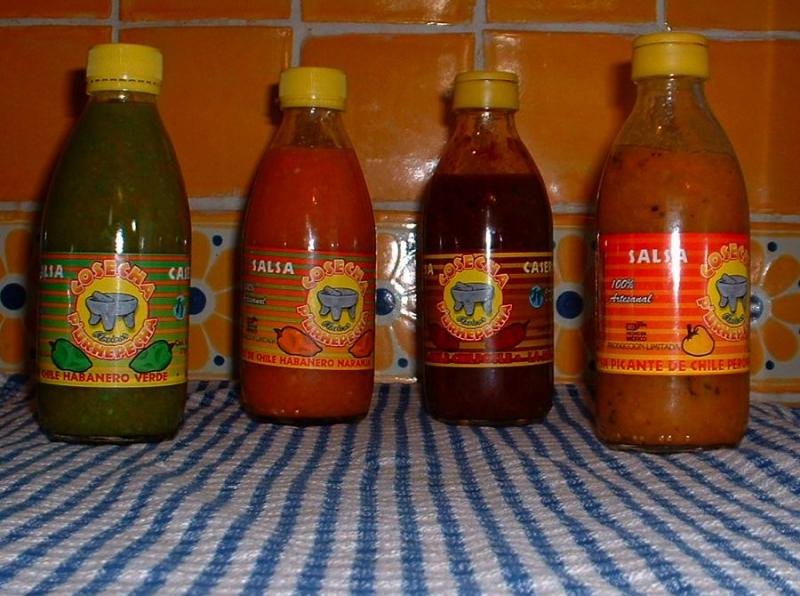
There is no cocktail sauce, but some of us made up a tasty do it yourself sauce of mayonnaise and thick, smoky rich Salsa Chipotle.

To balance all the "cold" foods, I also got an order of nice, perfectly acceptable Papas Fritas (French Fries.) There was a new-ish condiment I wanted to try, made by the same company, Cosecha Purépecha, who manufacture the Salsa Chipotle and other fine bottled salsas. The condiment is a chile vinegar, but way above the common stuff. It has 2 or 3 different kinds of chiles, carrot, bay leaves and other spices, attractively arranged. It went very well with the cucumbers* as well as on the French Fries.

I think that about covers all. There were some extra limonadas and another beer.

The total bill was $366.20 MXP, or around $33.38 USD, plus a 12% tip.

We love that place. The neatly dressed, white jacketed, mostly attentive employees seem genuinely happy, and that's a plus.

*Cucumbers are very cheap in the mercado (at retail). Typically, 3 kilos for 8 or 10 pesos. Once every vendor was pushing them 3 x 5 pesos.

Wednesday, January 16, 2008

A Bun For The Money?


We were in Pátzcuaro's alluring Mercado Soriana yesterday morning, picking up a few necessities (eg, 12 bottle cartons of Cerveza Nochebuena at 2 for 1 pricing) when we wandered over to the panadería section. At that hour there wasn't much fresh bread available, but there were some French style "pistolets" (usually called "bolillos" in Mexico, some teleras, the flatter oval rolls with two longitudinal creases, only one seeded baguette, and quite a few round, sesame topped rolls. The latter looked something like overly plump hamburger bins or uncreased Kaiser Rolls.

I started to put 4 of the round rolls on my tray, then saw the price card. I mistakenly thought that each one was 5 pesos, which is a high price here. But after some careful analysis using elementary decimal fractions, I understood that they were only 50 centavos, or 1/2 peso each. The bolillos and teleras were the same price, if I recall, and the lone baguette was 90 centavos. Eight cents.

Think about that. They cost about 4 1/2 ¢ each. No other bakery that I've been to sells bread at so low a price. Is it a function of buying power and production efficiencies, or are they undercutting the other stores and traditional panaderías with very aggressive pricing? I suspect the latter, and selling at under the cost of ingredients and labor. In my view, such practices are not limited to the well-hated (except by Mexican customers who throng to shop there) "Octopus of the North", Wal-Mart.

By the way, the rolls were plain but good, and we made some tasty sandwiches on them. For our dessert, we had some miniature pastries, based on cupcakes, which are very prettily fashioned and sell for only 4.5 pesos each. That's about 42¢. One, a fake whipped cream-filled Baba, was ok, but an elaborated "Hostess" cupcake, topped with a glazed strawberry half was unappetizingly dry. A nut-glazed cuernito is pretty tasty, especially when warmed in the toaster oven.

I guess you generally get what you pay for.

Friday, January 11, 2008

Culinary Adventures in the Inside Passage...


...of Pátzcuaro's mercado


In an effort to revitalize my sense of culinary derring do, seasoned with a dash of risk, we once again went forth where no guidebook dares venture. Today we walked along one of the inside passages of Pátzcuaro's
mercado. Our regular mercado path usually finds us in the bright sunshine of the market street where the fruits and vegetables are sold, as well as the odd pig's head and assorted viscerae.

We have made occasional exploratory forays into the cavernous gloom under the shed roofs.

There are discoveries to be made. This is not your Soriana, Wal-Mart or Comercial Mexicana.

The general layout of products and services places the fruits and vegetables outside along the street, the carnicerías and pollerías more or less together inside; a rather unattractive hall of fondas, and a small, fresh and dried fish section. Follow your nose.

The south side is dedicated to Sanitarios Públicos, peluquerías and natural herbal medicine tiendas. There is clothing and plastic wares near the clothing. You can pick up some Santa Muerte paraphernalia and 5 pairs of cheap socks, if you know where to look.

(HINT: they are in the passageway behind the attractive, ringletted señorita selling pepinos y jícamas, across from the outdoor vitrina de la víscera. Innards.)

There's the lower-end fruits and vegetables corridor inside, flanking the main outside pasillo. Our belief is that there are bargains there.

Yesterday morning we were returning to buy bananas from a particular inside vendor. My wife claims his bananas last longer. (Maybe I should be worried.)

The following review should not be misconstrued. This is not about a world class eating experience, deserving four stars in guidebooks and worth a special journey. It's about a tasty, cheap snack.

On our way in we pased at least 3 quesadilla stalls, as well as a couple of cocinas económicas; of the latter, at least one specializing in fish head soup.

One quesadilla stall which shone forth out of las sombras. It's called "Quesadillas Monse". My appetite quickened at the sight of crisping quesadillas being flipped in hot lard.

After a tortured deliberation as to whether to eat fish head soup or quesadillas, we turned to the latter. Monse's was very popular, and it was filled with happy munchers, while neighboring quesadillas stalls languished for clients. (At least, at that hour.)

Monse's even built a mini-comedor, or, call it a dinette, across the passageway from the hot fat frying. Or, you can sit right up against the fry station, and hope that the quesadilla cocinera es diestra and doesn't splash sizzling lard on your ascot. The tables of this cheerful nook held brimming bowls of salsa roja, salsa verde, shredded lettuce and crema.


CREMA? Who puts crema on fried food? Well, nearly everyone who was eating there. Yes, even on quesadillas de salchicha y queso (hot dogs and Oaxaca cheese.)

The selection of filings is limited, and that's probably good, because it tends to make freshness a likelihood. There's pollo con papas, rajas con carne de res deshebrada, tinga, queso Oaxaca, y salchichas. Weiners.


It's fun to watch the all-woman team in action. There's Monse, pulling queso into shreds, taking orders and alternately collecting payment*; there's the masa squasher pressing out the elongated ovals on the tortilla prensa; there's the quesadilla cocinera, wielding two spatulas, frying the elongated envelopes of masa y harina to crisp delicacies in manteca pura de cerdo.

Yes. The non-PC, non vegetarian, all natural, no trans fats, grasa verdadera. Pig fat. Real Mexican food.


There's even impromptu "found" entertainment. We were seated at a small table in the passageway, to which a man came to collect a costal of lettuce trimmings and outer leaves. It was stashed under our table, and Monse had to drag out a bigger sack of lettuce heads to retrieve it.


I was tempted to have another quesadilla, but it might have taken 5 minutes to make, and I was foolishly thinking of trying some menudo (Yes!) at the Plaza San Francisco. (I didn't. Probably a prudent choice.)


Disclaimers
*No te preocupes. Even though the alternating money and food handling violates one of my Rules of Street and Market Food Hygiene, I choose to believe that the sizzling lard kills off any bugs. No stomachs were harmed in the making of this blog post.

The graphic image at the top, which bears only a passing resemblance to the quesadillas Monse's, was borrowed from stock image site.
www.fotosearch.com/photos-images/quesadilla.html

Thursday, January 03, 2008

Rotate For Freshness

We live in a region of rotating population. The Michoacanos go to the "otro lado", that is, the United States, to work and earn a better living, while the retirees/expats move here for cheaper living and a more temperate climate. (I'll grant that there are other reasons for the expat migration, but that's not my theme today.)

Sometimes the expats return to their home countries, for varied reasons. Some, including our dear friends and neighbors, live here seasonally. One of the side effects of the rotation of the expat population is The Moving Sale. These sales give us who stay a chance to buy funny looking table lamps, side tables, Bundt pans and other artifacts at bargain prices. We scavengers can get herb and spice collections for free or a few pesos. But to accept these herbs, spices and odd lots of ingredients has its dark side.

One departing expat left me a Number 10 can of tomato paste, and about a pound of fennel seed. Questions arose. How do I open and store such a quantity of tomato paste in the overcrowded and overworked freezer compartment? And fennel seed—used in making Italian style sausage— it takes about a tablespoon per batch. I have enough fennel, between his gift and my unfortunately concurrent purchases, to make enough Italian sausage to circle Lake Pátzcuaro several times.


Another vexing challenge is that of redundancy and of freshness. I appreciated getting a small bag of celery seed, but how many more baggies of orégano can I use—or basil? How fresh are they? Did they come from the Other Side 3 years ago? Most of these herbs are readily available in mercados and supermarkets. So who wants to have to spend time rotating for freshness and finding both suitable containers for storing on increasingly chaotic shelves?

One type of seasoning, though, gives me no hesitation in pitching it into el bote (the trash can). Those are the little, premixed packets of Taco Seasoning, French Toast Batter Seasoning, Tuna Casserole Sauce Mix, and Caesar Salad Herb Blend; that sort of stuff. The kind of seasonings that are composed mainly of salt, sugar and MSG with a little spice as an afterthought. ¡Salgan!

The real problem is how to seem grateful for these gifts from the departing expats yet while maintaining my sanity. After all, I don't want to make their leave taking any more dolorous than it already is. So, in the end, I accept with feigned gratitude, while silently cursing the Herbal Triage that awaits me.

Sometimes I can bestow some herbs and spices on others less fortunately endowed. A couple of days ago, I brought the Number 10 Can of Tomato Paste over to our next door, Alabaman neighbors, Geni and Larry, along with some 1 cup plastic freezer containers. They packed about half the contents into their vacuum sealed plastic bags, and gave me the other half in my freezer containers. It was a small price to get that tomato paste where I could use it.

So, there is hope.
But there is also a catch.
Geni told me that when they turn off their electricity to leave, I will get their tomato paste.

Sunday, December 30, 2007

A Bad Dream: Where's my Luger, Peter?

A little while ago, I had a bad dream in which I was invited to eat at Peter Luger's Steakhouse, in Brooklyn, NY. It was my first visit, as I would seldom if ever pay that kind of $$$s for a meal there. But in this dream, someone else was paying. I found myself, fully suited and cravatted, in company with friends and friends of friends. Some of the latter were very rude diners, going so far as to reach across the table, to sample morsels using their fingers. On top of that, the obsequious waiter would suggest side dishes, but they sometimes wouldn't ever arrive. I ordered a side of sauteed spinach (FOOL! I can make that at home.) and it never came.
(Click on photo for an enlarged view.)

But the worst moment was when the dining companion next to me hastily got up to take a cell phone call or something. In doing so, he disarranged the chairs, and in the momentary confusion, the waiter came and cleared our plates. I could see my unfinished steak over on a sideboard. I cried out; "Don't let him take it away!", but in moment, it was too late. It was gone. (I could describe its grain and texture, and the degree of doneness. I'd been pleased that it hadn't been pre-sliced. I'd just begun to get a sense of its savor.)

I got the captain's attention after a bit, and haltingly explained what had happened. He listened sympathetically, but with a thread of skepticism. He asked me which cut of meat I'd been eating, and he might be able to replace it. I was so consternated, that I couldn't tell him. He gave me a menu, and despite several scans of the list of steak offerings, I couldn't remember. My credibility was fading fast. I despaired of ever finishing that famed steak.

My dining companions scattered, to return to their corporate endeavors, and I was left holding a couple of cellophane-wrapped peppermint candies.

After this post, I shall be banned from Peter Luger's for life. Ni modo.

Wednesday, December 26, 2007

Bitter Oranges and Sweet Mermelada


From late last winter, this post has been slowly aging in its cyber-cellar, until now it is ready for publication.


Yesterday, near Pátzcuaro, we visited a neighbor's ranchito along with a friend. Our amiga pointed out the orange trees and said "Son naranjas amargas."
I asked if they could be used to make mermelada, and she didn't know. These are not the same as the "Naranjas Dulces, 5 kilos por 15 pesos", described in another post. These oranges are bitter, but free.

I'd like to know more; whether they might be used to make a tasty, coarse shred orange marmalade. I suppose I'd need pectin, wouldn't I? I soon found out that it wasn't necessary.

A week later, there was a call at our gate. Our young amiga and her cousin had brought me some 5 kilos or so of oranges. I soon set to work.

After finishing the preparing, cooking and canning of a test batch of mermelada, I'm now having a medicinal brandy. ;-)

I started at about 5 a.m. cooking the washed and scrubbed oranges, then boiling them in plain water until tender. Although the recipe in the book, "Better Than Store Bought" suggests 6, large Seville Oranges, boiled for an hour, the 12, small to medium Mexican Seville (?) Oranges were done in about 35 minutes.

They are cooled in the liquid, which is reserved. Then each orange is cut in half, and the pips and membranes are scraped into a wide, copper clad bottom, stainless steel Revere Ware pot).

That pulp is cooked with the water for an hour. This step extracts the pectin. This mess is then food milled.

The resulting strained pulp is mixed with the finely cut peels. (I did that with a sharp knife on a cutting board, 2-3 peels at a time while the pectin was extracting.) Others recommend using a food grinder with a coarse plate, but that sounds less attractive in its results.

(We then went for a walk)

On our return, I divided the total into two batches of about 6 cups each. To each I added about 6 cups of sugar. There's also fresh lemon/lime juice in it. Each batch is cooked over a fairly high flame until the mixture thickens, and the liquid falls from the spoon in sheets rather than droplets. (Yeah, right.)

Now it's poured into sterilized jars, and, in some cases, a circle of brandy paper is placed on the gel before sealing. In other cases, I said, the heck with it, and just dribbled a little brandy on top of the marmalade.

The jars are wiped off with a hot, damp towel.
(I just heard a lid, "POP!")

This looks pretty good, and the tiny tastes we had indicate that it's worth it. However, I wouldn't think making any less than 4 pints is worthwhile.

Tip to Myself: Get the proper jars ahead of time next time you plan to make this.

UPDATE: We now have the jars, and the oranges are ripening on the trees. After the Christmas holidays, I will make more mermelada.
While looking for a picture to (a-hem) borrow as an illustration, I came upon a Chili-Orange Marmalade recipe. It's from a Danish chili (sic) lover! I didn't use his picture, but I will definitely try his recipe.

Saturday, December 22, 2007

NAFTA Salad

We have a bottle of locally purchased salad dressing. (No, we didn't buy it. Our departing neighbor gave it to us.)
It's labeled, " All Seasons Aderezo Campestre RANCH Picante".
In other words, it's Picante Country Ranch Dressing". Its country of origin is Canada. (I didn't know that the Canadians did picante anything.)
It was shipped across the border, at Laredo, Texas by an exporter.
It was distributed within Mexico by a distributor in el D.F. Who shipped it to a bodega somewhere in Michoacán, I guess, from where it was transported to the store where our neighbor bought it.

It's a well-traveled salad dressing.

I also found it on a blog, VidaMexicana.blog3
It appears to be in Spanish AND an Asian language.
This stuff must be widely distributed.

Oh. It's not bad, for bottled dressing.

Confronting Menudo

After many years, I think I've finally overcome my fascination with menudo, and the thrall in which it held me.

Let's face it. To eat menudo is a test of machismo. To eat it, without quivering or without echarme las tripas (puke my guts) would mean I was ready to experience the fabled " Real Mexico". On my first meeting with menudo, I failed the test. It took place in a small, Mexican cafe, near the railroad tracks, in Lordsburg, New Mexico, on a Sunday morning, about 7:30 a.m., sometime in the 1980s.


Menudo,
a sort of restorative soup, is tripe and sometimes other innards, cooked with onions, garllc and chiles. In El Norte, it often contains maíz pozolero as well. In the North, it's cooked blanco, sin chile; en El Sur , se cuece con chiles y lo sale rojo, sin maíz.

Sunday mornings, I knew, were prime menudo time, because the vatos locos borrachos de la noche pasada needed the curative powers of menudo para curar La Cruda. La Cruda (note the feminine ending) is a hangover of mythic proportions, scaled to how much machismo you possess. (I'd read The People's Guide to Mexico cover to cover, so I knew this stuff.)

When they brought the bowl to our table, I immediately and instinctively knew I wouldn't be able to eat it.
There was A Smell.

I applied as much crumbled orégano, chile piquín, y cebolla picada and limón as possible to mask the odor of somewhat aging viscera.
Not only was there a smell, but it was visually repulsive; a slightly viscid broth with unidentifiable fragments of innards rising to the surface to greet me.
I cautiously took a spoonful.
Urggg.

Not only did it smell funky, and look repulsive, but it was tepid. Brrrrr.
My brave wife took charge, called over the owner/waiter, and asked if it could could be heated more en la microonda.
Soon it returned, steaming hot and smelling as bad as before, but palatable for Susan, who cleaned the bowl.
As for me, I slunk out of Lordsburg, covered in shame. Me avergonzé.

Years went by, and in 1991, we traveled deeper into México, specifically to the fabled Silver City of Zacatecas. Our train arrived at dusk, and our taxi drove us down cobbled streets illuminated by the soft glow of wrought iron faroles de dragones lanterns. We were immediately enchanted.

The next morning, as I took a walk in the frosty air, I chanced upon the Plazuela Genaro Codina, with the statue of the eponymous Prof. Genaro Codina, playing his harp.
This charming little plaza became the center of my world in Zacatecas. Its two principal culinary attractions are side by side: La Panadería La Flor de México and Menudería La Güera.
(
There is also the Mercado El Laberinto, hidden away inside, and slightly hard to find.)

The Menudería opens very early. The front opens to the plazuela, doors wide open. Its walls are of polished gray stone with swirls of white. In the front of the shop, two señoras stand at the gas range, maintaining the large pots of menudo. It is a spotless eating place.

Theirs is a superior menudo. The pieces of tripas are larger and not iggy-squiggly. The caldo is boiling hot, and stoutly seasoned with aromatics and red chiles. The large size comes with a portion of meat on the bone. No pozole corn, just meat and chiles and herbs. The tortillas are hot. You can drink coffee (Nescafé) or orange juice.

I liked it. No; I loved it. It fortified me against the freezing cold, rarefied air of the 8000 feet a.s.l. of Zacatecas. After a bowl or two of that Menudo La Güera, I could climb the steep hills without gasping (much).

Years later, we moved to Michoacán. It's a different, and in my opinion, generally inferior version. The tripe is cooked apart from the caldo. The tripe is bland, white and squiggly. It's cut up into serving pieces, placed in your bowl and a ladle or two of caldo is poured over it. To me, it's like eating a bowl of tasteless, gelatinous wigglies in a relatively insipid chile broth.

Last week, here in Las Cuevas, they were cooking a menudo de olla for the early morning workers and cooks outside the church while preparing for the Día de La Virgen de Guadalupe. That menudo was bubbling nicely in a large clay olla over a charcoal fire. Everything in one pot; the broth, the seasoning and the víscera. It looked...umm... interesting. But we were on our way to a breakfast elsewhere, so we couldn't try it.
Darn!

Yesterday, our neighbors killed a large beef animal for the wedding today of Sr. Jesús O. and his bride, Sra. Praxedes.
I observed some of the butchering, which employed an ax as the principal tool, as the skinned head of the animal gazed sightlessly over its own dismemberment. It gave me pause. (I will probably recover my my brief spell of queasiness in time for dinner.)

Besides the obligatory, considerably simplified local version of barbacoa a la penca para la comida; menudo will be served for breakfast. Gracias, muy amable. Yo me quedo con mi pan tostado y huevos revueltos.

(Please. Let's not talk about eggs.)

Saturday, December 08, 2007

Confessions of a 79% Coffee Addict


The terrible truth is that I am a coffee addict. I recently had my suspicions confirmed when I took and online quiz. (See below) My years I'd worked the graveyard shift as a baker had taken their toll.

Now, it's one thing to be a coffee maven, but it's a terrible thing to lose your mind to caffeine.
The signs become clearer when, instead of grinding selected Chiapas beans, you start drinking Nescafé Clásico. Not for nothing is it referred to as "No es café". That stuff used to taste like the condensations of a Mexico City bus' exhaust. Now, it doesn't...taste...so..bad.
I don't drink it for the taste but for the kick-start to my day.

After one mug, I now switch to decaf. Do any of you coffee snobs know that there's a decent decaf with the Clásico label? I'll bet not.
We were introduced to this at the Restaurant del Arcángel, near Tzurumútaro. They have an espresso machine, but at 9:30 in the morning, the only coffee available was Clásico Descafeinado and a tea kettle of boiling water.

Accept no substitutes. Folger's Instant Decaf tastes bad. Very bad.

Real coffee, good coffee, is available for you mavens who scorn instant.
You can hardly get around Pátzcuaro's Centro without bumping into a cafetería. I might go so far as to say that Pátzcuaro Centro is two plazas defined by coffeehouses.

The sight of the Hygeia ice cream cartons of the Palomares coffeehouse fills me with nostalgia, but my Mundo de Café Centro revolves around the La Surtidora, on the Plaza Grande; or at the Gran Hotel, on the Plaza Chica. Those are favorite gringo aggregation social loci.

When I'm on my own, I sometimes get a café cortado at Lilian's Coffee, a tiny place niched into the Hotel Los Escudos, which has its own coffee shop. (We drank there once. Once only.) Lilian's is excellent, maybe a bit over priced, although the coffee is served in a paper cup. They also sell whole bean and ground coffee, but it's prepackaged, I think. I also like having choices of different types of beans, even though I almost always buy the same kind.

La Surtidora has the advantage that you can buy a variety of beans. (They also sell puros (cigars), both marcas nacionales y Habanos. However, that's another story for another day. One bad habit is enough for now. La Surtidora serves a deep cup. It's good, with the occasional trace of grounds to remind you that it's the real stuff.

If you are in Uruapan or Quiroga, you can buy excellent coffee at Café Tradicional Uruapan. The coffee at Café La Lucha is ok, but to me, it lacks that deep roasted flavor I prefer. Their drinking chocolate tablets are very good. Buy some to take home. The aroma alone is heavenly.

In Morelia, Café Europa has very good coffee. (Just not at their Wal-Mart Super Center outlet.)
There are several branches. There's a big café on Avenida Madero, but I haven't tried it. We usually bought coffee beans at a small Europa outlet on Humboldt, near the Casa de las Artesanías. (I haven't been there recently, so I'm not sure it's there.) Another café with food is the Europa on Avenida Enrique Ramírez, just beyond the Superama. They have especially nice service there.

Take The Coffee Addiction Test.

Tuesday, December 04, 2007

¡Alto! ¿ Jugos there?


Our isolated ranchito is well served by numerous motorized vendors that supply our needs. There's the gas trucks with their jingles and romantic musical pleas to housewives, the verduras truck, the artículos de limpieza truck (Fabuloso by the 2-liter Coke bottle, etc) and the "Beep-beep!" hot tortilla man, and now, we have the Naranjas Dulces driver.

"¡Aproveche! ¡Naranjas dulces, cinco kilos por quince pesos!", goes his recorded cry.

My wife warned my that if I succumbed to the blandishments, I would have to juice the oranges myself. Well, I'm retired. Now I'll have orange stains on my hands
in addition to the time already there.

Some vendors have a schedule. The suave blandishments of the Gas Del Lago truck come at 7:30-ish in the morning. The blaring klaxon of the tortilla truck awakens any lingering slugabeds.
I'm not clear if the Naranjas Dulces man has a fixed time. Being México, it's not a clockwork naranja.

The truck came up our street this afternoon while I was dozing. I sprang to my feet, threw on my pants, and slipped on my flip flops.
Usually, the Naranja Man turns around in front of our landlady's house. That, in combination with my inertia, and other inhibiting factors (miedo de exprimir, lack of sex apeel, whatever) have until now kept me from making a purchase.

This time, I made it. Out in the mellow Michoacán afternoon sun stood the truck, heaped with oranges. Our neighbor, the venerable Sr. Jesús O. was just finishing up his purchase. We shook hands, as is the custom on every meeting. He recommended those oranges to me. "Mucho jugo."
Sr. Jesús O. is a man of few words.

The teenage boy in charge of Atencíon a Clientes looked dubiously at my pale güero face and asked me how many I wanted.
"Cinco kilos, por favor." I said. He scooped them up from the waiting bin and deposited them in a large bolsa plástica. I gave him exact change. (Maybe he should have thrown in an extra medio kilo for me having exact change. ¿quien sabe?)

Cinco kilos is a whole lotta naranjas. Squeezing them ought to improve my arm strength as well as helping our Vitamina C intake. I figure on getting a liter or two from these juicy fruits.

Saturday, December 01, 2007

¡Holey Moley Molcajete!


(Even though they're not my kitchens, I'll be reporting on interesting eating places here.)


Yesterday, Rose Calderone, Susan and I had a pleasant visit with Didi of Posada Espíritu Libre, looking around Quiroga and environs.
Our appetites whetted by the mountain air, we then went to supper at Taquería Los Compadres, on the main street. (Unfortunately, I didn't get the address.)

(A viewer writes: AVENIDA VASCO DE QUIROGA NUMERO 293 COMO REFERENCIA SE ENCUENTRA ENFRENTE DE LA GASOLINERA Y SOBRE LA AVENIDA PRINCIPAL DEL MUNICIPIO.)

This place is a hole in the wall, but its food is first rate. (Note the shapely female silhouette on the sign painted on the facade. I'm not sure of its significance.)

The restroom is placed in an interesting spot under the stairs, which provides for some challenging personal configurations. Men, especially.

I'm of the opinion that places that specialize in one or two dishes, and keep their menus simple, often serve the best food. At Los Compadres, the menu (on wall signs) consists of various combinations of grilled meats, chicken and cheese, served in a variety of ways. At its heart, the ingredients are simple.

The Especialidades de La Casa are its molcajetes. (I have to confess, that before this visit, I thought of the molcajete presentation as a tourist gimmick, something on the order of Curried Chicken Salad served in a pineapple half. But this is a terrific dish; unlike one that Susan had in another, larger restaurant in Morelia, where the molcajete was a sloppy mess of acidic sauce and greasy food. But, enough about that.)

We ordered the Super Molcajete, which is more than enough for 4 hearty eaters. The cooks start by heating a molcajete (volcanic stone grinding bowl), inverted over a gas burner. The owner then throws a few carnes onto la plancha to asar them. Voilá! Carne asada!

These are then cut into fine ribbons and placed over some onion sections and salsa in the now heated molcajete. Strips of cooked chorizos are added, as is pork. There was supposed to be some chicken in it, but I couldn't detect it, and really, didn't miss it.

Word comes from another aficonado of Los Compadres that you can specify the degree of picante in the molcajete. Ours must have been "default", because it was tasty but not very picante. That's easily adjusted with an application of the table salsas.

Nopales are grilled and artistically draped over the sides of the bowl. An avalanche of shredded Queso Oaxaca crowns the creation. The cheese gradually melts due to the retained heat of the stone bowl.

We were presented with this monster molcajete, along with hot tortillas de maíz and a salsa roja and a salsa verde. Both were good, although I gave the edge to the red sauce. As you dig down, various goodies emerge from the depths of the seething crater. The cebollas were especially coveted.

The napkin consumption per person ranged up to 5, and the lime halves usage up to 8, depending on the personal squeezing power of the diner.

There was some leftover food, which they wrapped for us.
With 5 or so soft drinks, our bill was $210 MN for all four of us, plus tip.

If you are still hungry afterwards, you can find pan dulce vendors and candy shops all up and down the street. (You won't be hungry.)

SPECIAL NOTE of MERITORIOUS SERVICE: The plates and utensils were delivered to the table *before* the food came. This is a sign of good service, one not always experienced in other restaurants hereabouts. Quiroga seems like a progressive city, after all.

Footnote: On a walk after the meal, we stopped in at Café Tradicional de Uruapan, located in the inexpensive Hotel Tarasco, and purchased some excellent coffee for brewing at $45 pesos a half-kilo. I brewed some this morning, and what few hairs I have stood at attention.

On the Plaza, a couple were selling musical Christmas lights of different styles, playing different songs; which blended together in a not unpleasant cacophony. It was sort of a musical molcajete for Christmas.

Monday, October 22, 2007

The Chow's the Mein Thing

Ever since we lived up in the hills south of Pátzcuaro, we'd drive into town past a roadside food wagon that advertised "Comida China Hoy", in addition to "Burritos Gigantes", "Desayunos Americanos" and more.

A recent poll of favorite Pátzcuaro restaurantes elicited a glowing endorsement of this humble highway-side stand from expat and bon vivant "C.C". He said it was unbeatable for freshness and for price in the Pátzcuaro area. (He and his late wife operated a Chinese restaurant in the States.)

Susan and I tried it at last this past Saturday. We ordered: she Chow Mein PLUS Fried rice con pollo; and I, Cerdo Agri-dulce with Fried Rice and Chow Mein. Carbo loading, for our athletic lifestyle.

We took seats under threatening skies at one of two card tables at one end of the stand. There are also counter seats under the fold-down awning.

The friendly operators of the food stand, Chef Martín, his nephew Lorenzo, and Sra. María , will chat with you; Martín in more than passable English.

The ingredients are cleverly semi-prepared and finished a la plancha; that is, on a flat grill. Various sauces, some unique to this open air restaurant, are applied to the sizzling ingredients, each in its time.

We ended up with two, generously filled plates. Susan's Chow Mein-Arroz Frito con Pollo had tasty chunks of char-grilled chicken. My pork dish was a bit unusual: the pork part were several split wieners, coated in batter and fried. A bit wierd, but not bad.

The outstanding part of the food were the combined fresh vegetables, including broccoli, carrot, onion and sliced daikon radish. The latter takes the place of water chestnuts, which are virtually unobtainable here. I give them points for that, for when I looked for a substitute for water chestnuts, I used jícama, which works ok but is a bit too sweet.

Another plus is that the food is not swimming in gloppy sauce. There's just enough to point up the fresh ingredients.

We were brought a cruet of soy sauce and a larger squeeze bottle of a tasty, thick salsa picante. The plastic forks were doll house sized. Chopsticks are available, but we are inept with them.
(Also, using chopsticks in this venue might be a tad pretentious, don't you agree?)

When the rain began, we moved over to the counter seating and chatted with the staff. Martín had spent 16 years in the LA area, learning to be a chef. He returned to Pátzcuaro 2 years ago.

Our total bill, including two soft drinks, was $96 MXP.

My conclusion is that if you are looking for authentic Chinese food, this is not the place for it. But if you are looking for a meal of freshly prepared vegetables, interestingly combined, a change of place from la comida típica Mexicana, it's worth trying. After all; the chow's the mein thing.

Located on the Libramiento Ignacio Zaragoza, left hand side as you head up and to the south toward the Autopista to Uruapan; before Supercodallos super market (on the right). Open every day 9-5 except Sunday.

Saturday, April 28, 2007

Quick Bites: Caldo Tlapeño; Beets, Beans, and Bread Pudding


(I've slowed down a bit posting here, as we were away for 9 days, and our cooking "audience" had dwindled to one.)
But yesterday, I made a few things, an old favorite, Caldo Tlapeño; Susan also roasted beets, cooked acelgas (chard) and green beans, and I've got some eggplants and sweet peppers lined up for the next project. (She has a forte in vegetable cooking.) Small beets, roasted with a little olive oil and coarse sea salt, are unbeetable for deep concentrated flavor. We had hardly ever done this before. I even ate a section without peeling it.


The Caldo Tlalpeño in the linked photo is a bit on the heavy side. This time, I made a smaller quantity, starting with slowly simmering chicken stock out of bony parts, including the feet and the menuditos. I used onion, garlic, bay leaf, sea salt, epazote and black peppercorns, with one, dried chile chipotle for seasoning. After straining it, I had 3 liters, which I refrigerated over night.

Next day, I degreased it and passed it through a finer strainer. It wasn't gelatinous as I'd hoped, but it tasted good. I brought the stock to a boil and cooked one large, deboned chicken breast at a simmer for 15 minutes, then turned off the heat and let it sit, covered, for 45 minutes. Removed the breast to cool before shredding. (This breast was so large that it could be the basis of two soups, or one soup and some enchiladas de pollo or other antojitos.

I'd already cooked 2 cups of garbanzos and had them on hand. A cup of finely chopped carrots, a cup of onion, and two more cloves of garlic were sauteed in a little vegetable oil, then 6 cups of the stock, plus two, slivered chiles chipotles en adobo
were added. A bit more epazote also.

The garbanzos and all of their cooking liquid were added.

Meanwhile, I finely diced one ripe round tomato, and set it aside. Then, 1/2 cup of cleaned, disinfected cilantro, stripped of its stems. One half cup green medium hot chiles. Serranos were called for, but I used chilacas. One small avocado, peeled and cut into medium slices.

To the side, in a separate pot, I cooked rice for a total of 3 cups.

When the soup had simmered long enough to get the carrots tender, I set up the bowls for service.
A small portion of shredded chicken breast, about 1/2 cup; a small scoop of hot rice; chopped tomatoes; a couple of ladlesful of soup, being sure to distribute the garbanzos. Then, the finishing touches: cilantro, avocado, and at table, we passed the Tostadas Charras (an effective simplification of the original tiritas de tortillas fritas), and the ubiquitous limón sections.

Later, for dessert, I made Bread Pudding out of some staling mildly sourdough bread we'd bought in the Panadería El Maple in San Miguel de Allende. The pudding was composed from odds and ends we had in the fridge, such as a dried fruit compote, about 1 cup of homemade "condensed milk" from an experiment, a can of evaporated milk, 1 cup of whole milk, 1/3 cup of white sugar, 5 whole eggs, some vanilla extract, and a pinch of salt. I'd also lightly buttered each of the 6 large slices of sourdough on one side. All in a large earthenware baking dish, lightly sprayed with PAM.
I gave the mixture 5 minutes or so to soak, covered it with heavy aluminum foil, and set it into a 300-350º F oven. It was done in 55 minutes. I removed the foil for the last 8 minutes of baking. There were a few traces of scorch on the bottom, but it didn't detract from the custardy deliciousness. Next time, I'd try to set up a lower container of water to prevent the scorch.


Wednesday, February 28, 2007

Retired Older North American Men That Do Breakfast; At Las Cuevas

Even before we'd arrived in the Pátzcuaro area in late September, 2005, I'd read of the "R.O.M.E.O.s.", an informal group of retired men that met at a local restaurant every Tuesday morning for "networking" and breakfast. ("R.O.M.E.O.s." stands for "Retired Old Men That Eat Out".)

The homebase of the group is the Restaurant Cha Cha Cha, where co-owner Rick Davis serves the group a notable breakfast, buffet style. On alternate Tuesdays, the group meets at a different restaurant. This is usually a good plan, as it allows for some variety and change, but it is not without its risks. A few months ago, we met at a place popular for its lunches, but it turned out to be undesirable for both the food and the "networking ambience." I will not name it here.

Afterwards, I thought, "With a little help, I can do this far better myself." Some time passed, but Ricardo Lo Giudice, the informal "Jefe" of the group. was enthusiastic. We made our plans for Tuesday, February 27, 2007.
Here are some preliminary comments that I made on the Lonelyplanet.com Thorn Tree, Get Stuffed Branch:

This is the menu in general, and it's now set, except for small additions such as freshly squeezed orange juice.

menu:
Southern Style Meets Mexican Style


Cinnamon rolls
Angel Buttermilk Biscuits
Milk Gravy with homemade breakfast sausage
Scrambled eggs estilo N.O.t.B. with choice of red or green salsas
Real Southern Grits
Oven Roasted Potatoes
Thick-sliced, hickory smoked Wright's Bacon
Ambrosia Tropical Fruit Bowl
Real butter, jams and jellies.
Fried Apples, maybe...
Coffee 'Marat' of Coatepec, Veracruz
Freshly Squeezed Orange Juice


I will have our neighbors and Mrs. Anon (Susan) to help me. The preparation already began last week, when I bought 3 kilos of custom-ground pork at a local carnicería, seasoning it back in my kitchen with my Secret Blend of Herbs and Spices. (So secret, that I can't remember what they were. It's safer that way.)
I bought 10 dozen eggs. Do you think that will be enough? (I just calculated, based on 3 eggs each, plus those I need for baking, and I know I should buy more.)
Today I'll buy the potatoes, the fruits and any last minute stuff.

I'm also making 3-4 loaves of Oatmeal 3-Seed Bread, just to have it on hand.*
I'm hoping that one of our neighbors can take pictures during the event, between squeezing oranges, cutting up fruit, and making coffee. We will be serving buffet style, on better quality disposable "china", etc. The tables are already set up in our semi-outdoor entryway/"porch".

*The bread went unused.

All you care to eat, $70 Mexican Pesos.

Now it's Thursday, and the event is past. We are still eating and putting away leftovers. Looking back, it was a tremendous success. All the attendees were appreciative and they stayed longer than usual, schmoozing over their coffee, tea or juice.


The last hours were crucial to the operations. I arose at 12:30 a.m, made a pot of coffee, and was at work by 1:00 a.m, mixing 2 batches of cinnamon rolls, turning sausage and bacon drippings (sausage had been cooked the day before) into a huge Le Creuset pot of milk gravy
and cutting up and seasoning parboiled potatoes, for chipotle, orégano and cumin seasoned oven roasted potatoes with onions.
The Angel Biscuits had been mixed and stored as a dry mix two days before, then moistened with buttermilk the previous day, to be stored in plastic bags in the fridge, slowly maturing to tangy goodness. The day before I'd made two salsas, a coarse green salsa of tomatillos and a more finely textured red salsa, both of oven roasted fresh vegetables. In an insane moment on Tuesday morning, I'd also made a chunky salsa fresca of fresh tomatoes, chiles, diced avocadoes and radishes, seasoned with lime and orange juices. (We are still trying to consume that, as the texture becomes less crisp and much less attractive. The salsa roja and the salsa verde will keep longer, but need to be frozen for future enjoyment.)

Wright's Hickory Smoked Thick Slice Bacon, our favorite store bought brand, was panned up on parchment paper covering baker's half sheet pans. That was slowly cooked in the oven, two sheets at a time to "almost done", then removed to a paper towel lined deep quarter "hotel pan". Four dozen eggs were cracked, two at a time, beaten with a whisk, and poured into a half gallon plastic Rubber Maid bottle then refrigerated.

About 8 apples were cored and sliced, and placed in a bowl of acidulated water. Later, they'd be slowly fried in butter, sprinkled with light brown sugar and a squirt of lime juice.
(There is more, but I fear that it may become tedious to list everything.)

At 7:45, Geni and Larry arrived, bringing chairs, a beautiful bowl of Tropical Ambrosia (bananas, oranges, mangos, pineapple, Maraschino cherries, and topped with pecans and toasted coconut), PLUS, a half gallon of freshly squeezed OJ.

The staffers squeezed in a quick breakfast at about 8:45, and the crew was motivated in part by the thoughts of the Sangrita Marías that awaited us when we cleaned up afterwards.

Butter was put into ramekins, the paper Chinet plates were set out alongside the plastic tableware, jams and jellies, honey and napkins, salt and peper, all the salsas were on the dining tables or the sideboard.

The first guests arrived at 9:10. We encouraged them to have coffee and a cinnamon roll. I had the biscuits rolled out and panned on the half sheets, taking the place of the bacon.
Into the oven. Poof! They started rising magnificently within a moment. (Photo "lifted" from an unknown Web source.)


I got busy cooking scrambled eggs in two non stick skillets. This was actually the least time consuming and challenging part of the operations. I lagged behind two or three minutes, but once caught up, everyone was served.


I went out to the chowhounds during a lull, and proposed a toast: "To Mel O'Hara—who first showed us this beautiful place. Here's to you, Mel!"

The cooking dwindled to a stop, but the work continued. We were putting away surpluses and cleaning pans and utensils. The group stayed on, and I went out and sold them home made cookies (peanut butter, chocolate chip and oatmeal raisin) as a charity fund raiser, I also decided to sell off what I could of surplus cinnamon rolls for the same community causes."

At 11:00 o'clock, the last guest had left. We continued cleaning and putting away. Then I made a pitcher of Sangrita Marías. Here's the recipe:

For four hearty kitchen staffers:
Three, well chilled, 12-oz cans of Mexican V-8 Juice
Juice of 6 small Mexican or Key limes
1 cup of Tequila, nearly frozen in the freezer
Salsa picante, such as Salsa Tampico, Valentina, Búfalo or Tabasco, to taste
Lea & Perrins Worcestershire Sauce, to taste
A dash or two of Pickapeppa Sauce (optional)
Salt, or as here, Chipotle Salt, made by finely grinding a stemmed, but not seeded dried chipotle chile with a tablespoon of coarse sea salt, to taste.
Ice cubes. Strain into glasses, drink.
¡Salud!
Below, the Chef in his cups.


Link to PicasaWeb Album Photos

Friday, February 23, 2007

Up By the Roots: Learning from Doña Chucha

El Monstruo Verde
has been dead since last Autumn, when the chapulines used it as a place for their frenzied orgies of mating, only taking time out to nibble at the leaves for renewed energy. After a week or so of this behavior, El Monstruo had been reduced to a ghostly remnant of its former grandeur. A few days ago, Doña Chucha asked me if it would be all right if they removed the remaining roots. There is a motive besides yard beautification. Los raices del chayote can be cooked in a salsa de chile colorado. Susan had eaten a plate of this when we were at El Camino Real Restaurante. Although the root is bland and somewhat starchy, it makes a good base for the smooth, brick-red and picante salsa.

Yesterday, Don Mateo came and dug up the roots, first removing the unsightly supporting structure of tubería plásticas. In an hour or less, he had reduced the once fearsome plant to a small wash tub of tuberous roots.
A day or two passed. On Sunday morning, Chucha came to tell us that she would cook the chayote roots at 1 p.m. I would be there with my camera.

When we arrived at the house, we entered the dimly illuminated kitchen. The walls are covered with a gray colored, optical illusion patterned tile. What light entered through two small windows gave the kitchen an muted, shimmering feeling.
Their daughter, Verónica was already there to help.
Chucha had already peeled and boiled the roots. She'd also prepapared the thin, slightly picante tomato-chile sauce.

We watched Verónica separate the eggs by tapping out one end with a fork, then draining the whites out into a shallow dish. The yolks went into another bowl. Verónica first whipped the egg whites with a hand held electric mixer, then the yolks and folded them together.

Chucha then passed each thick, starchy slice of raíz by hand through the egg batter, or capeado, placing three slices at a time in a skillet of hot oil. As the slices browned, she turned them, then tilting them to drain off excess oil, placed then into a cazuela de barro in which simmered a medium thin puree of chiles and tomatoes. When all was done, we gathered around the kitchen table and ate of the flesh of El Monstruo Verde, now reddened with salsa; arroz a la Mexicana, and hot tortillas. It was simple, tasty and satisfying.

I'd run home next door for 15 minutes or so earlier to refashion some rolled chicken breasts, stuffed with acelgas and cheese, cooked in a light white wine sauce with diced tomatoes and sweet peppers. (all the parts were cooked previously, and all I had to do was assemble and reheat it.) All the family tried my dish and seemed to enjoy it, but I agreed with her that it was something only for a cook with a lot of free time available. In my opinion, her dish also required a cook with extra time, because I seldom batter fry anything, and the concept of an egg batter consisting only of whipped eggs and no flour is novel to me. (At the end, I saw Mateo heating up more homemade tortillas with which to fill out his meal.)

Chucha gave us a large quantity of Raíz de Chayote en Salsa Colorada to take home. A day or so later, I made a new, thicker sauce, more akin to to that served at Restaurante El Camino Real. I soaked 2 each seeded and stemmed, then lightly toasted chiles anchos y chiles mulatos in very hot water. Meanwhile, I toasted a little whole cumin seed and Mexican orégano with a small onion in chunks, and a large clove of garlic. I added a splash of plain vegetable oil
and 1 large and one small Roma tomato, cut into small dice, and proceeded to fry and reduce the tomatoes.
Meanwhile, I drained the now softed soaked chiles, and blended them in a powerful blender with the tomatoes and seasonings.
Be careful when doing this, as hot tomato chile sauce may spew out of the top of the blender. Blend it in small portions if necessary.

I added water as necessary to attain the desired thickness of sauce; something thinner than a typical mole, but thicker than a caldillo. The sauce is returned to the 14 inch iron skillet, to blend and thicken, over a low flame. Seasoning checked. I thought that it needed salt, which I added in the form of coarse sea salt and some Knorr-Suiza Caldo de Tomate. I placed all of the precooked, battered and fried chayote slices into the sauce to heat up. To lessen splattering of the thicker sauce, I put a perforated pizza pan, non stick side down, over the frying pan.

When a small pot of Texmati rice was done, we ate it with the chayote roots in their salsa de chile colorada rica. The three versions we had now tried were interesting, if minor variations on the basic dish, but all were good.

UPDATE: The raices de chayote got a new and (I hope, final) incarnation, as I have heated them up in the microwave, while a casserole of cooked grits, black beans and cheese, smothered in Salsa Colorada bakes in a cazuela en el horno.


Friday, February 16, 2007

Tiritas de Pescado Tres Veces

Three's a charm:
In the last week, I've eaten Tiritas de Pescado three times; one in Zihuatanejo, at La Sirena Gorda; once in Troncones, at the Burro Borracho; and now, in Pátzcuaro, at one of our favorite local restaurants, Mariscos La Güera. Surprisingly, this dish of lime-marinated strips of fish was the best of the three. I thought it was going to be a small appetizer plate, but it turned out to be a large and beautiful salad, with what seemed to be a half pound of fish strips heaped up, under rings of red onion and a sprinkling of crushed red chile. In fact, the setup was nearly identical to that of the other dish I'd had before, Camarones en Aguachile. It's on a bed of (washed and purified) lettuce, surrounded by crisp, fresh cucumber and orange slices.

I didn't have my camera along today, but here is a photo of the camarones version.
I ate this with the tortillas tostadas set on the table, although there are plenty of saltine crackers provided for those who prefer that. I squirted on Salsa Huichol, probably my favorite bottled salsa with fresh, cold seafood.

In reality, the plato de tiritas was about a third larger than the camarones plato. (All this for $45 MXP, about $4.10 US!) Not realizing the size and extent of the tiritas, I'd also ordered a Sopa de Mariscos (chica), which turned out to be a large bowl brimming with seafood, among the items were shrimp, crab, octopus, frog's legs (that's a first for me!) There were scallops and various pieces of unidentified mollusca. I did see a few small oysters in there.

The Sopa came with mini-baguettes, a plate of chopped red onions, cilantro, and limes.
Again, lacking my camera, I can only offer you a picture of the simpler but similar Caldo de Camarones, taken on an earlier visit.

I could only finish half of this delicious soup before requesting our waitress (she of the star-spangled eyelids) to pack it to go. (I can't imagine the size of a Sopa de Mariscos Grande; it must be enough to feed a family of six, with room for rubber duckies in the tub of soup.
Our total cost for the meal of two cervezas, 3 tostadas de ceviche, an order of fries, the tiritas, the sopa and a limonada, came to $182 MXP; or $16.56 USD.

Things moved a bit slowly, as the restaurant was beginning to fill up with customers (at about 3:30 PM) but the servers are energetic, and the kitchen clean and well organized. Besides, I think they cut and marinated the fresh fish to my order. The tiritas was one of the most refreshing dishes imaginable.

Mariscos La Güera, Avenida Federico Tena # 61, Centro, Pátzcuaro, Michoacán.
Telephones: 342-09-50
342-25-07
Open every day, from about 1 to 6 PM

Tuesday, February 06, 2007

Terror Reigns For Innocent Vegetables!!

Yesterday, Monday, Februrary 5, 2007 marked a brief reign of terror. Innocent vegetables, rudely torn from Madre Tierra, were trimmed and sliced open, then plunged into a savory marinade. Then each, in a precise order, was roasted over live coals.
Susan was in charge of the roasting, and she was indeed a fierce sight, as she hacked at the coals with her wickedly curved machete.

A few days before, I'd bought eggplant, sweet red and yellow peppers, chiles Poblanos, as well as onions and medium, red potatoes in the mercado. To my amazement, grape tomatoes were on offer, at a premium price. I'd planned to cook these sooner, but the trip to Tangancícuaro came up Saturday. Our neighbors had other activities for Sunday, so it was Monday, after we hiked up on the shoulder of the mountain, that we finally sacrificed the vegetables to appease our hunger.

The marinade was a vinaigrette of fresh lime juice, white wine vinegar and a splash of balsamic vinegar; olive oil, garlic, ground red chile, basil, coarse French mustard, salt, and minced anchovies. I used about 2 1/2 cups of olive oil in all. Frequent tasting by finger dipping was necessary, seasoning to get the right balance.

I trimmed the egplants and cut them lengthwise into 1/2 inch slices. The peppers were stemmed, seeded and cut into approximately 2 inch squares. The vegetables were briefly anointed and set in a large, stainless steel baking pan, while Susan prepared the fire.

Earlier, I'd baked Rosemary and Garlic Roasted Potatoes in the kitchen oven. I seasoned them with olive oil, coarse salt, thyme, rosemary, Pimentón de la Vera, and studded it with numerous whole cloves of garlic.

The vegetables were cooked in a precise order: first, white onions, cross-cut and wrapped in aluminum foil, dripping with the marinade and a few drops of Salsa de Chile Chipotle "Cosecha Purépecha". Then the eggplant steaks, followed by the sweet and mildly hot pepper chunks. Finally, the grape tomatoes went into a perforated "stir-fry grill pan" for a quick toss over the flames.


We had no troubled consciences as we dug into the smokey, savory and crisp-tender vegetables. It was accompanied by a sourdough, rosemary foccacia.


Dessert, after a polite pause, was a fresh fruit plate of watermelon, pineapple and papaya by Geni. (You can see more of her photos of this feast here.) Then, a warm, deep-dish apple pie.