Wednesday, October 08, 2008

Cardenal Virtues; Cardenal Sins

We'd considered 3 restaurants in the Centro Histórico for our "splurge" meal. One, El Círculo Vasco Español features mostly Spanish cuisine during the week, but on weekends offers an extensive buffet of seafood for $179 pesos pp. We actually went up and looked at it. At just after one in the afternoon, the chafers and cold dishes were filled, covered and waiting for guests to arrive. That there were no guests yet was just an indication that Mexicans eat at later hours than Norteamericanos, but the idea of chafing dish seafood "on hold" held little appeal for me.
The other restaurant, on Isabel La Católica, a block south of our hotel, was the palatial Casino Español, a place of grandeur if there ever was one. (Panorama QuickTime Movie of Stairs.) There are actually two dining rooms there. The ground floor room, "El Mesón" is very simple in decor, with Venetian blinds and dominated by a Coke cooler, and has a slightly less expensive menú del día than the sunny yellow upstairs dining room, with linen tablecloths and nice looking wineglasses. However, the upstairs dining room is not necessarily dressy, as I was assured by Ruth Alegría ("Ruth in Condechi") on the egullet.org Mexico forum.
But in the end, I felt that the menú of the day (less than $120 pesos) was rather restrained (although one could order a la carta instead.), so we postponed a meal there for another trip.
We decided on the third candidate of our short list.
El Cardenal is a classic, downtown, suited business persons' clubby dining spot. The ambience is conservative and genteel. Now it also seems also opened to nicely dressed,. well-behaved tourists like us and people wearing printed T-shirts. To accomodate the influx, the operators have used yield management to squeeze maximum income out of the three floors of dining rooms. They are connected by both stairs and elevator. Smartly dressed hostesses equipped with walkie-talkies dispatch customers to the tables as they become available.

Thus it was that we were seated almost in front of the elevator, on the third floor. The atmosphere in the corridor was somewhat sterile, but we could focus on the food and generally ignore the less than stellar seating. (I'll concede that we came on a busy Saturday afternoon.)

Our waiter brought us a Molcajete de Queso Fresco, Aguacate, y Salsa Fresca Verde. (It came unbidden, but it later appeared on our bill. Fortunately, it was very good and only cost $25 pesos, the cheapest thing we ate.) There was also a basket of pretty good bread and pastry sesame sticks.

Susan ordered an Ensalada Oscar (Butter lettuce, tomato slices, a little onion, and three generous slices of very good goat cheese. Olive oil and vinegar were available to dress the salad to taste); Sopa de Pescado y Nopal (a clay pot carrying a flavorsome fish stock, garlic, onion, fish chunks and nopal, with a touch of chile); Cazuela de Róbalo y Epazote (almost a reprise of the soup, but more chunks of fish, a more concentrated brown broth, and lots of fresh leaves of epazote); a dish of rice on the side, which she skipped.)

I ordered Tacos de Pato (very good, meaty duck tacos, accompanied by a small dish of very good guacamole. I shared the tacos with Susan).
Main course; Róbalo en Barbacoa. (Fillet of sea bass coated with chile, baked in parchment and a touch of beer.) Very good. Rice.

I ordered dessert: Pastel de La Casa (several layers of mocha-raspberry cake; good but quite unnecessary. Cafe Espresso; not good.

We shared a half bottle of a Spanish white wine. It was very nice, but it didn't go very far, of course.
(I didn't take photos, an exercise of self restraint in these upscale surroundings, but the birthday celebrants at the table behind us freely took many shots. The payoff was when three suited troubadours with guitars came to them and sang a beautiful rendition of "Las Mañanitas". I enjoyed a free ride on that performance.)

We were contemplating the tip for the pretty good service, when the check came with the tip already printed in. It was in the near vicinity of what we would have given, perhaps a bit more generously if on our own.

You may draw your own conclusions.

My conclusions: very good food, good enough service, poor treatment in the customer relations area (bad seating; unordered add-on; tip already printed on cc slip, waiting for signature.) But overall. we were pleased with the meal. On the other hand, our previous breakfast there, although simpler (and far less expensive) seemed more gracious.

Sunday, October 05, 2008

Mexico City: Will Walk For Food


Last weekend, we went to Mexico City to mark my 66th birthday with, umm, cultural activities and feasting.

The cultural part was pretty much limited to looking at and photographing the exteriors of Colonial Era churches, listening to the organ grinders and a lot of walking through the Centro Histórico.

The feasting part got off to a halting start with a stop at Bar Cantina La Montañosa, on Calle Las Palmas; listed in Nicholas Gilman's book, Good Food in Mexico City. The bar has a raffish scene, and the "free" food that comes with the purchase of a drink was o.k. but nothing special. A meal of one Caldo de Camarón and one Coctél de Seviche de Abulón accompanied by two Cervezas Victoria was $70 pesos.

Unfulfilled, we walked many blocks westward to an old favorite, the Taquería Tlaquepaque. We made a mistake this time in ordering very large assortments of tacos or taco fixings, which in the first instance ranged from ordinary to repugnant; and in the second case, passable but excessive. If we were to return (and I think that next time, we'd choose El Huequito instead.)

On the walk back, we found the strength to stop in at the fabulous Pastelería Ideal on Av. 16 de Septiembre. It was Friday afternoon, and the place was jammed, as citizens chose pastries and breads from the mind-boggling assortment on the hectares of self-service display tables.

At the checkout and wrapping counter, the crowd was so thick that I had to hold my tray high to avoid hitting other waiting customers in the head.
I always enjoy shopping in the Ideal, even when it's crowded. (Maybe more so.)

The next day, Saturday, we organized our itinerary better. We started out with fresh juices at Jugos Canadá; one Nopal combo and one Mandarina. Both were very good. We stopped at Cafe Jekimir on Isabel La Católica at Regina for some first rate coffee; then another long walk westward to Calle Ayuntamiento at Calle Luis Moya and the Restaurante San José, where we had a decent breakfast. We'd been to this restaurant twice in past years. It's just a neighborhood place, serving local folks. Since then, it's undergone a makeover, in knotty pine with sepia tinted photos from the Revolucíon era.

Restored, we sought the Mercado San Juan, whose entrances are hidden on a side street, Calle Ernesto Pugibet, one block south of Ayuntamiento, just west of the park of the same name and under the shadow of the Torre Telmex.

The medium sized market is notable for its high quality products, specializing in Spanish style embutidos; wild mushrooms in season, fresh Asian vegetables (I bought some beautiful ginger root at only $26 pesos a kilo.), pristine seafood and specialty meats. There were also some fine looking Spanish style breads. I felt constrained to buy only a couple of cans of "La Chinata" Pimentón de La Vera, which was a great find, at only $30 pesos a can.

Our walk back took us to Puros Hermanos Petrides, purveyors of fine, Mexican cigars for over 70 years. Calle Rep. de Uruguay, 22-A. The cordial staff assisted me in making a selection.

We'd done a lot of research on where to have our big, splurge meal, and after looking over the menus of two
Spanish restaurants, (one a seafood buffet), ended up making a reservation at El Cardenal. We'd had a wonderful breakfast there last April, and now wanted to try dinner.
We returned to our lodgings, the stylishly Art Deco Hotel Gillow, to clean up and rest.

To be continued...

Thursday, September 11, 2008

The Baker Man of Patzcuaro

Nearly every day, Alejandro the Baker Man comes out of his family's home bakery with the glass and wood showcase on his head. He deftly moves the case from the folded towel pad on his head to a "tijeras", or scissor stand. He makes his rounds of Pátzcuaro's Plazas.
 
The case is full of little pastry treats, the best of which are Empanaditas de Carne, delicate, hot turnovers, filled with picadillo or tuna. The thick, crumbling shortbread polvorones are super, still warm from the oven. 

Today, I met his father, Javier, who also sells the same baked goods and who taught Alejandro how to make them and sell them. Javier told me that all their products are artesanal and made by hand, without machines, then baked in an horno de barro. We are regular customers, and I can count on Alejandro to show up several times in the late morning and early afternoon, particularly at the corner of Calle Ibarra and Plaza Vasco Quiroga. The empanadas are available in a variety of sweet fillings as well, among them leche, coco o piña. Among the products are envinados or "rum cakes", "cream puffs" filled with cajeta, and especially, a moist, crumbly pastel de naranja.

Javier and his son Alejandro offer some of the true street food treasures of Pátzcuaro. I recommend their product to you. Look for them.

Tuesday, September 09, 2008

Super Higos


Fine fat fecund figs DuBosque. Super Higos.

Really, they are from a tree in the patio of our friends, the DuBosques. These, are indeed, "Super Higos". They are good to eat out of hand or halved and served with a dollop of crema.


They gave us several kilos of bursting, ripe fruit. The first batch went into a Fig Tart on an Almond Frangipane base with a sweet pastry crust.

For a Labor Day Weekend cookout, I wrapped each whole fig in a half slice of Wright's Thick Sliced Hickory Smoked Bacon. (We get it at Sam's Club in Morelia.)

Note the grilling basket in the above photo. It keeps precious morsels of crisping bacon from falling into the coals of the grill. While they grilled, I prepared a very simple reduction of balsamic vinegar with rosemary. When it was reduced to half its original volume, I strained it and added a tablespoon of dark, local honey and some black pepper. As the wrapped figs were done, they were passed into the shallow pool of balsamic sauce.

I'd researched goat cheese stuffed bacon-wrapped figs on the Web, and I'm sure that they are great, but this approach was very easy. The guests loved them.

Below is a video clip of "Women In Love" that may be the final word on figs and their eating.
Note: this video may not be workplace-safe.


Saturday, August 16, 2008

Dining Ambiance: whats it worth?

I've often said that in regard to restaurant dining, food and service were important; ambiance didn't matter. I'd now modify that opinion to say that food and service were most important, and atmosphere also counts, but coming in at third place.

I'll illustrate this with two examples, although the the restaurants have almost nothing in common.

I recently had breakfast with the Men's Group at the Hostería de San Felipe in Pátzcuaro.


San Felipe comedor

This is a "Categoría Especial" hotel, and the grounds and dining room reflect a lot of thought and care in design. For the first time in my memory, a U-shaped table layout enabled the group to converse more easily. The linens and table coverings were attractive. The dining room itself, although a bit dark, was warm and comfortable. It looks like a nice place to have dinner. The service was a little confused, but not unredeemable. The food, in my opinion, was passable but nothing distinguished.

Two thirds of the guests received orange juice, the other third did not. I requested it and it arrived promptly. It was fine.

The coffee was weak but just drinkable. The first bread that arrived was packaged toast slices, jam and real butter. Later, baskets of sliced teleras arrived.

I ordered what was billed as Costilla de Res con Chilaquiles. It turned out to be a really tough but tasty carne asada with some pretty good chilaquiles. Eating the carne asada was a workout. (I accepted the carne asada instead of the advertised costilla, because in these group breakfast situations, it's usually best to take what comes —if it is, indeed, your order. Otherwise you may wait a long time.)

The bill, averaged out among us was $75 MXP, including tip. That's a bit higher than average for the group breakfasts, which range from $40 upwards to $80.

My conclusion is that this was a case of paying for an upscale setting but not getting good value for our pesos in food and service.

Yesterday Susan and I went with our neighbor Larry R. to Mariscos La Güera Campestre, at kilometer 44.5 on the Pátzcuaro-Morelia highway. Susan and I had been there once before. (And of course, we've lost count of how many times we've eaten at the matriz, or main restaurant, on Av. Federico Tena in Pátzcuaro.

The new restaurant is very spacious, unlike the cozy series of rooms at the old place. There's even a separate outside dining location across the parking area. Where in the old place I get a feeling of warmth, the size of the new leaves me a bit uncomfortable.
True, it's an unfinished but functional space. It's a big barn hangar of a dining room.
I realize that it's a work in progress. In fact, workmen were adding metal panels to the roof when we entered and sat down. Some of the seating is on "Lifetime" folding chairs, others are inexpensive plastic Corona or Coke chairs. They are reasonably comfortable.

Now, the food we've had on two occasions is fine, the service congenial and reasonably efficient. On this visit, Larry and I both ordered Mojarra al Mojo de Ajo, a great deal at $42 MXP. It includes salad, rice, French bread and all the plain tostadas you want with bottled salsa. (One of the quirks of La Güera is that they don't normally provide any salsa cruda or verde, but they do have a wide variety of salsa in bottles.)

The mojarra was generous in size, the meat moist and flavorsome, the garlic in large, golden brown pieces, the rice well prepared and tasty, and nicely presented on the usual backdrop of fresh cucumber, tomato, orange, shredded carrots and lettuce with a few rings of purple onion.

Susan said her Caldo de Mariscos was very good, with a good stock, and all the seafood was fine, except for the vastly overcooked section of crab. (Not that crab is not even on the menu.)

The bill for the three of us, for one coctel de camarones mediano, one caldo de mariscos chico, two mojarras al mojo, five limonadas came to $268, plus tip. I'd say that's an excellent value.

Given a choice of Hostería de San Felipe with its warm and cozy atmosphere, or the big, oversized "hangar" of a seafood restaurant on the highway, I'd definitely opt for La Güera. But of course, I'm a known devotee of La Güera. And, at least for now, if choosing the old La Güera or the Campestre, I'd take the old.

Sunday, July 20, 2008

Soups For Soupy Weather


Even in the middle of July, we enjoy a cool, moist climate here, near Patzcuaro, Michoacán, Mexico . We are blessed by an altitude of about 2,200 meters above sea level. So, except in the hotter, dryer months of April and May, a soup is nearly always appropriate.

I had an abundance of vegetables purchased at the mercado; calabacitas, potatoes, carrots, green beans, chayote; two liters of light chicken stock, and an abundance of fresh basil in our garden. What could be more appropriate than Soupe Au Pistou?

I did a web search for a simple version of this Provençal soup, and the one on Food Network looked optimal. I only had to make a few small changes. I especially appreciated that their pistou or pesto had no tomato paste in it, which, although it might be "authentic", detracts from the fresh, herbal taste of a nice basil pesto.

This is their ingredient list:
1/3 cup dry white beans (navy or Great Northern), washed

Pesto:
2 garlic cloves, peeled
3 tablespoons extra virgin olive oil
1 bunch fresh basil, leaves only
1 cup (4 ounces) freshly grated Gruyere or Parmesan cheese


2 small red potatoes, with skins
1 large carrot, peeled
1 small onion
1 small zucchini, with skin
1 small yellow crookneck squash, with skin
1 stalk of celery, peeled
1 large tomato, peeled, and seeded
1/4 pound green beans

8 cups chicken stock or canned broth
Salt and freshly ground black pepper to taste
(For instructions, follow the Food Network link).

I subbed 1 chayote (mirliton) for the crookneck squash, essentially doubled the vegetable quantities, used sliced canned "stewed" tomatoes for the fresh tomato; for the beans, I'd previously cooked several cups of large white alubias, seasoned with salt, olive oil and a couple of bay leaves. Some of the cooking broth from these beans went into the final soup.

I cooked the green beans separately, to give me better control of its doneness, and besides, I had more green beans than the soup needed.

I also cooked some short pasta shapes in a separate pot; putting a few large spoonfuls of the cooked, drained and rinsed pasta in each large bowl, then generously ladling vegs and soup over, and finishing with a dollop of pesto.

The soup itself is "nice", a bit bland, but the pesto, redolent of garlic, Parmesan type cheese and especially, fresh basil, lifted it beyond the mundane.


A few days before, I composed a Michoacán version of a Vietnamese soup, Pho Gai.

It was was another sterling creation, combining principles of Southeast Asian cuisine with a Mexican chicken and a bag of reddi-2-cook soup vegetables. The latter are a great convenience food for soups, freshly cut vegetables in a bag, purchased in the mercado for prices varying from a few pesos to $15 pesos.

First, I made a seasoned stock from carrots, scorched onions and garlic, sliced fresh ginger, celery and a few spices. Black pepper, star anise, allspice berries, a few cloves. Then juice and rind of a small lime. Some Southeast Asian Fish Sauce. Brought to a boil and simmered 20-30 minutes.

Meanwhile, in another pot, I put half of a cut up chicken in with some cold water and (belatedly), some sea salt. I brought this to a boil, simmered less than 10 minutes, and turned off the heat. I left the chicken in this covered pot about 2 hours, then removed it. When cool, skinned and boned it. I reserved that cooking liquid for a later use: the Soupe Au Pistou.!

Next day, I reheated the spiced vegetable stock, adjusted seasoning with more salt, Fish Sauce and a dash of white wine vinegar. When it came to a boil, I tossed in the contents of the bag of reddi-2-cook vegs. Simmered until almost tender, then in went large shreds of cooked chicken plus cooked carrots.

Meanwhile, in another pot of boiling water, I dropped in a 14 oz. bag of tapioca noodles. Thick rice noodles are more usual, but to me, the tapioca noodles taste about the same: neutral. I was surprised at how long these took to get tender. But after cooking about 12 minutes, I just let them soak in the hot water, and they were fine. Then drained and rinsed with cold water.

Meanwhile, Susan prepared the two salad plates: on one plate, fresh Romaine lettuce leaves (lechuga orejona); on the other, fresh mint, basil, cilantro, sliced knob onion. separately: lime halves and further separate, one sliced green chile serrano.

We served the soup and noodles, and had Sriracha and Hoisin Sauces for those who wanted. None of us put Hoisin sauce in. For me, it's just too overwhelming for a Pho.

It was very pleasant and herbal; satisfying without being heavy. I had a small bowl again for supper, and on the following day, we had it for breakfast.

(Photos from other Web sources.)

Saturday, July 12, 2008

Gringo Finds Dog Biscuit In Orégano!


(This will be my shortest post, ever. Promise.)

I was just sprinkling some orégano Mexicano into a pizza sauce, when I found a tiny dog biscuit.

I'm assuming it was meant for a
perrito Chihuahueño or perhaps another breed, the pre-Hispanic esquintle.

What to do?? Pick it it out and continue.

The
bisquitito chiquitito was in the orégano, because the two costales (sacks) were side by side in the mercado where I bought the herb. There is no product quality control testing lab for mercado produce.

¡Ándale, pues!


Saturday, June 14, 2008

Up In Smoke

A cook's ambition grows ever more grandiose, marked by the purchase of new cooking equipment. In my case, it was a Kingsford Barrel Charcoal Cooker.

Beware, beware of hubris. Hubris is defined here as "over wienie pride." Do not ignore portentous omens.

My tentative, vastly hubristic menu plan was the following:
Assorted grilled Spanish and Argentine style chorizos (Spicy sausages)
Hamburgers
Home baked cornmeal buns and rolls. Our friend, Bruce, would also bring teleras from the Panadería La Espiga. (If he could find the unmarked bakery in the maze of side streets. He couldn't. Ni modo.)
Assorted condiments, sliced fresh tomatoes, sliced red onions, chipotle mayonnaise, etc.

Salads: Mediterranean Bean Salad, which I made a day before.
American Style Macaroni Salad.(One of the best macaroni salads ever.)
Sliced Cucumbers and Onions in Sweetened Vinegar.

Grilled assorted vegs: (I couldn't get eggplant, but we had tomatoes, knob onions, baby zucchini, a couple of nopal pads (prickly pear cactus pads/leaves) and, not to forget, huge Portobello Mushrooms.

Dessert would be grilled pineapple with ginger rum marinade.

Drinks: beer, Tequila, various miscellaneous local brews, such as Tepache or Ginger Beer. We passed on the ginger beer and the nasty batch of tepache in favor of Grolsch and Agua Fresca de Jamaica.

Four friends were invited for the launching of the Kingsford. Two had last minute delays and couldn't come. (We then decided against grilling the assorted sausages.)
The day had had several such small disasters. First the early morning blackout; then as we started cooking the grilled vegetables, a chubasco swept in, "an evil trick of nature", announcing with great drama the beginning of the rainy season.

As we retreated from the downpour, swarms of flies took shelter in our entryway, sampling the tapas on we'd been noshing. (Oh; I forgot to mention the hitherto unadvertised Tortilla Española that our friend Ron had brought; and the bits of the three cheeses and Spanish chorizo we had to accompany the Gringo Viejo Tequila that Bruce brought, and the impromptu Pimentón tasting we held.)

Once inside, Susan wrung herself out, and we continued.
The grilled vegetables were kept warm in a low heat oven. Bruce braved the fading squall to toast the Cornmeal Hamburger Buns out on the barrel cooker. I proceeded to cook the hamburgers in an iron skillet, with modest success.

Then we sat down and ate.
The vegetables, first brushed only with olive oil, then grilled, were excellent. They had received a light brushing of a parsley-basil pesto lemon sauce after cooking. The Portobellos were especially flavorsome.
The hamburgers were disappointing, but saved by melting Cheddar or Smoked Provolone on them, and slathering the buns with Quick Aiolí or Chipotle Mayo.

As the rain slowed then stopped, I went out to make dessert: spears of fresh pineapple, briefly marinated in rum and "Sichuan" Ginger Syrup, then grilled. That was a great finish to the meal.

(Although we sent our guests off with zip-locs loaded with salads and vegetables, we still ended up eating leftovers for the week. That was a pleasure, not a problem.)

..
Tortilla Española to begin and Grilled Pineapple with Ginger Rum Glaze* to finish.

*Here, the leftover pineapple served over warmed Gingerbread.


Monday, June 09, 2008

Had a BOING Lately?

There are some special added bonuses to riding intercity buses here, at least on the "AutoVías" lines, as from Pátzcuaro to Morelia. When the attractive hostess, standing outside the bus at her mobile desk checks your ticket, she also offers you a free agua purificada or a can of chilled Boing fruit drink. Who would reject such an offer and settle for water? Get a BOING in your bag. It will make that half of a sandwich de jamón y queso amarillo taste even better. So, sit back, and enjoy the movie with your BOING

(Obviously, the attractive bottled BOINGs, as pictured above, are impractical for the bus lines. So we settle for BOING in cans, and are content.)

This fruit-pulp bearing, "natural", non-carbonated drink was first brought to our attention by our distinguished and erudite friends, Sr. A., and his wife, Sra. G., in Pátzcuaro.

He told us of the social and labor aspects of the company, a worker-owned co-operative, one hundred percent Mexican ownership. He made a point of contrasting this desireable situation with that of "Coca Gúacala", described by him as "El agua negra del Imperio".

BOINGS are great.. According to the entertaining Pascual Boing website, it is available in the following flavors: Mango, Guayaba, Fresa, Manzana, Tamarindo, Naranja, Uva y Durazno.

For further reading, here's a WikiPedia.org article on the Cooperativa Pascual Boing.

For an alternative, skeptic's viewpoint, read here.

Saturday, June 07, 2008

Cooking By Candlelight

México! It's SO romantic! You can even cook by candlelight.
Don't ask when; it'll be a surprise.

I do a lot of my baking and cooking prep early in the morning, durante la madrugada. (before dawn)
Apagones (blackouts) are not unknown.

Just a couple of hours ago, I was preparing American Macaroni Salad for a cookout on Sunday on our new, Kingsford Barrel Charcoal Cooker.

The coditos (elbow macs) were boiling and eggs were simmering, when BLANK. The lights flickered and went out. I got a flashlight, located the candles in the trastero (dish cabinet), and lit two, so I could at least finish and halt the cooking.

I definitely was not going to continue slicing and chopping vegetables and herbs in the dim light. I went back to bed for a snooze.

As daylight came, with its sweet, fresh breath, I continued. The Macaroni Salad is a good foil for the spicy grilled Spanish and Argentine style chorizos, hamburguesas,ensaladas and Verduras Asadas a la Parilla we and our guests will enjoy tomorrow.

For the full menu, see my more recent posting, "Up In Smoke",

Wednesday, June 04, 2008

Nibbles

Not every meal is a big deal. What you read here represents less than a tenth of the foods we eat.

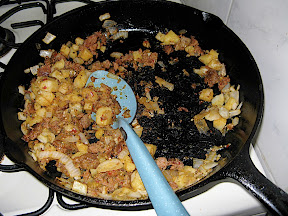
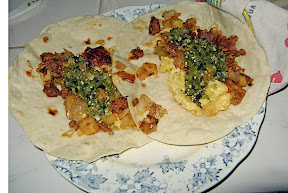
The other morning, for example, I made tortillas de harina for Burritos de Papas y Chorizo. The chorizo was the kind made by, or for Tienda Don Chucho, in Pátzcuaro. It's meatier and less fattier than your usual butcher block scrapings.


Here are some breakfast burritos I made from that.


We're still working out the leftovers from this.

A few minutes ago, an ambulant vendor came by, selling dulces. Usually I don't buy this stuff, but this time, I was in the mood.

I got a nice, pale blonde cocada, or coconut ball. The usual cocada is very dark caramelized, with medium fine shreds of coconut. This one consists of wider strips. It's not as gooey as the usual. There's a faint taste of smoke to it, which pleases me, although it's a bit odd.

I also bought una palanqueta de cacahuates. This one is really good with lots of well-roasted peanuts in a brittle that may or may not be made of a brown sugar.
(below)


Yesterday I made Chiles Jalapeños En Escabeche, replacing the inferior, canned ones that had been in our fridge for untold months.
The technique follows. I posted it yesterday on an informal food forum.

For about 14 medium, green, fresh Chiles Jalapeños.
I sliced three ribs of celery, most of an onion in chunks, three peeled carrots sliced in medium rounds, 6 cloves of garlic peeled and lightly smashed ("cracked"). These are lightly fried in a large skillet with canola or other vegetable oil.

The washed, stemmed jalapeños are partially slit lengthwise in 3 places, then they pass through the hot skillet, tossing just until their skins start to blister lightly. The first vegs are returned to the pan of jalapeños and about 3 cups or so of boiling hot cider vinegar, a tablespoon of sea salt, a couple of cloves, also allspice and possibly a few black peppercorns are added. This is allowed to simmer barely a couple of minutes while a couple of pint or larger jars are cleaned and dried. The hot mixture is portioned into the jars, and if you like, a couple of drops of Asian Sesame Oil is added to each.

Wipe the rims and lid the jars. These are allowed to cool to room temp before refrigerating. They are "hot" but best eaten chilled. Eat cautiously. They should have some crunch left. (The best pickled Chiles Jalapeños locally are those served in Quiroga at the Carnitas stands on the Plaza. They are crunchy, hot, sour, and bite back. Just right to cut the luscious grease of lard-fried chunks of pig.)


It's a lazy, rest day around here, and that's all I have for now.

Note that if you can't see the photos, please tell me.

Wednesday, May 21, 2008

A Ginger Binger

My fondness for ginger has deep roots. I've loved it especially in the candied or crystallized form. Fresh is nice, too, when used in cooking. Ground is fine for baking cookies and moist, molassesy ginger breads. There was once a great Ginger Ice Cream offered at Howard Johnson's, but no more.

Fortune blessed me recently with a serendipitious juncture of gingers. We'd visited the Mercado Medellín, in Colonia Roma Sur, México, DF. This is a very nice mercado in an upper middle class area of the city. Along its well-ordered aisles, I found at least two stand selling fresh ginger, at the reasonable price of $42 MXP a kilo.

I brought it home and it wasn't until several days later, while browsing the fun-filled forums of the Thorny Tree Refuge Stuff It! branch, that I saw a post by "Bixaorellana" on making ginger beer. That was intriguing, but the recipe used ground ginger, and I knew it had to be better made with fresh. A quick Google turned up a very easy way to make Fresh Ginger Beer.

I got right on it. The process is astoundingly simple. The primary caution involves gas. The rapid build up of CO2 may result in rupture of the soda bottle, unless you refrigerate it as soon as the fermentation has peaked. Grolsch Beer bottles with resealable stoppers would be better, but there's some extra expense involved, unless you are already a Grolsch drinker. My bottle simply erupted in a fountain of ginger beer. Providentially, I'd placed the 2.5 liter Coca Cola bottle into a larger, institutional food dervice container.

The brew was very pleasant although lacking a rich depth of ginger flavor, as well as looking too pale. I'd even substituted light brown sugar for the white sugar in the recipe, and increased the amount of ginger from the original recipe.

Concurrently, I made a rather thin-bodied but zesty ginger syrup out of the rest of the ginger.

After sampling the ginger beer, I dosed the rest with some ginger syrup, and put it out for a second fermentation. That took place in less than 12 hours. This time, I carefully captured the spewings of ginger fountain, and recycled them back into the bottle. The double-fermented brew was much better, and with more days in the fridge, it improved even more.

At any rate, this may become a regular item in my repertoire. I bought more fresh ginger at Superama in Morelia, and although not as nice as the Mercado Medellín stuff, it's more than satisfactory.

I have started a new brew, a Sichuanese style Spiced Ginger Beer made from a syrup base with piloncillos, dried Mandarine peel, cinnamon stick, star anise, a couple of cloves, allspice berries, Sichuan Peppercorns, and a dried red chile, as well as copious amounts of grated fresh ginger and some lime. It's steeping now. That will be strained and filtered, then uses in judicious quantities to spike the regular ginger beer. Results should be in in about 2 days.

Here's a recipe for Ginger Syrup for Home-Style Ginger Ale (etc)
from "Better Than Store Bought", by Wittie and Colchie, Copyright 1979, Harpers and Row, publishers. (I highly recommend it, if you can find a copy.)
GINGER SYRUP
4 ounces fresh gingerroot, approximately
2 cups water
1 1/2 cups sugar

Peel and finely chop the ginger; you should have about 3/4 cup
Bring the ginger to a boil with the water in an enameled or stainless-steel saucepan. Simmer for 5 minutes, then let stand for 12 to 24 hours, covered with a cloth.
Strain the pulp through a sieve lined with two layers of cheesecloth; squeeze the pulp in the cloth to extract all the juice.
Return the juice to the pan, add the sugar, and bring to a boil over moderate heat, stirring. Boil gently for 5 minutes, skimming off any froth.
Cool, strain into a bottle, and refrigerate.

Use about 1 tablespoon of syrup mixed with 6 ounces of chilled soda water to make a gingery drink.


Fresh Fruit Cobblers and Kuchen

The bounty of fresh fruits coming available in the Pátzcuaro Mercado attracts the eye, engages the cooking instincts, and gets the juices flowing. One of the most satisfying ways to use these fruits is in a cobbler or a kuchen.

Inevitably, some joker will ask, "What's kuchen?" It's a cake, Jake; that's what, with a fruit or cheese filling. Not a layer cake, but a cake-like or pastry base with a deep filling of sweetened cooked fruit.

A cobbler is a kuchen turned on its head. The sweetened fruit is on the bottom, in a deep baking dish, while the crust, (usually a sweetened, biscuit type dough), lies on top.
Take away the top or bottom crust, heap on some streusel, bake, and you have a Fruit Crisp.

The type and juiciness of the fruit determines whether you use a thickener or not. Berries, such as the luscious zarzamoras (blackberries) benefit from some thickener. Apples, with less moisture and containing the natural gelling substance, pectin, require little or no starch thickener.

The Plum Cake I made the other day, based on a recipe in The Joy of Cooking, had 3 tablespoons of Minute Tapioca and 2/3rds cup of sugar to 1 kilo (raw weight) of red plums. It was not enough sugar and a little too much tapioca.

Here's the recipe for Plum Cake (kuchen) from The Joy of Cooking, with my variations **.

Preheat oven to 425º F, 218º C.

Wash and drain 1 kilo fresh red plums.
Pit plums over a bowl. Cut in half if small and in quarters if large. This should yield about 4 cups or slightly more.

Sprinkle with 1 to 1 1/2 cups white or light brown sugar
2 teaspoon cinnamon (optional- I left it out)
Three or four drops of Almond Extract**.
2 tablespoons of Minute Tapioca**.
Mix lightly; let stand 15 minutes.


Dough
(This dough is actually from the JoC French Apple Cake recipe)
1 cup all purpose flour
1/2 cup sugar
1/4 teaspoon salt
1 teaspoon double-acting baking powder
Blend lightly

Cut in 3 tablespoons chilled butter.

Separately, mix 1 beaten egg and
1/4 -1/3 cup of milk, and
1 teaspoon vanilla.

Add wets to drys, mix lighly to make a medium soft dough.

Line a deep, 8 inch baking dish with the dough, patting out. It does not have to reach the rim.

Put the prepared fruit filling onto the dough base. I also added a few tablespoons of preserved (uncrystallized) ginger from Trader Joe's. Entirely optional, of course.

I also topped the fruit with a streusel, using a little oatmeal in it for textural interest.

Place on a baking sheet, and bake about 30 minutes, or until top is well browned.

Try to let it cool a while before digging in.

Here's a Cobbler version. It's even easier than the Plum Cake.

Prepare the fruit, as above. Butter the inside of the baking dish lightly.

NOTE ON BUTTER:
Please, use decent, real butter. Do not attempt these recipes using margarine, or whipped butter, or, "I can't really believe I bought this extra expensive, artificial butter resembling substance". When buying mantequilla pura de vaca, en México, check the package carefully to make SURE it's not margarine in cow's clothing. Sniff the package for an excess of saborizantes. A usually good brand is Gloria Mantequilla, sin sal, in the green wrapper. A better brand is Kirkland, usually available in Costco. It's said (although I haven't tried it) the best is Anchor Brand New Zealand Butter, sometimes at Costco. Recently sighted at Costco, a very expensive French butter, but not, in my opinion, worth the extra cost for use in baking. Maybe for shaving off curls to put on your croute de pain au levain, sprinkled with fleur de sel; chacon a son gout. (Cada loco con su tema.)


Return to recipe...
Pour in the prepared, sweetened, spiced fruit, with thickener as appropriate, dot with butter. You'll need more fruit for this, up to 7 cups.

Top with this dough, from the Fannie Farmer Baking Book, by Marian Cunningham, or a variation:

1 cup of flour
2 tablespoons of sugar
1/4 teaspoon salt
2 teaspoons baking powder
4 tablespoons chilled butter (1/2 stick or 1/4 cup)
6 tablespoons milk

Blend the dry ingredients, cut in the butter to a coarse, irregular cornmeal like consistency; add the milk. Mix dough lightly with a fork. Roll out on a floured surface. Place over fruit.
Optional glaze: a few tablespoons of milk on dough top, sprinkle with white sugar, bake at 425º F for 35 to 45 minutes.

A foil or parchment lined baking sheet is recommended under the cobbler dish in case of boil over.


Tuesday, May 20, 2008

Frutas de La Primavera

On our return from our stay in the U.S. and Mexico City, we hurriedly restocked our fridge with basics, such as acelgas, zanahorias, col, cebolla, ajo, jitomates, chiles poblanos, tomates verdes, limones Persas.

The second trip to to the Pátzcuaro mercado, and I picked up more "interesting" vegetables, such as pimientos morrones de colores, berenjenas, mango petacón.

There is one stand that specializes in "legumbres exóticos". It is run by Señora Padilla and her son. It's located in the cross-street of the mercado thay eventually exits onto Calle Codallos. It's in front of a few steps and a portón that accesses the central indoor corridor of the market. Thursday is usually the best day for berenjenas (eggplants). Sometimes there are rábanos negros or rábanos o nabos Japoneses; black radishes and daikons. The latter are more common than the former.
I first made fried peppers in vinaigrette, with capers; then on return I made escalivada, roasted eggplant, onions, peppers with olive oil and vinegar. I should not neglect to mention garlic.

There are seasonal surprises, as well. Ladies outside the mercado were offering luscious, locally grown zarzamoras (blackberries), at 26 or 28 pesos a kilo. I snapped some up and quickly turned them into a cobbler. My cobbler recipe is derived from one written by Marian Cunningham in the Fannie Farmer Baking Book.

Now ciruelas are offered at 14 pesos a kilo. These are very small red plums, and they are a p.i.t.a. to pit, but worth the effort, as they have a deep, concentrated flavor of plum-ness when baked. I made them into a variant on a Plum Cake from The Joy of Cooking. The cake is essentially an inverted cobbler. A sweet dough is patted out into a deep baking dish; sweetened and lightly thickened and spiced fruit is piled on. I made a butter streusel for a topping.

I saw greengage plums yesterday, also in miniature, but they don't appeal to me. And, of course, there's the regular, Michoacán "plum", a dense, oval fruit of gold-tinged red. I haven't eaten one recently.

Two women were selling young English Peas in the pod. A modest sized bag for 10 pesos.I asked them "¿Cuantas perlitas rinde una bolsita como esta?" They told me that you eat them, pods and all, as they were young and tender. I plan to try these today. They suggest using the peas in a soup. That's a possibility, but I was also thinking of a risotto or pasta. Some fresh mint might be nice.

I was pleased to see la bonita Señorita de los pepinos at her puesto. She was looking very nice, in a Renaissance portrait sort of way, in her Spring outfit. The cucumbers, for once, were smaller instead of the grossly mature, seedy ones usually sold, but a quick glance convinced me that these were not prime quality fruits. I may look more closely today.

Yesterday there were tomates bolas, round, American type tomatoes. They went for 18 pesos a kilo. We split one for lunch. It was a bit watery and underflavored, but not too bad. I baked some Honey-Oatmeal-Bulgur Bread so we can make Bacon Lettuce and Tomato Sandwiches today.

At the Mercado Medellín in México, DF, I'd bought a nice hand of fresh ginger. When we got home, I was inspired by a post on the Stuff It! forum of the Thorny Tree Refuge site to make Ginger Beer. Not only is it super easy, it's very good. I came up with an improvement or two on the original recipe, to make a stronger, more gingery brew, using home made ginger syrup. I'm about to make it again. It's quick, easy and delicious.

I'll try to post some cobbler variations and my ginger beer recipe later. Perhaps also a Black Radish Salad or appetizer, I learned from my mother.

¡Hasta pronto y buen provecho!

Thursday, April 24, 2008

A Hamburger Stands in Colonia Roma

Living La Vida Buena
Colonia Roma Norte, México, DF:

Streets paved with gelato and fountains spouting espresso drinks; beautiful women walking strange looking dogs, while others at chic cafes nibble gelati or panini while reading "Dios, Patria y Coca Cola" from an elegant book stand.


Meanwhile, I, ever in search of worthy street food and hole-in-the-wall fondas, go to the Hamburguesas A La Parilla* stand, at the corner of Calles Colima and Morelia, at the west side of the Jardin Alejandro Pushkin. This is at the very eastern limits of Colonia Roma, where it becomes Colonia Doctores, not many years ago noted for a high rate of violent crime. Col. Doctores is also the location of the National Baking School of México.

(*Correction: earlier, I thought the stand was called "Hamburguesas al Carbón". That was incorrect.)

I did not "discover" this place. I read about it in the Lonely Planet Mexico book, and, I thought, in the book on eating in Mexico City by Nicholas Gilman. Maybe not the latter. I may be the first to blog it.

At 2:30 p.m. on a Thursday, people lined up for a burger from the sizzling grill. The grill is fueled with gas, but even if so, the results are excellent. They are exemplary hamburguesas del estilo Mexicano. There's a crisp edged quickly cooked thin patty of beef, a sesame seeded bun warmed on the grill, sometimes getting a few charred areas itself, and un montón de verdura y condimentos.

These cheap, fast and tasty hamburger handfuls will satisfy you. They are available as singles ("sencillas"), singles with that white, melting cheese, singles with double cheese, singles with pineapple ring, single with cheese and
pineapple ring, single with double cheese and pineapple ring. (By the way, although it's not my favorite, the pineapple adds a mildly sweet juiciness to the medley.) It's easy to eat two, and I guess a double patty option exists. Prices are muy barato: starting at $22 pesos and going up to about $27. It's almost incredible that the full-sized, Jarritos bottled refrescos are only $4 pesos each.

Things to know before you go: Open 8:30 a.m. to about 1 a.m. Condiments available are ketchup, mustard, mayo, onions, sliced jalapeño chiles, lettuce, tomato. Cheese and pineapple slightly extra. No fries, no shakes, no seats. Eat standing or take it to a nearby park bench. Learn to eat the burger in a slightly bent over forward posture so that the juices don't dribble on your clothes.


UPDATE: Of course, the prices have risen a little in the intervening years, but it's still an inexpensive and fun spot for a quick burger or two. And now there are a couple of metal benches to the left side of the stand. But it's more fun to eat standing up.
Hamburguesas a la Parilla Roma:

NOTE: The original video is disabled because Google Video became YouTube. Maybe I can locate my video on the latter site and embed it here. But you can see it still, by clicking the photo slide show window.

Wednesday, March 19, 2008

Men's Breakfast at Las Cuevas 2008


This past Tuesday morning, Susan and I, with the help of our neighbors, Geni and Larry, and a friend, Bruce, had 22 retired men as breakfast guests to our house at Rancho Las Cuevas. Again, the theme was "Southern U.S. Breakfast", and as such, calories and cholesterol levels were ignored.


The Menu
  • Home made Cinnamon Rolls
  • Angel Biscuits, sausage gravy
  • Thick Sliced, Hickory Smoked Bacon
  • Hominy Grits
  • Scrambled Eggs
  • Shredded Cheddar Cheese
  • Oven roasted Potatoes
  • Salsas, both red and green
  • Strawberry Jam, Honey
  • Small, freshly squeezed Orange juice
  • Coffee
(A big urn type coffeemaker was lent to us by Rick Davis, co-owner of Restaurant Cha Cha Cha in Pátzcuaro. Many thanks, Rick!)

The day was bright and sunny when the guests started arriving at about 9:10, and we were serving by 9:50. However, preparations started the day before and I set to work in the early morning at 2 a.m to begin baking and cooking. The most time consuming part was the making of the cinnamon rolls, but I enjoyed it because it took me back, on a flood of nostalgia, to the more fun aspects of owning a bakery in the 80s and mid-90s.

The rest was basically Army Cooks' training coming to the fore with organizational skills and exquisite timing. There were a minimum of glitches.
When it was over, the guests were happy and well-fed, and we and our crew were rewarded with satisfaction and a pitcher of

"Mexican Bloody Marys."

Here's the recipe:
  • 5 or 6 chilled 12 oz V-8 juices
  • juice of 6-7 Mexican limes
  • 5-7 dashes of Salsa Huichol or favorite bottled salsa
  • Lea & Perrins, 2-3 dashes
  • Maggi Jugo, 2-3 dashes
  • 1 cup, approximately, ice-cold Tequila (nothing fancy)
  • ice
  • Serve in glasses rimmed with sea-salt and coarsely ground red chile .

Thanks to Geni Certain for the photos. Many thanks to Larry Wood for squeezing many kilos of oranges for orange juice, serving coffee, and moving furniture. Thanks to volunteer Bruce for his help serving. Muchas gracias a nuestros vecinos, Chucha y Mateo por nos dando prestacíon de unas sillas y una mesa. Special thanks to SFC (U.S. Army, Ret.) Ric H., for his organizational skills.

Click slide show to visit gallery.

Monday, March 17, 2008

The Cooking School In Patzcuaro

The Cooking Class at El Mesón de San Antonio


The proliferation of cooking schools in Mexico, ranging from short, one day classes to elaborate one week sojourns has been phenomenal in recent years. Oaxaca city seems to lead in offering cooking lessons, followed by Tlaxcala, Guadalajara, and Mexico City. This is an area of educational and entertaing tourism until recently neglected in Pátzcuaro.


I recently received an email from four Americans planning to visit Pátzcuaro, inquiring about Mexican cooking classes in the area. I knew of only one, on a distant Zirahúen ranch, and that was probably closed. I replied that I thought I could organize something for them, at the spacious and comfortable Hotel Mesón de San Antonio


With the cooperation of our friends, Mesón owners and hosts Sr. Alfredo del Río Mora, and his wife Sra. Guadalupe del Río, we put together a one day class of 5 to 6 hours. Guadalupe ("Lupe") is an excellent and dexterous cook, and would teach the class. I was the organizer and translator as necessary.

I corresponded at length by email with the guests to customize the class to their needs. The event was our "pilot program" and thus we were able to offer them a choice of menus with some variations. The theme was "Comida Michoacana", and the final menu was this:

CHURIPO MENÚ
• Ensalada de Nopalitos con queso fresco
• Churipo con Corundas
• Tortillas de Maíz Criollo hechas a mano
• Salsa de Chile de Árbol con Xoconostle;
• Postre: Copita de Gaspacho Moreliano
• Agua Fresca de Jamaica
• Pulque


We enlisted the help of Sra. Amparo Cervantes and her daughter, Mireya,
from the Restaurante Comida Regional in Tzurumútaro; specialists in the traditional making of corundas and handmade tortillas. They brought their vaporera, or steamer; and a metate y mano to demonstrate and teach the techniques to the guests.

Our day began when I led the guests, three of us toting shopping bags, on a shopping tour of Pátzcuaro's Mercado, to buy most of the ingredients for the meal. This was our shopping list:

• Carne de Res (Lupe purchased the beef earlier in order to get it cooking.)
• Cebollas
• Col
• Zanahorias
• Chayotes
• Calabacitas
• Xoconostles
• Cilantro
• Epazote
• Piña
• Jícama
• Mango
• Queso cotija
• Chile molido
• Limones
• Nopalitos
• Chile verde

Of course, we looked at many other things in the Mercado unrelated to our menu of the day. One could visit the Mercado every week and still find new and fascinating ingredients as well as prepared foods. The Pátzcuaro Mercado in photos.

When we arrived back at the hotel, Sras. Amparo and Mireya were there, setting up. You can see their demonstration of tortilla making in the video embedded below.

The guests were able to participate to whatever degree they wished; slicing, dicing, cutting, and most of all, trying their hands at tortilla making and, more challenging, filling and wrapping the 5-pointed corundas. I devoted my time to taking photos and videos, but was soon enlisted by Lupe to help in the preparations.

At a few minutes to 2:00 p.m., we sat down in the large "Refectorio" hall (once the set of a a telenovela filming) of the Mesón de San Antonio to our comida.

The churipo was rich with meat and vegetables; much better than any I'd ever had in restaurants; the Ensalada de Nopalitos, tart; slightly picante with chiles verdes serranos, and refreshing. The corundas were abundant, steaming hot, light and spongy, perfect for soaking up the broth of the churipo. The tamales, thick and earthy, were somewhat of an excess, but nevertheless welcome.

The agua fresca de jamaica was tart-sweet and refreshing.

Postre (dessert), was a light melange of diced fresh pineapple, jícama, and mango
bathed in freshly squeezed orange juice, sprinkled with Queso Cotija and a dusting of chile molido al gusto.


Excerpted Comments from Participants...

"We'd like to once again thank you for putting together a phenomenal cooking experience.. We found Lupe to be a gracious host, a beautiful kitchen to work around in and we appreciate all the work and efforts you all went to..."

"Market Shopping = A+ An exceptional experience especially for someone who's not attended a large city market. Knowing how to select and find the ingredients is of importance to most cooks."

"Menu = A+ With all the foods in Mexico to prepare it's hard to decide what would be the "perfect" menu for a cooking class. What you suggested and planned for fit us all perfectly. No complaints. This was a true and authentic menu..."

"An exceptional value for the experience..."
Leisa Bailey

"It was great fun and a nice and intimate setting to visit with very nice and interesting people. The Purhepecha menus for classes will be very appealing to people visiting, both foreigners and Mexican, I would think."

Carole Kocian


For further information, contact Mesón de San Antonio


Saturday, March 15, 2008

La Jaiba: Eat Here and Get Crabs


We'd heard how good this seafood restaurant is, but until Thursday, hadn't eaten there. There's another location, somewhere out near the Panteón Municipal, but it has been elusive. The one we found is at Blvd García de León # 937, north side, close to a TelMex office and parking lot. Parking is where you find it, on the street. There's a wheelchair ramp of sorts at the door. Tel: (443) 315 57 57. The rooms are fairly simple but well lit and spacious, as befits a marisquería. The menu fits on two sides of a folding carta.

We were immediately brought an attractively arranged platter of chopped onion, cilantro leaves and chopped chile perón; a small loaf of crusty bread, a dish of the popular, orangey colored spiced mayonnaise, and a small mound of what I call "ensaladilla Rusa; cubed cooked potatoes, peas and carrots in mayo. This has never attracted me, but it was actually quite good. There were two collections of popular bottled salsas; that the labels were gone added a frisson of daring to the meal.

Our drinks orders were taken promptly. There's a pretty good selection of cervezas and mixed drinks. I treated myself to a vodka and mineral water. The Absolut Vodka, poured generously at table, was what I need after having just spent an hour plus in a dentist's chair.

Our group of four began with a pair of Rollos de Jaiba and Rollos de Mariscos; sort of semi-formed Spring Rolls. They were "ok" but not great, with mushy, undistinguished fillings and not very crisp wrappers. They came with more ensaladilla Rusa. Being hungry, we ate them with no problem.

Choosing a main course was pleasantly challenging. The list of interesting preparations is extensive and inventive, such as Camarones Cocos. Camarones al Tequila, Camarones a la Salsa Mango, etc. They also offer cocteles de mariscos, of course. We saw a couple of men receive Cocteles Campechanas, a
large "Chabela" goblet, beautifully layered with fresh oysters, shrimp and octopus. The cocteles were very tempting, but fortunately, we'd already eaten, and I didn't violate my "Oath of No Raw Oysters in Mexico" that I swore in 1980, when I was ill for two weeks after an oyster cocktail in Tuxpan, Veracruz.

My wife, Susan, had some beautiful and tasty Brochetas de Camarones, presented with grilled orange wedges, sweet yellow peppers, onion and bacon on actual wooden skewers. (So often "brochetas" or "alambres" means a stir-grilled melange of tasty bits that once upon a time, might have been served on a skewer.) A small plate of so-so rice accompanied it, as well as some limp, somewhat greasy French Fries. Our two visitors split an order on Mango Shrimp. It was nicely done, 3 shrimp per diner (you can order as many as you want. The waitresses are very accomodating.) The sauce was a thick, puree of mango with a hint of chile. Not exactly my kind of thing, but the taste of sauce I had was pleasant.

I wanted a filete de pescado, as I wasn't up for tackling a whole fish. (During our meal, we saw a whole, raw fish presented to another diner on an iced platter for his approval. It stuck out over the sides of the platter. We were impressed.)

I hadn't had a proper Pescado a La Veracruzana in a long time, so I ordered that. I anticipated that the filet itself would be bland and very soft textured. I think that tilapia is very popular with restauranteros. It's by no means my favorite fish, as it's usually nearly devoid of any interesting texture nor taste, but on this occasion it suited me.
The sauce was very good; let me tell you:

*What are some signs of a good Salsa a la Veracruzana?*

• Fresh tomatoes; onions, a little garlic, certainly.
• Cooked Chiles Jalapeños, cut lengthwise.
• Green olives, hold the pimento stuffing.
Alcaparras (capers) lend a salty tang. (In another Mexican restaurant, in the U.S., I was once served the dish with peas as a stand-in for the capers.)
• Bay leaves. (Remove before tucking into your fish.)
• Juices are liquid, not thickened with tomato puree.
• A lightly fried chile güero on top is a classic touch.
IMO, the Veracruzana at La Jaiba met and exceeded these standards, except for no chile güero. Big deal. It was delicious anyway. I cleaned up all the sauce with the fresh bread.

Desserts are mini-individual cakes or flan. The cakes are cute, but nothing special really; the flan was a little firm, which is ok, and our Pennsylvania born friend jealously guarded it from me. Coffee was IMO, passable, but our Louisana-raised friend thought it was bad.

Summing up: I'd give La Jaiba 3 1/2 stars, moving toward 4, out of a possible 5. The service is excellent, the room is fine, the chairs comfortable. As to the food, the cocteles de mariscos looked magnificent and well made. (Did not try them.). The shrimp in Mango Sauce were plump, fresh and tasty. The Brochetas also. The Veracruzana, an A-.

The Fry Cook needs retraining, with special attention to oil temperatures.
In general, worthy of a special visit, and we would certainly eat there again.

Really, I didn't spot any crabs on my once-over-lightly scan of the menu. I could have titled this blog post; "Shrimps Served Here", but that wouldn't have gotten your attention as quickly.


Update:
We went to Morelia last Tuesday. The mid-day and afternoon heat was powerful.

A small group protesting on Blvd. García de León jammed traffic, but we were able to extricate ourselves and park about 4 or 5 blocks from Mariscos La Jaiba. Once inside, we found the overhead fan very welcome. We ate lightly, a shrimp cocktail for Doña Cuevas, and one of pulpos and camarones for me. They were delicious; among the better ones we've had. It wasn't that the shrimp were so much better; it was that the clear broth in the glass was tastier. I also like the platter of chopped cilantro, cebolla y chiles with which to garnish your food al gusto. We were also very thirsty, and we drank a pitcher of limonada and a michelada con Clamato.

At an adjoining table, a large family/friends group came in and ordered mariscadas, platters heaped with cold, boiled seafood, including what looked like a part of a langosta. It was very attractive and tempting. Our waitress explained that the price started at about $100 MXP per person, and went up, depending on the selection, and I suppose, the market price of some of the seafood. A mariscada is on our priority list for our next visit.

La Jaiba is located on Blvd. García de León near the corner of Calle Battalla de Cerro Gordo, but east of the Telmex Building. The next street to the west is Batalla de La Angostura.


View Pátzcuaro's Best Eats in a larger map