Tuesday, May 26, 2009

A Bellyful of Whole Belly Clams

Another greatly sought delicacy during our visit to the Northeastern U.S. was Fried Whole Belly Clams. Some of you, like us, may have sampled Fried Clam Strips, a dish that resembles short lengths of rubber bands and deriving most of its flavor from the breading and the accompanying Tartar Sauce. Think, "Howard Johnson's". I once worked in the kitchen at a Red Lobster (I'm still trying to compensate for those 9 months), and there, we cooked Clam Strips by dipping the end of a small plastic bag of preportioned, frozen clam strips into the hot fat of the deep fryer, releasing those wormlike morsels towards their final destiny.
Whole Belly Clams are a whole different dish.
(I'm suddenly curious why it's called Tartar Sauce or Sauce Tartare. I associated the Tartars as a tribe of horsemen who tenderized horsemeat by placing it under their saddles during vigorous, rollicking jaunts over the steppes. Thus, the possible origin of Tartar Steak.* They were also fond of koumiss, fermented mare's milk. (This is not an auspicious beginning culinarily.) The Mexican version of Tartar Steak is Carne Apache, a name which has some of the rough and wild associations of Steak Tartare. It's also a food I wil not eat, as served in its unrefrigerated and dubious form at street and mercado stalls. But, I digress.
Whole Belly Fried Clams are a New England Specialty. When I was growing up in and around New Haven, CT, we'd sometimes be treated to a fried seafood meal at the Clam Box at Branford(?), or even better, Jimmy's of Savin Rock, back when it was a parking lot and a stand, with long lines in the summer.

On this trip to Connecticut, we had two Whole Belly Clams ops. The first was at the excellent Maine Fish Market, in East Windsor, CT. Not to miss an opportunity, I started my meal with a shellfish platter of 6 icy clams and 6 oysters on the half shell. A Long Trail Ale was the perfect accompaniment.


After a small salad came a platter mounded with golden fried whole belly clams (WBC from here on.) There was a mountain of French fries and slaw as well.

(I'm sorry, but I don't have any photos of WBC at either restaurant! What must have I been doing? Eating. I'll Google a photo and put it in here.)

Thanks, I appreciate that.

The clams were excellent. In fact, I liked everything about the meal. well, maybe the Tartar Sauce wasn't great, but it was o.k.) I had to take about a third of the clams and half of the fries to our niece's home, where the next morning, I made a Connecticut version of Hangtown Fry. (Scrambled eggs, potatoes, fried WBCs.) More than you ever wanted to know about Hangtown Fry.

The second WBC op was at Skooter's Restaurant in Windsor Locks, CT. (Mentioned in a previous blog post under "Lord of the Rings".)


                            The Skooter's building


My wife had an order of clams only, a rather more modest portion, but very tasty and the right size for lunch, before boarding the Amtrak Vermonter train back to Newark, NJ.

This concludes our presentation for today.

Monday, May 25, 2009

Lord of the Rings

In my middle years, the 1970s, I was a Lord of the Rings. My job at King's Food Host, a fast food restaurant chain, first in an individual unit's kitchen, then in a large regional commissary stunk.

Or, rather, I stunk. After a day at work, my body and clothes reeked of onion juice.
One of my principal tasks was to prepare fresh onion rings. This was done by slicng off the ends of a 50 # or more bag(s) of onions, send them through a slicer, separating out the irregulars from the perfectas.
From the slicer the raw rings went to the breader. If the slicing stunk, breading was crummy.

The results were worth the tears and stink. The perfectly fried, golden rings were the crowning touch on many a Double Cheeseburger. These were, at least in my memory, the best OR's and the best hamburgers ever.
Since then, despite the smelly and often monotonous nature of the work, I've been big, if fussy fan of ORs.

Back in the U.S.A. for a 3 week visit, we had several opportunities to eat onion rings. The ranged from "good" to fantastic. All that was missing was "The World's Best Double Cheseburger", with its petite OR crown.


My first grab at the ring came at the Randolph Diner, in Randolph, NJ. My Mom ordered a magnificent plate of fried jumbo shrimp, that came with a generous portion of FFs and ORs, and a modest cup of slaw. She granted me on OR and I loved it.


Shrimp, FF and OR at Randolph Diner


My second chance was at the estimable Irving's Deli, Livingston, NJ.
It was a great meal with a half pastrami sandwich, a pretty good hot dog, some complimentary dill pickles, and a basket of really good ORs. They were nearly identical to those at the Randolph. I never would have thought of ORs to accompany a deli sandwich, but when the opportunity arises, you shold grab it.


ORs at Irving's. Who knew?


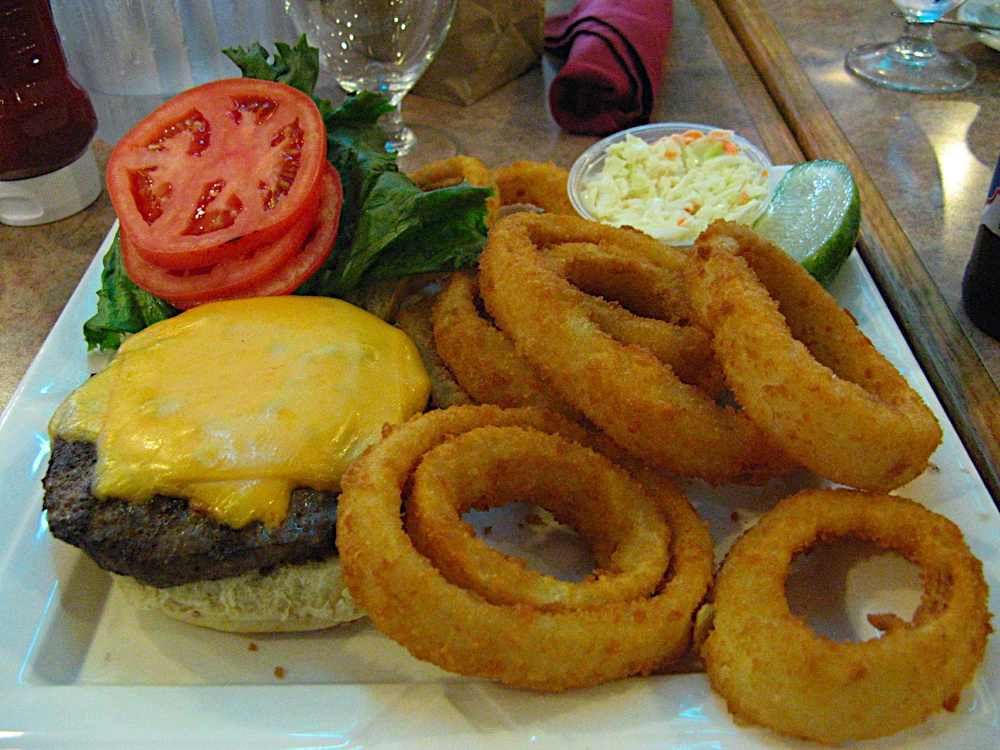
Let's have another look at the Randolph's ORs, alongside their fairly decent cheeseburger. (Not The World's Best Cheeseburger, but it would do.)


Cheeseburger & ORs, Randolph Diner


During a weekend visit to a niece and nephew in Connecticut, we got in one last OR op, this one at Skooter's Diner, near Bradley Field in Windsor Locks.

The Skooter's ORs are definitely home made, with a lighter, more fragile breading. I enjoyed them, but I'd give top honors in this group to Irving's, followed by Randolph.

Fragile, golden beauties at Skooter's


Skooter's is a sweet little place, which I'd probably patronize regularly if i lived nearby, but not, in my mnd, worth a special detour. By the way, the hamburgers were serviceable but not outstanding. The Fried Whole Belly Clams were good, according to my wife. (WBCs is perhaps another topic in this North East U.S. series. Later.)


A Case of Crabs

It was the season of crabs...
A side benefit of our visit to the Northeast U.S. was that soft shelled crabs were in season. I learned on Mouthfulsfood.com that Avenue Bistro Pub, in Verona, NJ, was offering them on pasta. But when we ate at Chengdu 1 in Cedar Grove the night before, there were soft shelled crabs on the menu, prepared Hot and Spicy with Chili (sic). Irresistible, even though we ordered Hot and Spicy Prawns with Chili as well. In the end, the prawns were better than the crabs.


Hot and Spicy SSC with Chili, Chengdu 1

Following that semi-successful meal (less the fault of the restaurant than the widely divergent tastes of the diners' choices.), we joined two old friends at Avenue Bistro Pub. I passed up the second chance for SSCs, and instead, had a great Hanger Steak with frites. My wife had the SSCs, subbing fresh spinach for the pasta. She said it was excellent.

                                          SSCs sauteed, over spinach, Avenue Bistro Pub

Another crab delicacy are Crab Cakes (CCs). These can be done well, but all too often are masses of breadcrumbs or potatoes, faintly flavored with crab and fried poorly. That, unfortunately, was the case at Reggiano Ristorante, where my single, large, and very expensve CC was guarded by a formidable nest of fried angel hair pasta. Once that barrier was removed, I found a poorly seaoned and fried CC, unredeemed by its underlying pool of "saffron aioli".

I got my good CCs, again at Avenue Bistro, this time nicely done, lightly fried, no barriers, and graced with a red sweet peper remoulade.

                                                    CCs at Avenue Bistro

(And now, the real crabbiness comes out, as I prepared CCs at the house.)

My Mom wanted me to make crab cakes before we returned to Mexico. Towards that end, we purchased two, one pound cans of crabs of crabmeat.
Only one day remained before our departure. My Mom planned a meal based on mixed green salad, crab cakes, corn on the cob, green beans and (SURPRISE!) potato salad. I will credit her with preparing all the salads, vegs and sides. I was left only with making the crab cakes. (There was more cooking and food preparation that day, but I won't go into the details here.)
I recalled that the year before, she and I wrangled over a newspaper clipping recipe. I don't recall the gist of the dispute, it it may have had to do with "not over seasoning to the point where you don't taste the crab." 
I totally agree with that opinion.
This year we wrangled only briefly, and she more-or-less let me have my way with a recipe I got on the Internet.
Who knows? The only requirement was that "Panko", the Japanese white bread crumbs, be used.
(I did take 3 slices of Pepperidge Farm Hearty White Bread, trim off the crusts, dice, place in the food processor and whirl with the steel blade until they were crumbs. Those were the "filler" inside the CC mixture.)
Here's the recipe I used, for "Best Crab Cakes", from teriskitchen.com
I consider it a very good starting point.
Keep in mind our quantity was doubled, yielding 12 large crab cakes. I'll put my modifications in a colored font.

(A little celery, sweet red and/or green pepper, red or white onion, Tabasco Sauce, a pinch of  thyme, a few dashes of cayenne pepper.)

My Mom's kitchen is compact, and she more or less knows where everything is stored, while I, her usually intelligent son, am generally clueless in that regard. Nevertheless, I manage to make the CC mixture before lunch (a vegetable frittata), between other more or less continuous kitchen tasks, and get it refrigerated.

Later, I patted out the CCs and began to fry them. I would have used two skillets, but the burners were occupied with corn on the cob and green beans. My temper finally exploded as my wife started removing the cleaned dinnerware from the dishwasher, underfoot where I was working. It was necessary, but stressful. Plus, "there are ways of doing things in every family".

But after my crabby outburst came calm. I continued, frying 4-5 CCs at a time, placing them on paper towels in an oven proof dish and keeping them in a 200º oven until serving time.

THEN:
FIRST, the salad.
clear the plates
SECOND, the corn and green beans.
clear the plates (my wife says I was mistaken. We did NOT clear the second plates. But we did eat the vegs as separate courses.)
THIRD, the CCs. Pass the mayonnaise, ummm; Tartar Sauce. Mmm!
I had more salad, which was "noticed".
It was just almost worth the hassle. I ate two big CC's. They were great.
I skipped the baked bananas, as they held no apeel for me.

                          Home made CCs, hecho a mano por mi.
I suddenly realized that I'd blogged a topic of the same or nearly the same title, a couple of years ago: Eat Here And Get Crabs
So it is. No, I'm not obsessed with that affliction. Originally, this post was titled, Crabby In the Kitchen

Wednesday, April 29, 2009

Foods of My Native Land

We are leaving tomorrow to spend a few weeks on the old family hacienda in New Jersey. Not only will this be an opportunity for visiting mis papás y hermana, we will also be treated to some of the comida típica del país viejo. That is, some of the special foods we either can't get here in México, or only in diluted versions. Below are some of the delights we are anticipating.
•Proper sour Jewish Caraway Rye Bread.
•Pastrami sandwiches on that rye, with hot, spicy mustard and...
•Garlicky Kosher pickles.
•Good hot dogs, with taste and a casing with snap. (Mexican hot dogs here are uniformly dreadful.) See Irving's Deli menu (pdf). The main web site is being remodeled.
•Dunkin Donuts (Yes; I indulge in a couple of Dunkin Donuts every other day while we are there. I especially like French Crullers. Be assured that they are nutritious.
I can get totally wired on their excellent coffee (and much cheaper than Starbuck's down the street.) while geting wi-fied over their free internet connection. Just try to find a table with enough room for the laptop.

•Brisket pot roast with spicy gravy. Kasha Varnishkes. (Steamed whole grain buckwheat groats with egg noodles, lightly bathed in melted chicken fat with crispy, caramelized onions. I can make it in México, but it's better in the Old Country.)
•Connecticut style hot buttered lobster rolls. Fried whole-belly clams. (In photo.)


More...

•Really good Italian food, and pizza!


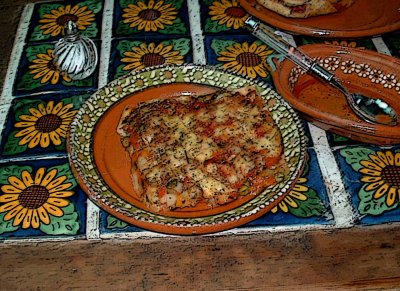
A vegetable pizza at Pepe's Pizzaría Napoletana, in New Haven, Connecticut.

•Decent bagels.
MORE...

Actual, real Chinese food, especially Sichuan style.


Baby Wontons in Spicy Red Oil Sauce, at Chengdu 1, Cedar Grove, NJ.

I hope to be reporting back as often as the primitive, regional coconut fiber network permits.
Watch this space for updates.

Tuesday, April 14, 2009

Holstein: Variations On a Milanesa

Ja, Das Ist Ein Holsteiner Schnitzel!

Pardon my Alemán. I've never studied that language. But I got enthusiastic yesterday when I spotted Milanesa Holstein on the menu at Sanborn's Restaurant at Plaza Las Américas in Morelia. It's true that I was first drawn to the Sandwich Caliente de Pavo con gravy; but having had a very disappointing earlier experience with that at Sanborn's Centro Histórico Morelia, my eyes leapt to the Milanesa Holstein. There is also a Milanesa Italiana or perhaps Parmesana, which the colorful photo menu explains as in a tomato sauce with gratineed cheese. It looks like "Chicken Parmesan", with the chicken standing in for veal.


I'd better explain what Schnitzel (or Milanesa) Holstein(er) is. A thin slice or meat, originally veal, but could be pork or chicken, is pounded out thin and breaded then fried. For the Holstein variation, the fried schnitzel is topped with a fried huevo estrellado. (See my previous work on How To Order Eggs Without Fear, here.) The fried egg is garnished with a couple of anchovy fillets and a few capers. The latter two are among my favorite condiment foods. Put a small order of Papas Fritas, and you've a rare treat when you are surrounded by enchiladas and comida típica Mexicana.

Where did the milanesa originate and how did it come to Mexico? For illumination, I turned to www.wikipedia.org and the article on the Wiener Schnitzel and variations.

Here is some relevant historical context:
The dish may have originated in Milan, northern Italy, as cotoletta alla milanese, and may have appeared in Vienna during the 15th or 16th century. According to another theory, it was introduced in 1857 by Field Marshal Radetzky, who spent much of his life in Milan. The term Wiener Schnitzel itself dates to at least 1862.
The article is a bit thin on Mexico and its adopting of the Milanesa:

Mexico

Thinly sliced beef breaded and fried is also known as "milanesa" and is a popular ingredient in "torta" sandwiches sold in street stands and indoor restaurants in Mexico City.

I theorize that with the French invasion and occupation of Mexico in 1862 to 1867, and the placing of Emperor Maximilian of Austria on the throne, Central European dishes were introduced to Mexico, including the schnitzel-milanesa, and, I'll throw in pasta hojaldre (puff pastry for strudels and other flakey treats of pan dulce.)

Earlier, Hapsburg Austria dominated northern Italy, and Lombardy, where Milan is located, and this food may have migrated northward to Austria. From there, it traveled to Mexico, where it is ubiquitous, and most prominently used in tortas. (Mexican "sub" sandwiches) Those milanesas are often of poor quality; tough and badly fried. For a really good Milanesa de Pollo, served plated as a lunch or dinner, I recommend those served at the restaurant of the Gran Hotel in Pátzcuaro. Now I can also recommend those at Sanborn's Plaza Las Américas location in Morelia.

So, what's the Holstein connection? Holstein is a county, part of Jutland, in Northern Germany. How does that explain a fried egg with anchovies and capers?

MyGermanFoods.org has this explanation; believe it or not as you wish:

Holsteiner Schnitzel (Holsteiner Schnitzel, Schnitzel nach Holsteiner Art)

Holsteiner Schnitzel, a veal fillet (pork can be used instead) breaded and browned in butter and topped with a fried egg and an anchovy was the favorite meal of the great 19th-century Prussian diplomat Friedrich von Holstein – who liked to eat in a hurry – so he had his appetizer and main course all on one plate.

This concludes my light-hearted investigation of the schnitzel-milanesa in Mexico. May your next Milanesa be a great one.

Sunday, April 05, 2009

Un Gringo Cocinero En Cuernavaca Parte 2

Yo era un cocinero gringo para una familia Mexicana de Cuernavaca.

Liz' 16th birthday was approaching, and she was more than happy if I would make pizzas for her birthday dinner. The challenges were many, but I was flush with reckless enthusiasm, so I took on the task.

The first thing was to enlist my enthusiastic paisanas in the effort. I probably misread their intentions, because they seemed more motivated towards the nebulous concept of a "party" for Liz, (a little cake, a little punch, some finger sandwiches, ¿quien sabe?) while I was up for a fiesta de pizza a toda madre. (To phrase that more delicately, "an all out effort"; "awesome".)

To launch the latter project, Amelia loaded Liz and me in the Talking Chrysler.
I hadn't told you about that, have I? It was Amelia's carro favorito de siempre, a Chrysler station wagon that would warn you, in a deep, masculine Spanish voice, "Abroche su cinturón.", or, "La puerta está abierta."
Off we went to Gigante and its salchichonería (deli) to buy rare and exotic sausages and cheeses. Amelia gave Liz free rein until she started looking longingly at some shrimp.

My memories are dim, so I don't recall if I made the pizza sauce from fresh or canned tomatoes. These days, I greatly prefer canned. Back then, I had the ganas to make my own sauce from fresh tomatoes.

Yet in the back of my mind was a small but gnawing doubt about what sort of pans were available to bake the pizzas. There were none. Inspired by artesanal pizzaioli
Italiani, I decided to bake directly on paver tiles. There were even some surplus ones stacked in the patio. All they needed was a good scrubbing.

A piece of heavy cardboard, covered with foil, would serve as my pizza peel.

Preparations reached a fever pitch on the morning of the party. My paisanas soon retreated from the kitchen and its lunatic pizza maker. The oven was giving its best effort to reach its feeble maximum temperature. I
rolled out the pizza crusts with a mescal bottle.

I'd lined the oven rack with the paving tiles earlier so that they could heat to the perfect temperature. En mis sueños.

The Moment of Truth had arrived, as it must come to all men.

I clumsily transferred a pizza, brimming with sauce, cheese and delicacies onto my primitive peel. I inserted it into the oven, gave it a jerk, and immediately slapped it up against the back wall of the oven. ¡Que desmadre!

I scraped out the remains and trashed them. With greater care, I loaded another one. This one worked.

Eventually, all 5 (?) pizzas were done, and I fell back, suddenly drained as the family and guests snarfed pizza. I don't remember much more of that, except that the next time "la muchacha" (the housekeeper) came in to clean, she had the task of removing the mozzarella and sauce deposits burned onto the oven.

That was the end of my career as a pizza baker in Cuernavaca, but not the end of my cooking and baking in La Ciudad de La Primavera Eternal.

"
But man is not made for defeat. A man can be destroyed but not defeated."
Ernest Hemingway
Possibly to be continued...

Incorngruity


I love corn. I really do. So, what is it about the abuse of canned corn* that turns me off so?

*Please don't confuse this with CanCun. This is not a travel blog.

Really, canned corn is convenient and useful. You just open, pour and heat it.
(You should, however, keep cream-style corn away from children who might be corrupted by soft pour corn.)
Whole kernel corn has legitimate applications. I may think of some if you give me some time; could be a few years.

It tastes o.k. I'm just mildly appalled by the indiscriminate addition to so many recipes, such as black bean and corn salsa; to chili, and in casseroles. (The latter often baked in Corning Ware™, as if that would justify it.)

I just did something I rarely do: I committed the sin of canned corn abuse by opening a can of it and pouring the contents into a pot of Chipotle Chicken Chile I was concocting. This chili was improvised from various garish recipes on the Internet.

I based my version on one smoked pork chop, diced; most of a pollo al carbón that we bought alongside the road in Tzurumútaro. These are terrific broiled,
spatchcocked chickens (There he goes again, Mildred, with his smutty talk.); daubed with adobo and slowly grilled over a smoky charcoal fire. Fresh orange juice is squeezed on them at the finish, and a few shakes of salt and pepper.

In addition to the meats, I added a couple of small onions, chopped; one clove of garlic, chopped; one sweet yellow pepper (it's what I had on hand); one chopped chile chipotle en adobo plus its sauce; a tablespoon of pimentón de la vera. I use "La Chinata" brand, because I like the red can and the cool label. Sure; and some Mexican orégano and just a bit of cumin also. Too much cumin smells like sweat.

While the bones of flavorsome skin from the chicken plus the small pork chop bone simmered in a liter of water in a separate pot, I added two cans of S&W brand Italian style stewed tomatoes to the main pot.

Then I did it: I opened one can of S&W Whole Kernel Corn and tossed it into the pot. I pushed this tacky, trashy act into the bargain basement of my conscience.

After the bones had simmered 15 minutes, I strained the stock into the chili pot. I also added a heaping tablespoon of Knorr-Suiza Caldo de Jitomate powder. This may have put the salt a little over the top.

Not to forget the frijoles. They were about 3 cups of cooked frijoles vaquitas, which are called thus for their cow-like, black and white markings. (You'll probably never find these, so don't even try. You can use cannelini beans or common black beans.)

Just for "Authenticity"—hah!— I put a large, dried hoja de aguacate in. I did that because I know most of you can't get them, and that further enhances my smug sense of superiority.

Remove hoja de aguacate before serving, or else everyone will want one.

I slowly added about 1/3rd cup of quick white grits to thicken the juices a bit. This (and any other step) is optional, or as we say, "como te gusta."

When I tasted a few sample spoonfuls, it seemed a bit more picante than my sister-in-law, (who will be visiting us this week) might tolerate. So I damped down the picor (the bite) with the addition of the juice of two Mexican limes, and the juice of one naranja dulce. (Just a sweet juice orange, nada más.)

The chili tasted fine after simmering another 15 to 20 minutes. It's now cooling on the kitchen counter.

Now then; when you imagine the above concatenation of ingredients, each contributing their part towards the common good, ask yourself what the corn does.
It's there because it's too easy to do. As Constantino commented, it's "filler"

I'll close with this link to a truly frightening example of what can happen if you slide down the slippery slope of canned corn abuse. This can happen to you. (For Mature Viewers only, with strong stomachs.)

PS: you can, if you like, serve this with a blob of crema (thinned sour cream), queso rallado, and chopped cilantro on top.
Pass the corn chips.

Tuesday, March 10, 2009

Un Gringo Cocinero En Cuernavaca Parte 1

Yo era un cocinero gringo para una familia Mexicana de Cuernavaca.

How it started, below...

I first arrived in Cuernavaca to attend the Fénix Language Institute in February, 1992. The Institute lodged me in the home of Sra. Amelia (a later photo, to the left.) and Sr. José, their two older sons, Gustavo and Pepe; and sweet sixteen daughter, Liz.

The family had escaped México, D.F. after the earthquake of September, 1985, and bought a two-storey house, with rentable apartments behind in the northern part of Cuernavaca. Don José continued to work for some years in el D.F., coming home on weekends. Unfortunately,
at the time of my two-week stay he was in the hospital. I was not to meet him until a visit the next year. This memorable man deserves a blog post of his own.

The two weeks at the school was what I needed to help hone my Spanish skills, but the home stay provided a great environment to practice a more vernacular Spanish. Amelia liked to teach me refrains and proverbs, while Gustavo taught me some colorful slang.

Meals were included, but I was greatly disappointed at first by the bland, White Bread offerings. There was not a chile in sight. We seemed to be eating a great deal of white rice and milanesas (bread pork or beef cutlets, the Mexican schnitzel), and white bread toast. The reasons for this atypical diet soon became evident.

There were other student guests in the house, two young women from Minnesota. One was suffering Culture Shock while the other did her best to support her friend. Their food interests were unlike mine. The one with CS was comforted by peanut butter spread on sliced white bread. She wouldn't eat the clean, healthful salads the Amelia prepared. White rice and plain spaghetti were about as daring as she could eat. (It could be that she was also suffering "Las Turistas", but we didn't speak of such things.)

After three days of tough, boring milanesas and Midwestern-oriented White Bread Food, I was getting worried that I'd never get any really good comida casera Mexicana. So, I started a conversation with Amelia, expressing my food interests.

She asked me what of the Mexican repertoire I liked. She shook her head "No. Mucho trabajo." when I suggested tamales. Somewhere in the discussion I said, "cochinita pibil". At that, her eyes lit up. "Mi esposo es Yucateco. Me enseñó como preparar cochinita pibil."

My interest in this marinated, slowly baked pork dish, sparked her to begin preparing it over a 3 day period. I got to invite my principal language instructor, Marco. My two Minnesotan housemates absented themselves from this fabulous comida. At least one was aghast that I could contemplate eating something that had reposed overnight unrefrigerated in a basin of spicy, tangy marinade. They went out for more cocteles de aguacate and a margarita or two. (Too bad for them. More for us.)

The pork, swaddled in banana leaves, cooked slowly for many hours in a roaster on the gas grill on the patio. Meanwhile, Amelia made delicious frijoles negros. Cebollas moradas en vinagre and salsa de chile habanero (if I recall correctly) for a condiment. Tortillas were readied and heated.

Our meal began with shots of mezcal and we proceeded to the succulent, tender and aromatic
cochinita. It was easy to stuff ourselves. This was a dish that we could gladly eat over the next three days. The barriers were broken. I was keen to make some baked specialties, which I would do in the pre-dawn hours in the kitchen below my humble apartment.

Video how to make Puerco (Cochinita) Pibil; sexy, funny, not entirely authentic, but good. (Lo contiene algunas malas palabras)


Here's a link to Rick Bayless' recipe for La Verdadera Cochinita Pibil (serves 35).

Note that ours wasn't pit cooked, but was still delicious.
But, Liz' 16th birthday was approaching, and she was more than happy if I would make pizzas for her birthday dinner. The challenges were many, but I was flush with reckless enthusiasm. so I took on the task.

To be continued...


Saturday, March 07, 2009

Nutty Honey Sticky Buns

I got the nutty notion to make sticky buns yesterday. After Googling, "World's Best Cinnamon Roll", I decided that I already had more know-how than most of those recipe writers (and copy-and-pasters).

My ideal cinnamon roll should be light, tending toward fluffy, with a tender crumb and a distinct, but not heavy cinnamon sugar filling. Raisins are o.k., but quite superfluous. A simple powdered sugar and water icing, lightly flavored with vanilla and lemon zest is sufficient for this type.

The sub-category, the ultra rich, nutty and gooey sticky buns with pecans, or, second best, walnuts, should be heavily glazed by the sticky bun caramel schmear. All is rich with real butter.

My Google research came up with all sorts of baffling recipes. Some had no eggs. Others, no milk. Some had an insufficiency of fat in the dough; calling, for instance, for a tablespoon of oil.

I rejected all those, and turned by favorite source book, "The Fanny Farmer Baking Book", by Marian Cunningham.

Two sweet dough recipes are given; a standard one, rich with eggs, milk and butter; and a potato sweet dough, which promises to be lighter and fluffier though milk less.

Why not combine the best of both for optimal results? I do that a lot. The problem is, while moving from one recipe to another, I skipped over the sugar, the very thing that makes it a sweet dough. I rationalized that because of all the enriching, sweet fillings and toppings that
the dough would carry, the small amount of sugar in the dough would never be missed. (I was a bit dazed from having just awakened from a nap. That's my excuse. Or maybe I DID put in the sugar. )

I was right: after the bulk dough spent the night in the fridge, I let it come towards room temperature for a couple of hours, then rolled it out. It was very easy to work with.

I patted
on and spread 1 1/2 sticks of unsalted butter, then a heady blend of dark brown sugar and cinnamon. (Why had I ever used white sugar for this before? It's much better with brown sugar.)

Then I prepared the schmear for the 3 cake pans. One and 1/2 sticks more of softened butter, a little over a cup of brown sugar, 3 tablespoons of honey (dark corn syrup is usually called for, but honey tastes so much better), a tablespoon of flour; blending well. I added a tablespoon or two of very hot water to smooth it out.

This schmear coated 3, 9 inch round cake pans very generously— a bit too much, so that there was overflow and burning of the excess during baking. That's why I put the cake pans on foil lined baking sheets, and another sheet in the bottom of the oven.

Each schmeared pan got a generous handful of pecan halves distributed more or less evenly. The pans hold 8 cut medium sized buns. One pan got only 7. This is a constant in making these. They almost never come out even in number. The cut buns should be lightly pressed into the shmeared pans to help them coalesce during the final proofing (rising).

After
proofing on top of the stove as the oven preheated to 350º-375º F., they were ready to bake in about 45 minutes. Thirty minutes oven time saw them mostly done, but with a lot of smoke from burning glaze overflow.

Usually, when the cake pans of buns are inverted onto aluminum foil or parchment paper, they need to return to the oven for 4 or 6
more minutes to finish browning the gooey bottoms.

It's prudent to wait 5 minutes or so for the buns to cool before eating them. The hot glaze is tenacious and unrelenting in burning the tongue or skin.

They are wonderful. We ate 3 for breakfast, then I carried 4 to Sra. Chucha and family.
There's more left here, some to eat soon and some for the freezer.


Friday, March 06, 2009

Hotel Real Palmira Pátzcuaro


The Hotel Real Palmira is surprisingly located along Calle Obregón, below the mercado entrance on Plaza Chica. The congested street has until now been more notable for its ferreterías and the Correos midway to the next corner. (The corner, incidentally, where the yet unopened new mercado structure lies fallow.)
Note that the entrance is up a set of stairs over the lower level parking garage.

In my three visits, I've never seen a guest in the hotel, but it's new
and has yet to make the guidebooks. (By the way, a double room starts at
a very reasonable $650 a night.)

Here's a slideshow for your visual delight.


My wife and I had been in the hotel before, just to look around, escorted by a friendly staff member. I thought of the restaurant there for a possible Mens' Breakfast. With that in mind, four of us got together for a tryout.

Again, the staff was accomodating and friendly in showing us the attractive architecture and decor. The centerpiece is the magnificent patio, a relaxing and comfortable place for gatherings large and small.
The balcony level restaurant, 'El Rincón', hold 42 diners in a more intimate setting, but one can also dine on the patio.

We ordered breakfast, available a la carte or as paquetes desayunos, averaging $70 pesos for the latter. They include juice or fruit, a main dish and coffee.

Service was fine. (We were the only guests in the restaurant.) The food was attractively presented, but there were several shortcomings in the meal. The coffee, described as "normal coffee" by our waiter, I would call "weak". The accompanying papas fritas were barely warmed up after passing through the frying oil.

The main dishes were pretty good. Plating presentation was attractive.
Some came with average frijoles refritos and a diced vegetable medley
(lukewarm). E. and I both had a pretty tasty aporeadillo (like machaca
con huevo with salsa or chiles mixed in). R. had chilaquiles verde. They
looked good to me. S. ordered Huevos a la Mexicana, which she described
as "o.k"

Our orange juice was freshly squeezed and tasty. The tortillas were just
passable, as they were unusually tough. I suspect they'd been heated in
a microwave oven.

Overall, it's a lovely place to breakfast, but it disappointed us that the food, and especially the coffee, is not at the same high level of quality as the beautifully restored building. We hope that the food quality will improve as more people stay there or use the ample spaces
for special events.

I'd tentatively rate the restaurant, on a 1 to 5 scale: 5 for
ambience/decor; 4 for service, and 2.5 for food. Averaged out, 3.8.
To be fair, it would need more visits over time to get a fair
evaluation.

Location and contact info.
Obregon #10, Centro Historico
Pátzcuaro, Mich, Mex.

Telefono: 434 3421037 y 434 3421295

Fax: 434 3421037

Obregon #10, Centro Historico

Pátzcuaro, Mich, Mex.

Telefono: 434 3421037 y 434 3421295

Fax: 434 3421037

email: hotelrealpalmira@hotmail.com

msn:hotelrealpalmira@hotmail.com

Sunday, March 01, 2009

El Día de las Albóndigas

El Día de Las Albóndigas was first established here at the Rancho, a tradicíon begun by our landlady, Sra. Chucha B. and me.
(Photo from another source.)

I was planning to pay our rent, then go next door to our gringo neighbor's house, in whose refrigerator freezer I store surplus foods, to pick up a container of "Italian" meatballs in home made tomato sauce.

But while paying the rent at Casa Chucha, I smelled the rich and mouthwatering aroma of the comida she was preparing. When I asked what was cooking, she said, "Albóndigas". I suggested a swap so that we could sample each other's meatballs. She agreed, and anticipated the arrival of a sample in the next hour or so.

She explained that hers were made with rice, marjoram, hierba buena (mint), other herbs I forget, and tomato. No chiles, as the visiting grandson is only 3 or 4 years old and not yet accustomed to comida picante.* She plans to serve the albóndigas in their broth, I think, with nopalitos. (Prickly pear cactus pads cut into strips. De-spined, of course.)


These nopalitos are served as a salad.

I started the water boiling for the pasta, so I could offer her some with the meatballs. I had only 8 meatballs here, with more in the freezer, but we didn't need very many.

*I wonder at what age Mexican children are introduced to chiles in order that they become accustomed to them.

She came over with the albóndigas, simmered in a tasty soup with lots of carrots (cut lengthwise as is the custom here), a little potato and some chayote. The meatballs themselves were delicate of texture, with a surprising kick of ¿black pepper? when I bit into the first one. Overall, very light and tasty.

My defrosted "Italian" style meatballs, in red tomato sauce were richer, spicier and heavier. I could only eat one of mine after two of hers. And these meatballs were more lightly seasoned than I usually make.

The nopalitos were coarsely chopped, cooked with tomato and onion and a little touch of chile perón (also called chile manzano). They were refreshing, as nopales tend to be. The leftovers will go into this mornings huevos revueltos con queso.

Lo siento, pero no
les puedo ofrecer algunas recetas para mis albóndigas ni de la Señora. It's because I use recipes as a guideline from which to spring into creative variations.

I will offer the following guidlines:
  • I use a ratio of 2:1 ground beef and ground pork, with extra fat added for juiciness.
  • A kilo and a half of ground meat yields about two dozen medium sized meatballs.
  • A cup or two of fresh bread crumbs are soaked in just enough V-8 Juice to cover.
  • Two eggs to a kilo y medio of meat.
  • The seasonings are finely minced onion, a little garlic, basil, marjoram or oregano, fresh parsley if available, and salt and pepper. A couple of tablespoons of finely grated Parmesan type cheese is a tasty addition.
  • The last recipe I used, from Classic Italian Cooking, by Marcella Hazan, instructed to roll the formed meatballs in fine, dry breadcrumbs before frying. I consider this unneccessary after doing it once.
  • I almost never fry the meatballs, but bake them on a PAM sprayed, rimmed baker's half sheet or similar receptacle. At a temperature of 375ºF, they take about 25 minutes to brown. It's unnecessary to turn the meatballs during the baking, but it can't hurt to turn the pan once.
  • I usually have a quick, medium or light tomato sauce prepared, in which I simmer the meatballs for about 20 minutes after they brown in the oven.
Las abóndigas a la Mexicana are prepared very differently. I may write about Sopa de Albóndigas and Albóndigas al Chipotle at another time.

¡Buen provecho!

Thursday, February 26, 2009

The Eclair Workshop


Photo by Geni Certain

My recent post on cannoli elicited some enthusiastic reader response, particularly from Jackipdx. We agreed that while cannoli were great, a well made eclair is a thing of joy.

So, after date and transportation arrangements were emailed, Jacki bused and cabbed out to Rancho Las Cuevas last Sunday. Our friend and neighbor, Geni, was also present to observe, photograph, and especially, sample eclairs.

I called it a "workshop", rather than a "class", as I hadn't made these in many years. There are numerous variables that must be dealt with to get good results. In the end, I'd say we did well, although there were several areas needing improvement.

The following are technical details. You can skip over this if you like and jump directly to the slideshow. -below.

We first made a pastry cream using milk plus evaporated milk (I deemed the cream specified in the recipe would make it too rich.) It's necessary to make the filling first so that it may cool properly before filling the eclair shells.
There was also granulated sugar, cornstarch, egg yolks, a pinch of salt, and vanilla extract.

The recipe was derived from one in Bernard Clayton's Complete Book of Pastry. I thought some of the procedures were illogical, such as putting the vanilla in with the milk, then heating it. Usually, vanilla is added last so its volatiles don't evaporate. I adjusted according to my own experiences in making puddings, pie fillings and pastry creams.
When the cornstarch, mixed with the 4 tempered egg yolks were added to the remaining hot milk, the mixture set up almost instantly. That was very unusual. It could be that 4 yolks have one too many, or it may have been that I'd drawn out too much hot milk for the tempering. The filling was so thick that I added 1/2 cup or more milk to loosen it up a bit. I added a tbsp of butter and the vanilla, and whisked it in.

The hot mixture was emptied into a bowl over an ice water bath so it would cool more quickly. After, a little granulated sugar was sprinkled over to reduce crusting, then plastic film, and all was refrigerated.

After cleaning up the utensils, we proceeded to make the pate a choux, or cream puff paste.

That consisted of bringing to a boil water with a little milk, a stick of butter and a pinch of salt. In all my bakery years, no one ever used milk nor butter in cream puff paste. My opinion is that vegetable shortening results in a firmer and crisper, if less tasty shell. But I went along with it.

The paste looked good as we cooked it to a ball, then placed it in the mixer with the paddle attachment. A few moments of cool down, and we added the 4 whole eggs in 4 increments, incorporating thoroughly after each addition.

We were ready for the Test. Jacki had brought a couple of pastry bags and tips. We set up the bigger bag with a large, metal cone tip, and filled the bag.
We'd prepared the baking sheets by dabbing spots of shortening on, then placing baker's parchment over it. The shortening keeps the paper from shifting around as the paste is extruded onto it.

Bagging out the paste for eclairs is a learned skill which doesn't come easily. Results ranged from so-so to not bad. This really needs a video illustrating the technique. Fortunately, we have a slide show. The little end tips of paste should be pushed back with a moistened finger, not with the pastry bag cone, and after the sheet is filled. Generous spacing is important.

Into a 425º F oven, about 22 minutes, then exchange the two sheets, and 5 minutes more.

The baking sheets are placed on cooling racks, then each eclair shell is pierced with the tip of a skewer to vent steam. This helps prevent sogging.

At this stage, we broke for lunch: a large, composed Salade Niçoise. (Photo by G. Certain), and some pain du campagne, baked earlier that morning.
I believe in doing these things in style.

After lunch, we returned to fill and glaze the eclairs.
I strained the custard (usually unnecessary) as I'd seen small lumps.
The filling stage is relatively easy, but it's good to fill the shells until they bulge. Handling a pastry bag is just another skill to be learned and practiced.

After some indecision, I decided to make a simple chocolate glaze by melting semi-sweet chocolate and a little butter in the microwave oven. No powdered sugar was necessary, although that can be used.
The filled eclairs are iced/glazed simply by dipping them lightly into the warm icing, then gently removing any excess with a small spatula.
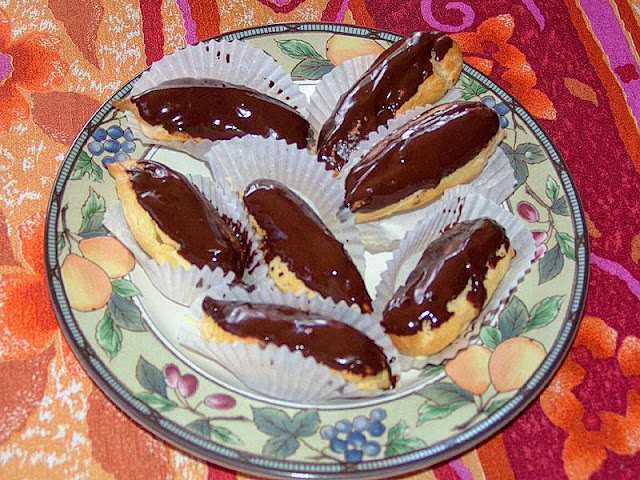
I placed them onto opened cupcake liners on a platter, and they were ready to serve.

Here's the slideshow, which illustrates the entire process in simplified form.
All photos by Geni Certain, copyright 2009.

Addendum
I just found an interesting discussion of the origins of pate a choux, on Chowhound.com


A Taste of Capula


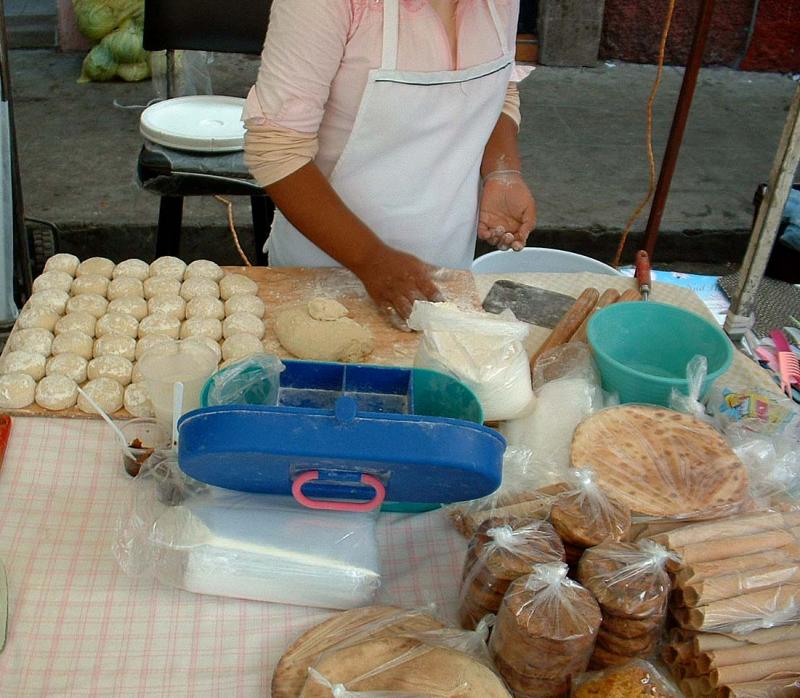
We went today with two friends to Capula, Michoacán, where we bought pottery items. In the town itself, we sampled some "pan corriente" (regular, common bread, but hardly common to us.) We snacked on some good examples of pan hojaldre in its various forms.

It was Míercoles de las Cenizas, and fresh fish was sold around the Plaza.
But we weren't prepared to buy any to take home, so we sought lunch elsewhere.


First, we went "fishing", but caught nothing.
On the way back toward Quiroga, we first stopped to check out a fine looking new restaurant, next to an even finer, yellow house, at El Puerto. That was "Mariscos El Puerto". It has been in business for about a year, but because we seldom travel that route, we were unaware of it. The stentorian owner was sweeping out the dining room, just getting ready to open. We looked over the fairly limited menu, and decided that, under the circumstances, we would eat elsewhere, but were willing to try Mariscos El Puerto another day.


The next place is no turkey.
Not too far down the road to Quiroga, we saw the more down-home-type roadside eatery, "El Jacalito de Los Pavos", also known as "Los Pavos". The first name means something like "The Turkey Hut or Coop." As soon as it came into view, I exclaimed, "This is my kind of place!"


We went into the cool, dim interior and were surprised by the ample space and seating there. It seemed a likely stop for tour buses, and when I asked, I was told that is indeed the case.

The baños are out the back door and down some stairs. They were nice looking, from the glance I made and there was a shared hand washing sink, with a bar of soap and improvised paper towels, similar to that purplish-gray paper on which tacos are served.

I sneaked a glance into the back kitchen. It's clean and well organized.

There was no comida corrida available, but the a la carte menu was moderately priced. Turkey was not available except on Sundays. So, no turkey for us! Out back, the unaware turkeys were foraging for their food.

Our selections were:
  • Costillas asadas de res, an ample, if rather chewy blade steak. It came with a bowl of nice frijoles de olla.
  • Mole de Pollo, con sopa seca de arroz. Standard, but decent mole. Chicken was a bit resistant to the fork, too.
  • Enchiladas Suizas; extremely rich chicken enchiladas in salsa verde, covered with melting white cheese and generous lashings of crema. No beans nor rice.
  • Bisteces a la Mexicana, good, homey version of Mexican Pepper Steak: diced onion, tomatoes and mild chiles.
There was a bowl of a very good dark salsa based on chile pasilla and/or negro and tomatillos. There was another bowl of coarsely cut salsa fresca of tomatoes, onions, and chiles manzanos. It was tasty but less picante than the other. (Less interestingly, it had no cilantro in it.)

La cuenta was $220 pesos. That included a jarra de limonada and a Fresca sabor toronja. Propina extra.

I've uploaded some photos of both restaurants, starting here at Mariscos El Puerto.

Update: I regret to report that three of our group who ate at Los Pavos got sick in varying intensities. The illness (traveler's diarrhea or vomiting) manifested itself the next day and grew worse for two of the group last night. This is circumstantial evidence, but the common factor seems to have been the limonada. I, who had the Fresca instead of the limonada, have had no illness.

All three have now recovered at least partially.

Monday, February 23, 2009

Redefining Mexican Cuisine

I was leafing through my tattered edition of The Joy of Cooking, when I found a strange entry for Mexican Tomato Sauce.

The writers preface it by stating:
"Just what you might expect. You will feel hot inside, down to your toes."
Back then, "Mexican" food must have been defined as "HOT!", without regard to race, creed, color or national origin.

For your culinary interest, I have written the ingredients below;
  • Canned tomatoes or fresh
  • Chili Sauce
  • Prepared Mustard
  • Grated or prepared Horseradish
  • sugar, salt, pepper, cayenne
  • Curry Powder (!)
  • Vinegar
  • Onion Juice (WTF is Onion Juice, and how do you squeeze it out?)
  • Garlic
I think this sauce would be perfect for a quesadilla made in a Santa Fe Quesadilla Maker. (My choice for poster child for the Unnecessary Kitchen Gadgets of the World.)


In the words of the immortal Don Anónimo:
"Cada Loco Con Su Tema."

Monday, February 16, 2009

Eating Our Way From NOLA to NAPOLI in One Day


Our days are full, and so are we. Yesterday was an unusual, but enjoyable example.

In the late morning, were treated by our neighbors, Geni and Larry to a lavish brunch, New Orleans style. There were pungent Bloody Marys, warm French Bread and butter; fresh strawberries and cream. Then, rich Eggs Sardou, dark roast coffee, and optional Mimosas. We agreed that the beautiful, fruit topped Pastel de Tres Leches would be best if we ate it much later in the day.

We wobbled the short distance home, where we took a necessary nap. After, we prepared a late lunch for Geni and Larry and two visitors, Didi and Barb. I made two large pizzas and Susan made guacamole and a salad. Didi brought a beautiful fruit bowl, and then, just barely, we all had some Pastel de Tres Leches.

I enjoy making pizzas with offbeat toppings. I had some daikon radish tops left from making radish kimchee. I simmered these with some salt and a little onion. Squeezed dry, the greens (really a sort of giant turnip
greens) became a topping for a half pizza, perked up with blobs of creamy requesón (ricotta) cheese, crisp bacon pieces and sliced chile serrano.
The other half was good old pepperoni plus sliced fresh onion.


I found the recipe for a pizza with greens and ricotta on the Oprah website! I don't like cornmeal crust, so I just made my regular dough. I also subbed fresh, seeded and deveined chile serrano for the red pepper flakes.

Our other pizza was totally dedicated to vegetables. It had sliced sweet red and yellow peppers, onion, mushrooms (canned), capers and Kalamata plus jumbo green olives.

I was unhappy with the crust, which wouldn't brown nicely as it used to. I do use 16 inch diameter perforated pans, and I had the oven up to 435º F.
I think that next time I'll add a tablespoon or two of powdered milk, to assist browning. I have in the past tried a pizzza baking stone, with poor results. They are also a lot of hassle and limit you to baking one pie at a time.

Next post "Weird pizza toppings I have made and loved."
Here are some favorite pizzas of the past.

I'm about to have a light snack of a couple of wedges.

Sunday, February 08, 2009

"Don't Forget The Cannoli"


There's a famous line from the movie, "The Godfather", a set-up for the punchline, "Leave the gun, take the cannoli".

I promised cannoli and I didn't forget my promise.
But I'm not here this morning to discuss nuances of classic films. I didn't want to neglect cannoli after mentioning them in my post, "Melanzana alla Michoacana." My cannoli are cannoli para flojeros (slackers).

I was introduced to cannoli at an early age in my childhood in Brooklyn, NY. They became my second most favorite pastry after chocolate covered, custard filled eclairs*. The photo above shows "real" cannoli
.

Wikipedia.org says:
Cannoli, (plural) in Sicilian, are Sicilian pastry desserts. The singular is cannolo, meaning “little tube”, with the etymology stemming from the Latin "canna", or reed. Cannoli originated in Sicily and are an essential part of Sicilian cuisine. They are also popular in Italian American cuisine and in America are known as a general Italian pastry, while they are specifically Sicilian in origin.

Cannoli consist of tube-shaped shells of fried pastry dough, filled with a sweet, creamy filling usually containing ricotta cheese (or alternatively, but less traditionally, sweetened Mascarpone) blended with some combination of vanilla, chocolate, pistachio, Marsala wine, rosewater or other flavorings. Some chefs add chopped succade or chocolate chips. They range in size from "cannulicchi", no bigger than a finger, to the fist-sized proportions typically found in Piana degli Albanesi, south of Palermo, Sicily. Sometimes cannoli can be found with the shells dipped in chocolate, in addition to being stuffed with filling.

But we don't live in Sicily, nor even Brooklyn. If we want cannoli, we'll have to make them ourselves. Susan and I have some experience at that. We even have the metal forms for frying the tubes. But being retired (lazy), I skipped the laborious parts and bought some ready made pastry tubes. They are called "tostadas de nata". Some are flat wafers and others are rolled into crisp tubes, (lower right) somewhat narrower and more delicate than a true cannolo tube, but, as we say, "It works for me."
(Thanks to Esperanza, Mexican Kitchen Forum Moderator on Mexconnect.com for the correct terminology.)

If you want a serious, more authentic cannoli recipe and technique, I suggest looking at Il Mezzogiorno Cucina Siciliana

The tubular challenge solved, we could then deal with the filling. Ricotta cheese is not widely available in Pátzcuaro or Morelia. However, requesón, which is closely related to ricotta, is. At Mega Comercial in Morelia, I bought a couple of small containers of Cremería Aguascalientes Requesón. This is a very finely textured version of requesón.

Using only one small container, I added about a third of a bar of Philly Cream Cheese. With an electric hand mixer, I broke up the cheeses, then gradually whipped in about 1/3-1/2 cup of powdered sugar and a good dash of ground cinnamon. I continued whipping until it was very smooth; then added a few drops of orange liqueur (Controy), and folded in with a spatula a teaspoon or so of minced preserved orange peel and a a little preserved citron. (Acitrón).

Next, I finely chopped a tablet of Mayordomo Chocolate con Canela, a total of about 2 tablespoons, and folded it in. You can use semi-sweet chocolate or even mini chocolate chips.

At serving time (being particularly lazy), I spread the cannoli filling on the wafer type tostadas de nata, then heaped each with a big handful of well washed and drained, plump zarzamoras** (blackberries). A light dusting of powdered sugar finished it easily and attractively. Serves 4 or 5.

I still have the tubular tostadas de nata and a container of requesón. Once I rig up a pastry bag for filling the tubes, we'll have Michoacán cannoli.


*Eclairs. Our dear friend and neighbor, Geni, (who makes the best Key Lime Pie ever.***) would like to learn how to make eclairs. When we recover from a series of lavish home dinners here, we may do a lesson and a tasting.

**Zarzamoras. Some, small and very expensive, come from Oregon. Others, less expensive, larger and plumper, are grown locally. They are available in January. This is a miracle of climate. I last paid $20 MXP a kilo. Lástima, we weren't able to eat them all before they molded.

***Key Lime Pie: yesterday's Key Lime Pie by Geni was lighter and fluffier in texture than usual. She whipped the egg yolks for 5 minutes before adding the rest of the ingredients. The individual slices were garnished with plump strawberries. (Available most of the year at low prices, about $15 MXP a kilo.

Now, as an added Nostalgia Bonus, this 2 minute plus clip from "The Godfather". (Offscreen violence)

Tuesday, February 03, 2009

Melanzana alla Michoacana


I think of all the cuisines of the world that I've tried, I like best that of Italy. Fortunately, with a bit of flexibility, appropriate ingredients can be found here in Michoacán.

Yesterday, we had our two neighbors to comida. They'd just returned from a long weekend in Mexico City.

I decided that an Italian meal would be suitable to welcome them home. The menu we decided on began with a mixed salad with bocconcini (cheese marinated in herbed olive oil); eggplant parmigiana, a simple, fusilli or rigatoni pasta, and a variation on the theme of Sicilian cannoli, with fresh, local blackberries.

Most Thursdays, and sometimes other days, we can get eggplants in the Pátzcuaro mercado, at the vegetable stand of Familia los Padilla. They also have nice basil, sweet peppers in various colors, and other specialty vegetables.

The bocconcini were based on a recipe from Joyce Goldstein's Mediterranean Cooking, with the addition of sun dried tomatoes and Kalamata olives. To make it, a cup of olive oil is gently warmed. Oregano, a bit of red chile, black pepper, crushed garlic and salt are briefly infused in the oil. When cool, it's poured over a pound of small cubes of mozzarella. I used a package of little balls of cheese from Cremería Aguascalientes. They weren't as soft and mellow as real, fresh mozzarella balls, but they were adequate. The cheese is left to marinate several hours at room temperature.

The salad itself had romaine lettuce, sweet red and yellow peppers, seeded chopped cucumber and vine tomatoes (purchased at Costco. These are really the best tasting tomatoes I've yet found in Mexico. Amazingly, they are grown in Ontario!)

The Melanzana alla Parmigiana was based on a simple recipe by Marcella Hazan. I sliced three medium eggplants about 1/2 inch thick. Unlike the Hazan recipe, I didn't peel them. The slices are salted and left to stand upright at least 30 minutes.

Meanwhile, I prepared the sauce. Two cans of S&W sliced Italian Style tomatoes (from Costco) were drained. I then coarsely chopped them in the food processor.

Next, about 1/2 cup of chopped onions and 2 cloves of garlic, were sauteed in some of the oil, over low heat in a large, wide pot. As they began to turn golden, I put in the chopped tomatoes, These were cooked briefly and
I added 1 can of Cidacos brand Spanish ground tomatoes. (Superama or Wal-Mart in Morelia). This was seasoned with a little salt, some Asian fish sauce (could have added some finely minced anchovies, but I didn't want to open a can); hot Spanish paprika and a squirt of red wine vinegar.

After cooking on a low flame some 20 minutes, I then added chopped fresh basil (from los Padilla) and a good pinch of Mexican oregano. The tastings indicated a couple of tablespoons of sugar would be a good addition.
I like to make extra Italian tomato sauce to freeze, but we used all but two cups of this batch.

Meanwhile, back at the eggplant: the slices were patted dry on paper towels, and fried of medium-high heat in a mixture of extra virgin olive oil and canola oil; turning once when brown on the underside. It was necessary to do this in two batches.
As they emerged from the frying pan, they were again blotted on paper towels.

Asssembly: in a 12 inch diameter pottery casserole, I put a single layer of fried eggplant, followed by a thorough covering of tomato sauce.
That was followed by a generous shower of coarsely shredded mozzarella, and a couple of tablespons of Queso Reggianito. (A Latin American facsimile of Parmigiano Reggiano, but much less expensive. At Costco.)

Repeated with a second layer of eggplant, sauce, and finishing wih cheeses.
This goes into a 400ºF oven for 20 minutes, at which time any surplus liquid is spooned off. Then returned to oven for another 15 minutes.

Meanwhile, a large pot of well salted water was brought to a boil, and approximately 300 grams of short pasta
added (in this instance, Barilla Fusilli. Costco, Wal-Mart and other stores.)

Back to the salad: when it was attractively assembled by Susan in a large, wooden salad bowl, I drained the bocconcini and placed them atop the salad.

With some of the marinade, I added enough red wine vinegar to make a vinaigrette dressing, correcting the seasoning.

Nostra Melanzana alla Michoacana was luscious. I'm having an eggplant sandwich for breakfast. It won't be as richly lush as this one, but it will be enough.


We had a loaf or two of Mercado Soriana Panadería's sesame Baguet. I think it was 6 pesos a loaf.
With this meal, we drank water and glasses of our everyday vino tinto, Concha y Toro Seleccíon Cabernet Sauvignon-Merlot blend. Costco, 6 bottles for $299 pesos.

Dessert details will have to be the subject of a separate post.

Images from Internet sources.