Tuesday, June 23, 2009

More On the Cecina Scene

I posted a link to this blog on the Any port in a storm forum, and got some feedback from Oaxaca area resident. "Bixaorellana"


Nicely done report, DonC, although I've got some quibbles. One is that the pork version of cecina is not semi-dried. As a matter of fact, it's quite common to order it and wait for the butcher to make it from a solid piece of pork right in front of you. And the two versions are cecina blanca -- simply salted, and cecina enchilada. The cecina enchilada is smeared not with chile molida (ground dried chile), but with a paste of ground chile guajillo, garlic, oregano, vinegar, salt & maybe some secret ingredients. Each meat stall has its own recipe.

Ditto the beef tasajo (no accent on the o!). When you ask for tasajo, it's fresh beef, although dried versions are usually hanging over the display area. I need to find out if they're called tasajo as well. It's always simply dressed with salt around here -- no enchilada version.
Mexican food is so very regional, however, (note the disparity between what's cecina here & what's tasajo) that maybe cecina in other parts of the country is always semi-dried.
You are totally correct in your response to the reader who questioned the red flag. That misguided person must think that all the meat he buys in the supermarket is truly "fresh".
And more:

Food in Oaxaca is frequently over-salted. When I first moved here, I thought I'd never be able to eat out, as so often the food seemed ruined with too much salt.
Cecina and tasajo don't have to be too salty. Since meat cutters (who are very frequently women around here) are quite willing to make it for you on the spot, you could request it with no salt at all.
If you wanted to try it, you could have your local meat cutter thinly butterfly something like a piece of top sirloin. Take that home & lightly salt it yourself. Let it set at least a half hour, then cook it in a very hot, lightly oiled skillet. For pork, something like boneless loin would do the trick. It's very good with some kind of light salsa added at the table -- try fresh minced chiles, minced or crushed garlic, lime juice and cilantro.
I can't vouch for this recipe as I've not tried it, but it looks like a pretty good guide if you want to try the spiced pork cecina. As I point out above, there's no reason to bother with the drying process.
I appreciate the authoritative input from our friend, Bixa.
Over the weekend, Doña Cuevas and I visited Guanajuato. Rachel Laudan had given me a lead on a restaurante campestre, "La Cabaña de Lolita", at Puerto Barrientos, a few kilometers from Santa Rosa.

Three of us sampled their crispy cecina, as part of a more extensive meal. It was delicious yet even less substantial than the usual kind, cut more thickly.
Here's a look:


Update:
I found a photo I took in January of plated cecina enchilada, at Restaurante María Bonita, in Oaxaca.
Nice, but it doesn't have the rustic character of that at La Cabaña de Lolita.

Friday, June 19, 2009

Cecina: Worth Its Salt

  Cecina is thinly sliced, salted and partially dried sheets or strips of beef or pork. The technique for making it requires an extremely sharp knife and considerable skill and patience. A largish piece of boneless beef of beef is turned into a continuous roll of thin slices by deft cutting, back and forth, within the mass of muscle.

It's much simpler to go to a specialist who'll make it for you. Remember, a little piece goes far to satisfy your need for both protein, and salt, for that matter.

I've had it, both in the United States and in different parts of Mexico. Some (at a Mexican restaurant in Little Rock, Arkansas) it was so tough that it was impossible to chew. Even 4 hours of slow simmering at home rendered it barely masticable.


But cecina varies.

In Chihuahua city, in 1990, we entered a small shop selling everything needed to make antojitos Mexicanos: dried chiles, hojas de maíz para tamales, masa fresca, maíz pozolero preparado. They also served platillos típicos del Distrito Federal. The owner, Ramón, was from el DF and Edomex. One platillo offered was cecina enchilada. Although the hour was late, and the owner was reparing to close, he cooked a slab of cecina enchilada for me, and heated up a bowl of first rate pozole for Susan.

When the cecina arrived, I was a little surprised: it was like a large, thin, boneless steak. I had misunderstood and had been thinking of "enchiladas": corn tortillas dipped in a thin chile sauce, lightly fried, with a filling.

This was different. Pura carne, lightly coated with chile molido. It was pleasantly salty and mildly picante, chewy but doable. I'd rate it a "9" on the Chewy but Doable Decimal Scale.

Some years later, while in Oaxaca, we had tasajo, the Oaxacan version of cecina, often served in small pieces on tlayudas, (extra grande tortillas), smeared with a paste of frijoles negros, and nicely garnished with onions, avocado, tomato and quesillo, or Oaxacan string cheese. One is a meal.


Oaxaca goes its own separate way in la comida regional. There, "cecina" refers to sheets of semi dried pork, often with a sprinkling of chile molido. Tasajo is made from beef. This section of the Mercado 11 de noviembre, in Oaxaca Centro, specializes in grilled tasajo and cecina. It looks like a scene from Hell, but it smells great.


Here's a picture of a tlayuda con tasajo.

Tasajo Tlayuda in a Fonda Oaxaqueña

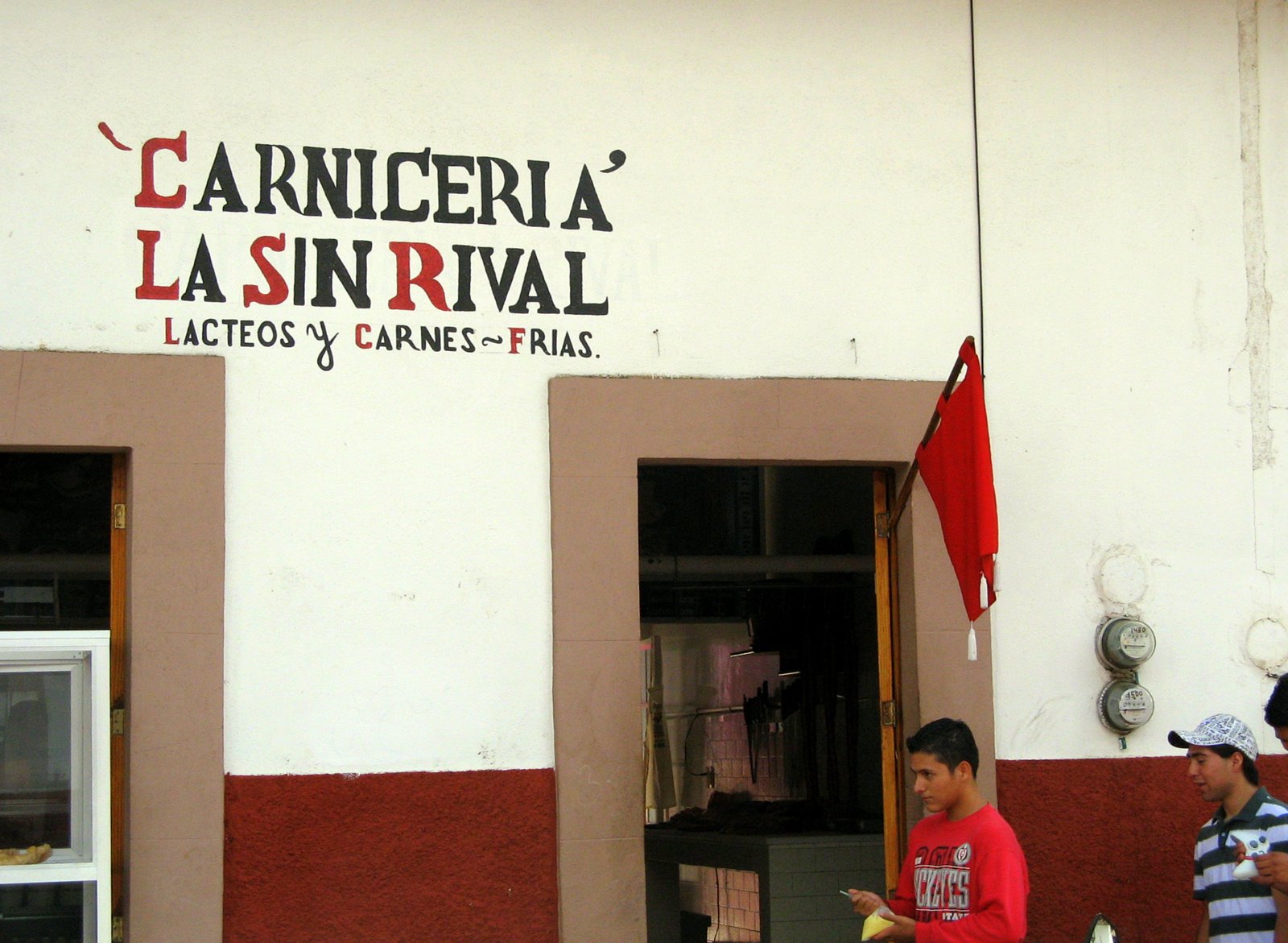
Last week, I saw that one of our favorite Pátzcuaro carnicerías, La Sin Rival, had some strips of cecina on top of the counter. I asked the hard working owner, Sr. Moíses Pérez H. about it. He guided me to some that was drier, for not long ago, at another carnicería, I'd bought some that spoiled. The fault was mine, for leaving it in the plastic bag without refrigeration. Not all cecina attains the dryness of carne seca, otherwise known as jerky.

Red flag means "Fresh meat today"

The cecina from La Sin Rival fared better. It became breakfast a few mornings later. I lightly oiled a skillet, and browned the meat on both sides. Meanwhile, I fried some huevos estrellados. These were flanked by a steaming mound of stone ground speckled grits from Nora Mill, Helen GA. Add some salsa casera of your choice, and you're all set. It's my Mexican version of a Good 'Ol Boy breakfast down South; the cecina a perfect stand-in for salty, aged Country Ham.

A couple of days  later, I lucked out when carrying my camera while in Pátzcuaro Centro. I went to La Sin Rival with hopes of photographing some cecina. Sr. Pérez told me that none was available until later, as it was drying at that moment, in the patio of the family house. 

He generously allowed me to pass through the work area of the carnicería to the pleasant patio where a large slab of plywood held sheets of meat drying in the sun.

Cecina drying in the sun

The carnicero and his assistant apply vegetable oil to keep flies from alighting.

Applying a light coat of vegetable oil


Sr. Moises with some dried cecina

I asked if any jugo de limón was used in the process, as I'd read in an old Mexican food cookbook.
"No Señor, solamente sal y un poco de aceite.", he replied.*

I recommend trying cecina when you have the chance. Just be sure to get it from a reliable shop like La Sin Rival in Pátzcuaro. (But, if you are less adventuresome, get una Hamburguesa Doble, como te gusta, at the Cafetería Chió's next door. Sr. Pérez wife runs the tidy little lonchería, and makes some of the best, juiciest hamburgers in Pátzcuaro.)

Soon, we hope to sample some at a Santa Rosa, Guanajuato Restaurant, "La Cabana de la Lolita", recommended to us by Rachel Laudan, food scholar living in Guanajuato, as serving "Incredible cecina."

I hope to report back soon with my findings.

*I have the theory that all too often, American writers on Mexican food make overly complicated, overly elaborated versions of some simple, uncomplicated food. We could discuss the example of carnitas, but not here at this time. Remind me later.


Wednesday, June 17, 2009

Camarones a la Mandarina o Naranja

   
   Our comida yesterday was a big deal. The day before I'd bought 500 grams of headless shirmp in the shell. I have had this idea of Camarones a la Mandarina for sometime.

I got out an old Chinese cookbook by Virginia Lee and Craig Claiborne. It's notable for its excess in seasoning. I found a recipe for Szechwan Shrimp, which was my anchor.

The night before I put some dried tangerine peels to soak in some Cien Años Tequila (lacking Absolut Mandarin).
Today, I slowly dissolved a big cone of piloncillo (crude brown sugar) in simmering water, and reduced it to a molasses like syrup.

Meanwhile, I shelled and deveined the shrimp, trying to keep the tails. That was only partially successful. It was also tedious.

I put the shrimp in a small bowl and sprinkled on some tangerine peel-Tequila infusion. Some Controy Orange Liqueur figured somewhere in here also.

Separately, I peeled my last remaining ginger root, shredded it as well as some garlic and 3 or 4 very picante yellow Chiles Piquines (as defined in Michoacán terms).

Next, I peeled and julienned one stubby carrot and about 1/3 of a large, sweet red pepper. Celery, cut small. Then one white onion, cut vertically into segments. (Supposed to be green onions—scallions— with the tops, but I didn't have any.)

A sauce was mixed in a small bowl of light and dark soy sauces, red wine vinegar, brown sugar, plus some Tuong Cu Da, to substitute for the Fermented Rice I didn't have. I figured some Sichaun (modern spelling) Pepper would go well, so I ground up a little and sifted it through a tea strainer, to avoid those hard little pieces. There was sesame oil in the sauce and on the shrimp with the Mandarin infusion. Black pepper also.


I also used some of the macerated mandarin peel and shredded it finely to add to the ginger, garlic and chiles.

Method:
First I stir fried the carrots, celery, onions, and removed them from the pan.

Then I stir fried the shrimp, adding the chiles, ginger, etc. There was an eye and sinus-searing blast of strong chile fumes.

As the shrimp became opaque, I tossed in the soy sauce mixture. Next, a small amount of that reduced piloncillo syrup. Then the cornstarch-water suspension, which I failed to mention earlier. It took a moment to thicken.

I tasted it: too sweet. More vinegar to perfect it.

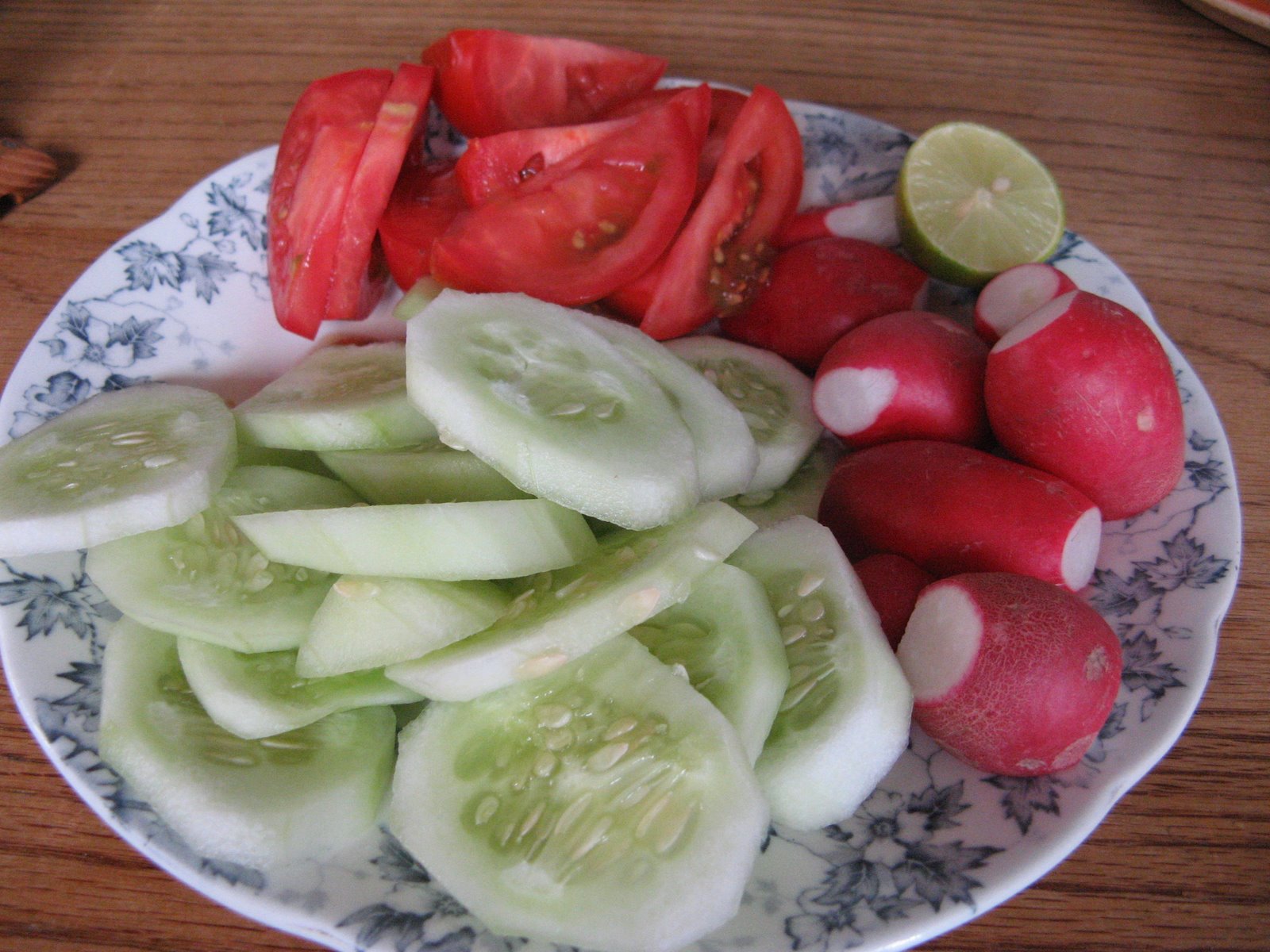
I garnished it with a small thicket of very nice cilantro leaves, and we ate it with our Basmati Rice, green beans, etc; and a plate of sliced cucumbers, radishes, a tomato and the rest of the cilantro.


With this meal, I paired a lovely, red Agua de Jamaica, Mexico, 2009; which exhibited subtle floral notes that were underscored by its native acidity. I had to drink a lot of it, but really, the picante aspect of the main dish was less assertive than expected.


Sunday, June 14, 2009

On Eating Cocteles de Mariscos


A friend emailed me regarding shrimp cocktails as sold at MEGA Comercial in Morelia. You get them in the Fish Department, preferably earlier in the day.

Until now, I was unaware that Mega offered such. Somehow, it just doesn't seem quite right to eat a coctel de camarones in that setting. Coctelería should be left to the specialists, not a mega hypermart chain. This is the same, "full service" store that among its notable features is an espresso bar, but one that is rarely staffed. To get a coffee, you have to flag down the Produce Manager or whatever employees nearby and they'll hail some especialista callow teenager barista to put the coffee pod into the machine and push the BREW button.
My friend asked, in a followup:
"Now then, about those stands at Plaza Chica (Pátzcuaro) that you seem to regularly 'never frequent'???"

Yes; what about them? I don't eat at those out of concerns of hygiene. Friends who've eaten at those open air carts, with the blocks of ice, (passed on by Canine Inspection Teams as the blocks lay waiting in the early morning gutter) have reported no ill effects. But I'd rather spend a little more for assuring quality and good hygiene. Chopping onions or tomatoes on a wooden board perched on an upturned catsup bucket, resting in the street, as traffic sputters by within arm's reach doesn't cut it for me.
In 2004, within the Mercado Independencia in Morelia, I ordered a coctel de camarones. I waited and watched while the guy defrosted the plastic bag of shrimp under running tap water. It was a passable, but not great CdC. What do you expect for breakfast at a stand overlooking the skinned cow's heads over at the carnicería close by? I'll spare you the foto de las cabezas de vacas.
A couple of years ago, I had a small, cheap CdC at Don Prisci's within the Pátzcuaro Mercado. It was poor; the shrimp were mealy, the sauce corriente. Don P should stick to his birria.

The first coctel de camarones I ever, ever had was the Gulf Coast village of Nautla, Veracruz. It was our first trip to Mexico, Feb, 1980. The air was warm and sultry, under the palms. A borracho entertained himself by mildly bugging us.

The coctel arrived; a very tall glass, brimming with very fresh, barely cooked shrimp, in a light red, not too sweet sauce, studded with fresh, picante bits of chopped chile jalapeño, minced onion, and LOTS of chopped cilantro. This was El Chingón Coctel de Camarones, one which will always be that against all others are measured.

The restroom was, unfortunately, quite memorably ghastly.

Nowadays, at least here in central Michoacán, cocteles are made too sweet for our taste. Even at our querido y lindo Mariscos La Güera. The trick is to ask for it as you like. "Poco catsup, pero con mucho cilantro, por favor."

The one exception, so far, to sweet cocteles has been at LangoStiko's in Morelia. They offer specialty cocteles including a Coctel Mazatleco style, made with NO CATSUP but with pepino and pineapple, and garnished with carambola. (starfruit.)


Actually, it's almost too pure for me. I'd appreciate the addition of some cilantro.

The same restaurant, and by no means, the only one, makes Micheladas Preparadas con Clamato and shrimp and oysters in it. Very tempting, but as I don't eat raw mollusca while in Mexico, I ordered it with shrimp only. (Michelada is basically beer with lime juice in a salt rimmed glass. Starting there, many different seasonings and variations are possible.)

We are lucky to have decent seafood inland here in Michoacán. Years ago, in Zacatecas, inland, far from the sea, I had a coctel at Mariscos Boca del Río, at the Plazuela Genaro Codina. It was murky and borderline hazardous. I hope that it's better there now.

La Jaiba, on Blvd. Garcia de León in Morelia has amongs its offerings huge chabelas (large goblets) full of Vuelve a la Vida (occasionally called "Levantamuertos"), either of which seem to have some sexual revival connotations. The La Jaiba version has just about every kind of boiled and raw seafood in it that they have. I had the oysterless version once. It was quite good, but lacking the oysters, I can't report on the sexual revival aspects.


Similarly, the "Viagra" coctel at El Pescador, Morelia. It's something like a Vuelve a la Vida coctel but in Clamato instead of the usual clear syrup-stock and catsup. Here is the Vuelve a La Vida under an alternative name of "Rompe Colchón": "Break Mattress". You figure it out. Here's a recipe, in Spanish, for this treat.


To conclude; in my opinion, you generally get what you pay for. In the better marisquerías, you can customize your cocktail al gusto. It helps to speak Spanish.

As a reward for staying the course until this point, our Feature Presentation of Pátzcuaro's beloved Mariscos La Güera, below.

Saturday, June 13, 2009

Chicken Hash: An Improvisation

Leftovers? What to do.

I had some leftover, boneless poached chicken, some sliced, boiled potatoes, celery, onion and a lot of seasonings and condiments. And some Granny Smith apples.

The chicken, although less than two cups in all, needed to be used, soon.

Solution: Chicken Hash.


I found a nice recipe on Epicurious.com, but I didn't have more than a cup and a half of chicken and no green pepper. So, instead of green pepper, I used green, Granny Smith apple, diced.

The rest was easy. Instead of chile powder, I used Pimentón Español Picante and Pimentón de la Vera Agri-dulce. I did have branch thyme.

Instead of cream or half and half, I used Crema Aguascalientes, an excellent brand.

Here, a pic of it cooking:


Here's a picture of the finished, plated dish:


A question arose on the forum, "Any Port In A Storm".
"Don C....how do you cook the eggs like that?"
The answer was, "I spray some custard cups with non-stick food spray. I get a small round sauce pan going with simmering water. I crack one egg each into the custard cups, and immerse them up to their midlines. Then I partially cover the pan and lower the heat.
Despite the PAM spray, the eggs wouldn't slip out easily, so we just spooned them out of the cups."

We did have the requisite whole grain toast; some oatmeal and bulgur bread I'd made, which toasted up beautifully. The Chicken Hash was a hearty, brunch dish, and it sustained us until 4 o'clock in the afternoon.

Bodega Aurrerá Pátzcuaro Opens

No Frills, and No Thrills, Either

We went today, June 13, 2009, to the newly opened Bodega Aurrerá in Pátzcuaro, after the opening day crowds had subsided. Getting in and out was easy, as long as you are headed up the Libramiento. It's a good location for those living north of the city center.

We arrived at about 11:00 a.m. and it was only moderately busy. The inflatable jump-up-and-down-and-scream games had been deflated and taken away after Tuesday's uproarious opening.

I'm please that the building is relatively attractive, and the paint job is o.k., although the earlier, adobe color was more attractive. (Another, well-known, local blogger, told me that the city made them repaint it to approximate Pátzcuaro traditional colors.)

The publicity campaign had been intense, as sound trucks carted persons costumed as "Mamá Lucha", the indomitable Aurrerá super heroine about the city. Even distant ranchos were visited by publicity trucks bringing a little excitement to la vida cotidiana.

The real life store is fine for what it is, but it has few thrills to anyone seeking specialty foods ("gringo necessities"). Mamá Lucha has fought hard to bring you precios bajos, and that's what it's all about.

Parking seems limited, but probably adequate.
The store has that enjoyable "new store" smell of fresh paint.

It's essentially a stripped-down Wal-Mart, a warehouse look, bare cinder block walls, exposed girders; without flash or decor, focusing on low prices in a no frills environment. Our brief reconnaissance shows a very limited selection of brands and varieties in many categories. There are lots of options in the rice and dried beans department, and in Tequila ready-to-drink. No Controy, pero sí, (ugh!) Margarita Mix.


At least one item was represented only by the house brand.

On the bottled salsas shelf, I couldn't find either Salsa Huichol nor Salsas Cosecha Purhépecha. It was mostly Valentina and La Costeña.

One brand of agua, Santorini, in big garrafones.


The carnicería is small and seems to have a very limited selection, but that could be my (possibly erroneous) impression. Surprisingly, two women were working in the carnicería. I didn't see any men. This seems a little unusual in Mexico.

Huevos, rojos or blancos, I think are higher than in the tienda de abarrotes where we usually shop for them. At Bodega, over $30 for 18. At Abarrotes Los Fresnos, I think they are less. I recall paying $27 for 18 at Soriana, but it's been a while.


The produce was above average, and a wider selection for a supermercado. We got some nice looking and smelling nectarines, pears and firm, not overmatured smaller cucumbers.

I didn't look in detail at the panadería, but it reminded me of Soriana's, perhaps a little smaller.

This is a store for staple items and very few, if any imported luxuries. The deli was pushing those pale pink hot dogs and bland cheeses so beloved in Mexico. Not a Chorizo Español or Jamón Serrano to be seen.
The meat department, surprisingly, not the Deli, had some cooked pork ribs in barbecue sauce in a hot case.


The checkouts are narrower than Soriana's. Overall, though, the store's aisles are better arranged, with only two racks of shelves per aisle. Better than Soriana, it's easy to get to the checkout without threading the maze of clothing racks and other merchandise obstructing your way.


There is no snack bar, no cafetería, no kiddie rides, no ATM, as far as I could see. iPod Shuffles and iPod Classics in Electrónica, but no iPod Touches. They don't offer to cook your meat purchase for free. There are also no "Savings Cards", which suits me.

These are my first time impressions, and they may change on future visits.

Wednesday, June 10, 2009

Stretching the Strudel


Baking Madness may strike at any time. Back in March, I had a powerful urge to make a strudel. On of the motivators was that we have in our dining room a round table capable of seating six diners comfortably. This is just what strudel stretching calls for. You need to be able to walk the perimeter in order to evenly hand stretch the dough.

The ingredients for strudel dough are few and simple: bread flour, warm water, vegetable oil, eggs, salt and possibly a small amount of vinegar or lemon juice.

The ingredients are mixed, then the resulting mass is vigorously kneaded; either by hand or machine. Ten minutes of heavy handed dough slapping is considered normal and not excessive. But a Kitchen Aid stand mixer, or a heavy duty food processor makes short work of it.

After kneading, the dough rests under cover for 20 minutes to an hour.

Meanwhile, the table is prepared by first placing protective plastic sheets down and thumbtacking them into place. Then a patterned tablecloth or bed sheet is placed over the plastic. The pattern is useful to determine how this you've stretched the now nearly transparent dough.

While the dough rests, the filling is readied, cinnamon sugar is mixed, and toasted bread crumbs prepared.

The rest of this semi tutorial will be in slide show format. If you click the slide show window, you will be taken to a web album of the photos.
(This post was backdated to synch it with the actual event occurence. It was then updated on June 9, 2009. In other words, a reprise.)


Thursday, June 04, 2009

El Pescador, Morelia

Our favorite food when eating out is seafood, and it's good to try someplace new. Rose Calderone recommended El Pescador, at Cuautla # 77, Centro, Morelia. It's down at the western end of Avenida Madero where it goes into a tree-lined area, then about a block south on Cuautla.

I was pleasantly surprised to see such an attractive dining room. Some of the places we frequent around Sanabria, a tiny crossroads north of Tzurumútaro,  populated by 3 roadside fish shacks. El Pescador has one of the nicest dining rooms of the various marisquerías we've tried, with prices to match. When I looked at their website, Mariscos El Pescador , I saw that there's a simpler, upstairs dining room as well.

The menu is compact yet covers a lot of ground. The entradas include the usual tostadas and more. (Sorry, I wasn't taking notes. That means I'll have to return and try more dishes.)  I had a tostada de marlyn (their spelling) and Larry had one of calamar. The marlyn was meatier than most that I've had elsewhere, and it was heaped upon the tostada in a way that sort of justified its price of $20 MN.

Susan ordered a Coctel mediano de Camarones y Pulpos, and it was about average, good, but not stellar.
I noted that one coctel was called "Viagra", a combination of callos, ostiones, camarones and some other shellfish, in a Clamato-tinged sauce. As I don't eat raw oysters in Mexico, I didn't try it. That's the only reason.

My three companions all ordered some form of filete de pescado. Larry's was the best looking, Filete dorado; lightly crumbed and cooked in a little oil.

Rose had her filete asado, which if I understod our waitress correctly, is grilled a la parilla. Susan had hers a la plancha, which is cooked one a flat top grill. It was simple but pleasant. She told me that as in most seafood places, the filete de pescado was bland and with a very soft texture. I speculate that the fish used is Blanco de Nilo, or Tilapia, which to me has very little character.

The plates of filetes were accompanied by arroz blanco and a finely chopped carrot salad with raisins, which Larry enjoyed but I thought was boring. Thus tastes vary.

For a main course, I went for the gusto, ordering a
mediano Huauchinango a la Veracruzana. Truthfully, it's not my top favorite way to prepare fish, but it's a classic, and serves as a test of the restaurant's kitchen. And, at $100MN, it was deal.

A pescado entero mediano turned out to be more than I could finish. The whole fish was heaped with tomatoes, onions, garlic, sweet peppers, olives (but no capers) and lots of chiles Jalapeños. In fact, it was the Huachinango a la Veracruzana más picante de siempre. The only accompaniment was a big scoop of plain white rice. It was welcome in toning down the "heat".

El Pescadors' version of pescado al al Veracruzana was pretty good, but was somewhat overwhelmed by the chiles. In addition, the flesh of the fish seemed very wet and cooked almost to the point of mushyness.

Their treatment was the polar opposite of that of La Güera, in Pátzcuaro, which was spartan to a fault, at least the only time I tried it a few years ago. The best Huachinango a la Veracruzana I've had in the region was at a marisquería on the outskirts of Ario de Rosales, of all places. Also, that at El Navegante, also in Morelia, on Blvd García de León was better than average.

In the end, it was a nice lunch, although a bit pricier than that to which we we are accustomed. With a Coke, a Michelada preparada, a half pitcher of horchata and a small bottled water, the cuenta was $541 MN, plus propina. 


After we paid la cuenta, we looked into the sparkling clean, tiled kitchen. One of the cooks, I could tell, was preparing crepes. We asked what they were for. They said that the crepes were used mostly in desserts, as in crepas con cajeta, but there was at least one dish, involving crepes filled with shrimp, but not on the printed menu.

PS: There's a more down market seafood place next door called "El Corsario". We don't know any more about it than that.

Tuesday, May 26, 2009

A Bellyful of Whole Belly Clams

Another greatly sought delicacy during our visit to the Northeastern U.S. was Fried Whole Belly Clams. Some of you, like us, may have sampled Fried Clam Strips, a dish that resembles short lengths of rubber bands and deriving most of its flavor from the breading and the accompanying Tartar Sauce. Think, "Howard Johnson's". I once worked in the kitchen at a Red Lobster (I'm still trying to compensate for those 9 months), and there, we cooked Clam Strips by dipping the end of a small plastic bag of preportioned, frozen clam strips into the hot fat of the deep fryer, releasing those wormlike morsels towards their final destiny.
Whole Belly Clams are a whole different dish.
(I'm suddenly curious why it's called Tartar Sauce or Sauce Tartare. I associated the Tartars as a tribe of horsemen who tenderized horsemeat by placing it under their saddles during vigorous, rollicking jaunts over the steppes. Thus, the possible origin of Tartar Steak.* They were also fond of koumiss, fermented mare's milk. (This is not an auspicious beginning culinarily.) The Mexican version of Tartar Steak is Carne Apache, a name which has some of the rough and wild associations of Steak Tartare. It's also a food I wil not eat, as served in its unrefrigerated and dubious form at street and mercado stalls. But, I digress.
Whole Belly Fried Clams are a New England Specialty. When I was growing up in and around New Haven, CT, we'd sometimes be treated to a fried seafood meal at the Clam Box at Branford(?), or even better, Jimmy's of Savin Rock, back when it was a parking lot and a stand, with long lines in the summer.

On this trip to Connecticut, we had two Whole Belly Clams ops. The first was at the excellent Maine Fish Market, in East Windsor, CT. Not to miss an opportunity, I started my meal with a shellfish platter of 6 icy clams and 6 oysters on the half shell. A Long Trail Ale was the perfect accompaniment.


After a small salad came a platter mounded with golden fried whole belly clams (WBC from here on.) There was a mountain of French fries and slaw as well.

(I'm sorry, but I don't have any photos of WBC at either restaurant! What must have I been doing? Eating. I'll Google a photo and put it in here.)

Thanks, I appreciate that.

The clams were excellent. In fact, I liked everything about the meal. well, maybe the Tartar Sauce wasn't great, but it was o.k.) I had to take about a third of the clams and half of the fries to our niece's home, where the next morning, I made a Connecticut version of Hangtown Fry. (Scrambled eggs, potatoes, fried WBCs.) More than you ever wanted to know about Hangtown Fry.

The second WBC op was at Skooter's Restaurant in Windsor Locks, CT. (Mentioned in a previous blog post under "Lord of the Rings".)


                            The Skooter's building


My wife had an order of clams only, a rather more modest portion, but very tasty and the right size for lunch, before boarding the Amtrak Vermonter train back to Newark, NJ.

This concludes our presentation for today.

Monday, May 25, 2009

Lord of the Rings

In my middle years, the 1970s, I was a Lord of the Rings. My job at King's Food Host, a fast food restaurant chain, first in an individual unit's kitchen, then in a large regional commissary stunk.

Or, rather, I stunk. After a day at work, my body and clothes reeked of onion juice.
One of my principal tasks was to prepare fresh onion rings. This was done by slicng off the ends of a 50 # or more bag(s) of onions, send them through a slicer, separating out the irregulars from the perfectas.
From the slicer the raw rings went to the breader. If the slicing stunk, breading was crummy.

The results were worth the tears and stink. The perfectly fried, golden rings were the crowning touch on many a Double Cheeseburger. These were, at least in my memory, the best OR's and the best hamburgers ever.
Since then, despite the smelly and often monotonous nature of the work, I've been big, if fussy fan of ORs.

Back in the U.S.A. for a 3 week visit, we had several opportunities to eat onion rings. The ranged from "good" to fantastic. All that was missing was "The World's Best Double Cheseburger", with its petite OR crown.


My first grab at the ring came at the Randolph Diner, in Randolph, NJ. My Mom ordered a magnificent plate of fried jumbo shrimp, that came with a generous portion of FFs and ORs, and a modest cup of slaw. She granted me on OR and I loved it.


Shrimp, FF and OR at Randolph Diner


My second chance was at the estimable Irving's Deli, Livingston, NJ.
It was a great meal with a half pastrami sandwich, a pretty good hot dog, some complimentary dill pickles, and a basket of really good ORs. They were nearly identical to those at the Randolph. I never would have thought of ORs to accompany a deli sandwich, but when the opportunity arises, you shold grab it.


ORs at Irving's. Who knew?


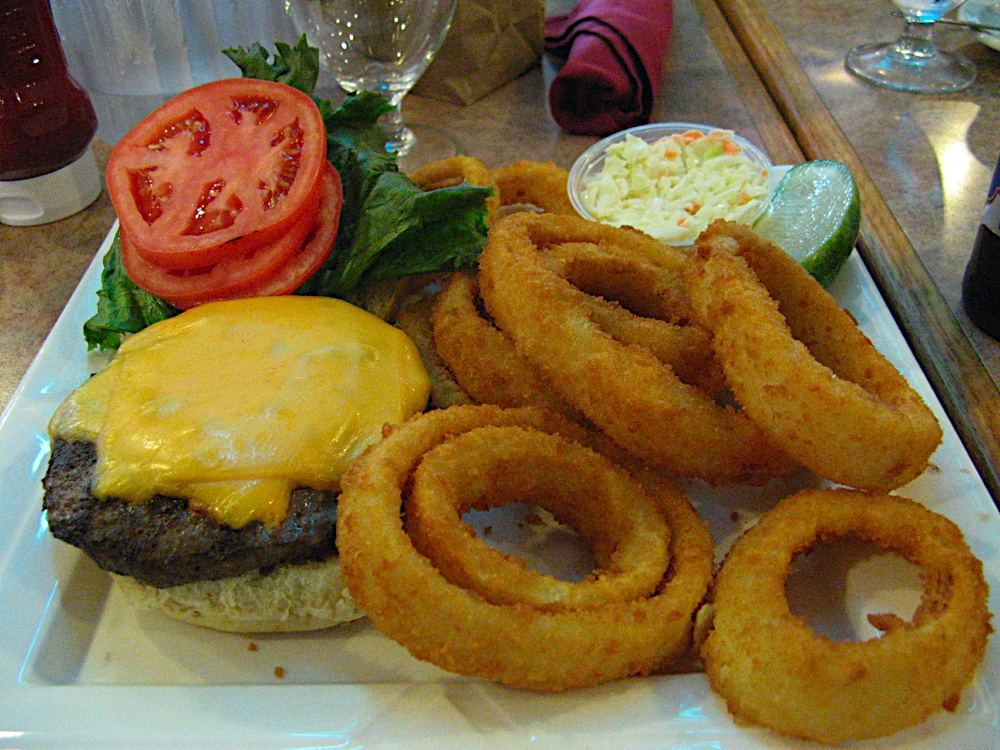
Let's have another look at the Randolph's ORs, alongside their fairly decent cheeseburger. (Not The World's Best Cheeseburger, but it would do.)


Cheeseburger & ORs, Randolph Diner


During a weekend visit to a niece and nephew in Connecticut, we got in one last OR op, this one at Skooter's Diner, near Bradley Field in Windsor Locks.

The Skooter's ORs are definitely home made, with a lighter, more fragile breading. I enjoyed them, but I'd give top honors in this group to Irving's, followed by Randolph.

Fragile, golden beauties at Skooter's


Skooter's is a sweet little place, which I'd probably patronize regularly if i lived nearby, but not, in my mnd, worth a special detour. By the way, the hamburgers were serviceable but not outstanding. The Fried Whole Belly Clams were good, according to my wife. (WBCs is perhaps another topic in this North East U.S. series. Later.)


A Case of Crabs

It was the season of crabs...
A side benefit of our visit to the Northeast U.S. was that soft shelled crabs were in season. I learned on Mouthfulsfood.com that Avenue Bistro Pub, in Verona, NJ, was offering them on pasta. But when we ate at Chengdu 1 in Cedar Grove the night before, there were soft shelled crabs on the menu, prepared Hot and Spicy with Chili (sic). Irresistible, even though we ordered Hot and Spicy Prawns with Chili as well. In the end, the prawns were better than the crabs.


Hot and Spicy SSC with Chili, Chengdu 1

Following that semi-successful meal (less the fault of the restaurant than the widely divergent tastes of the diners' choices.), we joined two old friends at Avenue Bistro Pub. I passed up the second chance for SSCs, and instead, had a great Hanger Steak with frites. My wife had the SSCs, subbing fresh spinach for the pasta. She said it was excellent.

                                          SSCs sauteed, over spinach, Avenue Bistro Pub

Another crab delicacy are Crab Cakes (CCs). These can be done well, but all too often are masses of breadcrumbs or potatoes, faintly flavored with crab and fried poorly. That, unfortunately, was the case at Reggiano Ristorante, where my single, large, and very expensve CC was guarded by a formidable nest of fried angel hair pasta. Once that barrier was removed, I found a poorly seaoned and fried CC, unredeemed by its underlying pool of "saffron aioli".

I got my good CCs, again at Avenue Bistro, this time nicely done, lightly fried, no barriers, and graced with a red sweet peper remoulade.

                                                    CCs at Avenue Bistro

(And now, the real crabbiness comes out, as I prepared CCs at the house.)

My Mom wanted me to make crab cakes before we returned to Mexico. Towards that end, we purchased two, one pound cans of crabs of crabmeat.
Only one day remained before our departure. My Mom planned a meal based on mixed green salad, crab cakes, corn on the cob, green beans and (SURPRISE!) potato salad. I will credit her with preparing all the salads, vegs and sides. I was left only with making the crab cakes. (There was more cooking and food preparation that day, but I won't go into the details here.)
I recalled that the year before, she and I wrangled over a newspaper clipping recipe. I don't recall the gist of the dispute, it it may have had to do with "not over seasoning to the point where you don't taste the crab." 
I totally agree with that opinion.
This year we wrangled only briefly, and she more-or-less let me have my way with a recipe I got on the Internet.
Who knows? The only requirement was that "Panko", the Japanese white bread crumbs, be used.
(I did take 3 slices of Pepperidge Farm Hearty White Bread, trim off the crusts, dice, place in the food processor and whirl with the steel blade until they were crumbs. Those were the "filler" inside the CC mixture.)
Here's the recipe I used, for "Best Crab Cakes", from teriskitchen.com
I consider it a very good starting point.
Keep in mind our quantity was doubled, yielding 12 large crab cakes. I'll put my modifications in a colored font.

(A little celery, sweet red and/or green pepper, red or white onion, Tabasco Sauce, a pinch of  thyme, a few dashes of cayenne pepper.)

My Mom's kitchen is compact, and she more or less knows where everything is stored, while I, her usually intelligent son, am generally clueless in that regard. Nevertheless, I manage to make the CC mixture before lunch (a vegetable frittata), between other more or less continuous kitchen tasks, and get it refrigerated.

Later, I patted out the CCs and began to fry them. I would have used two skillets, but the burners were occupied with corn on the cob and green beans. My temper finally exploded as my wife started removing the cleaned dinnerware from the dishwasher, underfoot where I was working. It was necessary, but stressful. Plus, "there are ways of doing things in every family".

But after my crabby outburst came calm. I continued, frying 4-5 CCs at a time, placing them on paper towels in an oven proof dish and keeping them in a 200º oven until serving time.

THEN:
FIRST, the salad.
clear the plates
SECOND, the corn and green beans.
clear the plates (my wife says I was mistaken. We did NOT clear the second plates. But we did eat the vegs as separate courses.)
THIRD, the CCs. Pass the mayonnaise, ummm; Tartar Sauce. Mmm!
I had more salad, which was "noticed".
It was just almost worth the hassle. I ate two big CC's. They were great.
I skipped the baked bananas, as they held no apeel for me.

                          Home made CCs, hecho a mano por mi.
I suddenly realized that I'd blogged a topic of the same or nearly the same title, a couple of years ago: Eat Here And Get Crabs
So it is. No, I'm not obsessed with that affliction. Originally, this post was titled, Crabby In the Kitchen. 

Wednesday, April 29, 2009

Foods of My Native Land

We are leaving tomorrow to spend a few weeks on the old family hacienda in New Jersey. Not only will this be an opportunity for visiting mis papás y hermana, we will also be treated to some of the comida típica del país viejo. That is, some of the special foods we either can't get here in México, or only in diluted versions. Below are some of the delights we are anticipating.
•Proper sour Jewish Caraway Rye Bread.
•Pastrami sandwiches on that rye, with hot, spicy mustard and...
•Garlicky Kosher pickles.
•Good hot dogs, with taste and a casing with snap. (Mexican hot dogs here are uniformly dreadful.) See Irving's Deli menu (pdf). The main web site is being remodeled.
•Dunkin Donuts (Yes; I indulge in a couple of Dunkin Donuts every other day while we are there. I especially like French Crullers. Be assured that they are nutritious.
I can get totally wired on their excellent coffee (and much cheaper than Starbuck's down the street.) while geting wi-fied over their free internet connection. Just try to find a table with enough room for the laptop.

•Brisket pot roast with spicy gravy. Kasha Varnishkes. (Steamed whole grain buckwheat groats with egg noodles, lightly bathed in melted chicken fat with crispy, caramelized onions. I can make it in México, but it's better in the Old Country.)
•Connecticut style hot buttered lobster rolls. Fried whole-belly clams. (In photo.)


More...

•Really good Italian food, and pizza!


A vegetable pizza at Pepe's Pizzaría Napoletana, in New Haven, Connecticut.

•Decent bagels.
MORE...

Actual, real Chinese food, especially Sichuan style.


Baby Wontons in Spicy Red Oil Sauce, at Chengdu 1, Cedar Grove, NJ.

I hope to be reporting back as often as the primitive, regional coconut fiber network permits.
Watch this space for updates.

Tuesday, April 14, 2009

Holstein: Variations On a Milanesa

Ja, Das Ist Ein Holsteiner Schnitzel!

Pardon my Alemán. I've never studied that language. But I got enthusiastic yesterday when I spotted Milanesa Holstein on the menu at Sanborn's Restaurant at Plaza Las Américas in Morelia. It's true that I was first drawn to the Sandwich Caliente de Pavo con gravy; but having had a very disappointing earlier experience with that at Sanborn's Centro Histórico Morelia, my eyes leapt to the Milanesa Holstein. There is also a Milanesa Italiana or perhaps Parmesana, which the colorful photo menu explains as in a tomato sauce with gratineed cheese. It looks like "Chicken Parmesan", with the chicken standing in for veal.


I'd better explain what Schnitzel (or Milanesa) Holstein(er) is. A thin slice or meat, originally veal, but could be pork or chicken, is pounded out thin and breaded then fried. For the Holstein variation, the fried schnitzel is topped with a fried huevo estrellado. (See my previous work on How To Order Eggs Without Fear, here.) The fried egg is garnished with a couple of anchovy fillets and a few capers. The latter two are among my favorite condiment foods. Put a small order of Papas Fritas, and you've a rare treat when you are surrounded by enchiladas and comida típica Mexicana.

Where did the milanesa originate and how did it come to Mexico? For illumination, I turned to www.wikipedia.org and the article on the Wiener Schnitzel and variations.

Here is some relevant historical context:
The dish may have originated in Milan, northern Italy, as cotoletta alla milanese, and may have appeared in Vienna during the 15th or 16th century. According to another theory, it was introduced in 1857 by Field Marshal Radetzky, who spent much of his life in Milan. The term Wiener Schnitzel itself dates to at least 1862.
The article is a bit thin on Mexico and its adopting of the Milanesa:

Mexico

Thinly sliced beef breaded and fried is also known as "milanesa" and is a popular ingredient in "torta" sandwiches sold in street stands and indoor restaurants in Mexico City.

I theorize that with the French invasion and occupation of Mexico in 1862 to 1867, and the placing of Emperor Maximilian of Austria on the throne, Central European dishes were introduced to Mexico, including the schnitzel-milanesa, and, I'll throw in pasta hojaldre (puff pastry for strudels and other flakey treats of pan dulce.)

Earlier, Hapsburg Austria dominated northern Italy, and Lombardy, where Milan is located, and this food may have migrated northward to Austria. From there, it traveled to Mexico, where it is ubiquitous, and most prominently used in tortas. (Mexican "sub" sandwiches) Those milanesas are often of poor quality; tough and badly fried. For a really good Milanesa de Pollo, served plated as a lunch or dinner, I recommend those served at the restaurant of the Gran Hotel in Pátzcuaro. Now I can also recommend those at Sanborn's Plaza Las Américas location in Morelia.

So, what's the Holstein connection? Holstein is a county, part of Jutland, in Northern Germany. How does that explain a fried egg with anchovies and capers?

MyGermanFoods.org has this explanation; believe it or not as you wish:

Holsteiner Schnitzel (Holsteiner Schnitzel, Schnitzel nach Holsteiner Art)

Holsteiner Schnitzel, a veal fillet (pork can be used instead) breaded and browned in butter and topped with a fried egg and an anchovy was the favorite meal of the great 19th-century Prussian diplomat Friedrich von Holstein – who liked to eat in a hurry – so he had his appetizer and main course all on one plate.

This concludes my light-hearted investigation of the schnitzel-milanesa in Mexico. May your next Milanesa be a great one.

Sunday, April 05, 2009

Un Gringo Cocinero En Cuernavaca Parte 2

Yo era un cocinero gringo para una familia Mexicana de Cuernavaca.

Liz' 16th birthday was approaching, and she was more than happy if I would make pizzas for her birthday dinner. The challenges were many, but I was flush with reckless enthusiasm, so I took on the task.

The first thing was to enlist my enthusiastic paisanas in the effort. I probably misread their intentions, because they seemed more motivated towards the nebulous concept of a "party" for Liz, (a little cake, a little punch, some finger sandwiches, ¿quien sabe?) while I was up for a fiesta de pizza a toda madre. (To phrase that more delicately, "an all out effort"; "awesome".)

To launch the latter project, Amelia loaded Liz and me in the Talking Chrysler.
I hadn't told you about that, have I? It was Amelia's carro favorito de siempre, a Chrysler station wagon that would warn you, in a deep, masculine Spanish voice, "Abroche su cinturón.", or, "La puerta está abierta."
Off we went to Gigante and its salchichonería (deli) to buy rare and exotic sausages and cheeses. Amelia gave Liz free rein until she started looking longingly at some shrimp.

My memories are dim, so I don't recall if I made the pizza sauce from fresh or canned tomatoes. These days, I greatly prefer canned. Back then, I had the ganas to make my own sauce from fresh tomatoes.

Yet in the back of my mind was a small but gnawing doubt about what sort of pans were available to bake the pizzas. There were none. Inspired by artesanal pizzaioli
Italiani, I decided to bake directly on paver tiles. There were even some surplus ones stacked in the patio. All they needed was a good scrubbing.

A piece of heavy cardboard, covered with foil, would serve as my pizza peel.

Preparations reached a fever pitch on the morning of the party. My paisanas soon retreated from the kitchen and its lunatic pizza maker. The oven was giving its best effort to reach its feeble maximum temperature. I
rolled out the pizza crusts with a mescal bottle.

I'd lined the oven rack with the paving tiles earlier so that they could heat to the perfect temperature. En mis sueños.

The Moment of Truth had arrived, as it must come to all men.

I clumsily transferred a pizza, brimming with sauce, cheese and delicacies onto my primitive peel. I inserted it into the oven, gave it a jerk, and immediately slapped it up against the back wall of the oven. ¡Que desmadre!

I scraped out the remains and trashed them. With greater care, I loaded another one. This one worked.

Eventually, all 5 (?) pizzas were done, and I fell back, suddenly drained as the family and guests snarfed pizza. I don't remember much more of that, except that the next time "la muchacha" (the housekeeper) came in to clean, she had the task of removing the mozzarella and sauce deposits burned onto the oven.

That was the end of my career as a pizza baker in Cuernavaca, but not the end of my cooking and baking in La Ciudad de La Primavera Eternal.

"
But man is not made for defeat. A man can be destroyed but not defeated."
Ernest Hemingway
Possibly to be continued...

Incorngruity


I love corn. I really do. So, what is it about the abuse of canned corn* that turns me off so?

*Please don't confuse this with CanCun. This is not a travel blog.

Really, canned corn is convenient and useful. You just open, pour and heat it.
(You should, however, keep cream-style corn away from children who might be corrupted by soft pour corn.)
Whole kernel corn has legitimate applications. I may think of some if you give me some time; could be a few years.

It tastes o.k. I'm just mildly appalled by the indiscriminate addition to so many recipes, such as black bean and corn salsa; to chili, and in casseroles. (The latter often baked in Corning Ware™, as if that would justify it.)

I just did something I rarely do: I committed the sin of canned corn abuse by opening a can of it and pouring the contents into a pot of Chipotle Chicken Chile I was concocting. This chili was improvised from various garish recipes on the Internet.

I based my version on one smoked pork chop, diced; most of a pollo al carbón that we bought alongside the road in Tzurumútaro. These are terrific broiled,
spatchcocked chickens (There he goes again, Mildred, with his smutty talk.); daubed with adobo and slowly grilled over a smoky charcoal fire. Fresh orange juice is squeezed on them at the finish, and a few shakes of salt and pepper.

In addition to the meats, I added a couple of small onions, chopped; one clove of garlic, chopped; one sweet yellow pepper (it's what I had on hand); one chopped chile chipotle en adobo plus its sauce; a tablespoon of pimentón de la vera. I use "La Chinata" brand, because I like the red can and the cool label. Sure; and some Mexican orégano and just a bit of cumin also. Too much cumin smells like sweat.

While the bones of flavorsome skin from the chicken plus the small pork chop bone simmered in a liter of water in a separate pot, I added two cans of S&W brand Italian style stewed tomatoes to the main pot.

Then I did it: I opened one can of S&W Whole Kernel Corn and tossed it into the pot. I pushed this tacky, trashy act into the bargain basement of my conscience.

After the bones had simmered 15 minutes, I strained the stock into the chili pot. I also added a heaping tablespoon of Knorr-Suiza Caldo de Jitomate powder. This may have put the salt a little over the top.

Not to forget the frijoles. They were about 3 cups of cooked frijoles vaquitas, which are called thus for their cow-like, black and white markings. (You'll probably never find these, so don't even try. You can use cannelini beans or common black beans.)

Just for "Authenticity"—hah!— I put a large, dried hoja de aguacate in. I did that because I know most of you can't get them, and that further enhances my smug sense of superiority.

Remove hoja de aguacate before serving, or else everyone will want one.

I slowly added about 1/3rd cup of quick white grits to thicken the juices a bit. This (and any other step) is optional, or as we say, "como te gusta."

When I tasted a few sample spoonfuls, it seemed a bit more picante than my sister-in-law, (who will be visiting us this week) might tolerate. So I damped down the picor (the bite) with the addition of the juice of two Mexican limes, and the juice of one naranja dulce. (Just a sweet juice orange, nada más.)

The chili tasted fine after simmering another 15 to 20 minutes. It's now cooling on the kitchen counter.

Now then; when you imagine the above concatenation of ingredients, each contributing their part towards the common good, ask yourself what the corn does.
It's there because it's too easy to do. As Constantino commented, it's "filler"

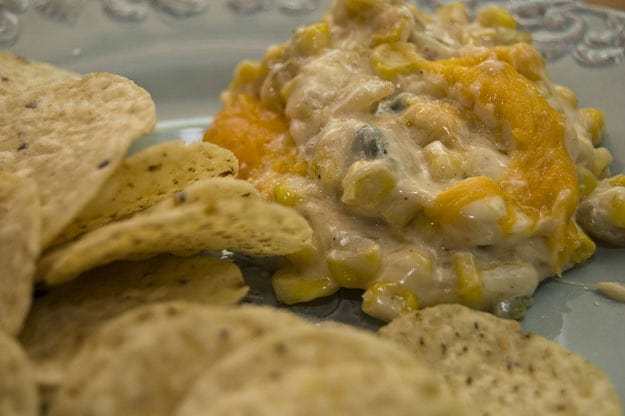
I'll close with this link to a truly frightening example of what can happen if you slide down the slippery slope of canned corn abuse. This can happen to you. (For Mature Viewers only, with strong stomachs.)

PS: you can, if you like, serve this with a blob of crema (thinned sour cream), queso rallado, and chopped cilantro on top.
Pass the corn chips.