Friday, October 05, 2012

It's Not Easy Being Green

or,
Amphibious Exercises at Mariscos La Güera

From the New Yorker Magazine
Sunday, September 30, 2012, we joined friends for another comida at La Güera, our favorite restaurant in Pátzcuaro. It was after 2:00 p.m. on  Sunday, the busiest day of the week. The day before, I had requested a special dish not on the menu: Guatape Verde de Camarones. Judith Melgoza, the owner and our friend, agreed to make it. There were some doubts as to whether my wish would be realized, but after a confused exchange with our waitress, we suspended our hopes and ordered regular apps. 

Then, suddenly, Judith appeared with a smile, and a chowder cup in hand with two spoons, to give us a taste of a green, herbal sauce. We approved, and our waitress served the six of us two large plates of Guatape. The dish was good, although lacking much of the desirable anise-like taste of hoja santa. 

When I had made Guatape a few years ago, I overdosed the dish with too many pungent herbs as well as a strong shrimp shell stock. That error was compounded by overthickening the sauce. See the recipe below.

Guatape Verde de Camarones "La Güera"
Guatape Verde de Camarones. Adapted from "Mexico—The Beautiful Cookbook".

Ingredientes
3 chiles poblanos, quitan las semillas y membranas

4 tomates verdes, sin cáscaras

2 tazas de perejil fresco

3 hojas pequeñas de hoja santa

4 tazas de agua o de caldo de camarón

1/4 taza de aceite de olivas o de manteca

1 cebolla grande, finamente picada

1 1/2 cucharas soperas de Maizena, suspendida en un poco de agua tibia.

sal y pimienta blanca

1 kilo de camarones crudos, preferemente con sus cabezas intactas

jugo de un limón 

Modo de hacer

En licuadora, haz puré de los chiles, tomates verdes, perejil y hierba santa con el agua. Pase por un tamiz y pon al lado.

Caliente el aceite en una cacerola grande, pon la cebolla y acitrona. Añadie el puré de chiles y hierbas, freir hasta que llega a hervir, añadie la Maizena suspendida en agua. Cocine hasta que se espesa.

Pelar solamente los lomos de los camarones y añaden al la olla. Los cocinen 5 minutos. Sirvelos calientes, con arroz blanco si quieres, unas gotas de limón sobre el guatape. 
We appreciate the efforts of Judith and her staff. When the cuenta arrived at the end of the meal, we were surprised and pleased that we had been given the Guatape "cortesía de la casa".
Gracias a la muy generosa y amable Sra. Judith.

Judith Melgoza, left
What came next might serve as a caution. It’s best not to go to your favorite restaurant at peak times. Not only were we there at the peak hour on Sunday, it was also the festive weekend of the Founding of Pátzcuaro. So, we'll give La Güera the benefit of the doubt.

Less than a month ago, we tried the Ancas de Rana (frogs’ legs) at Mariscos La Güera in Pátzcuaro. They were tender, perfectly seasoned and cooked. The time was around noon on a Friday.
But yesterday, they were dry, stringy and tough. You can compare them in the photos.

August 31
September 30
Similarly, our friend Ron’s Filete de Salmón was thin and overcooked. It was a real contrast to the first time we’d tried it, a couple of months ago, when it was thick and moist. (Another factor may be that on the earlier occasions, we’d ordered the large portion and this time the smaller).

Mark’s Coconut Shrimp, though, was satisfactory, if a bit pale in color. Mariscos La Güera does best what it knows best. That is, tostada appetizers, shrimp dishes, cocteles de mariscos, and pescados. (Except salmon, apparently.)
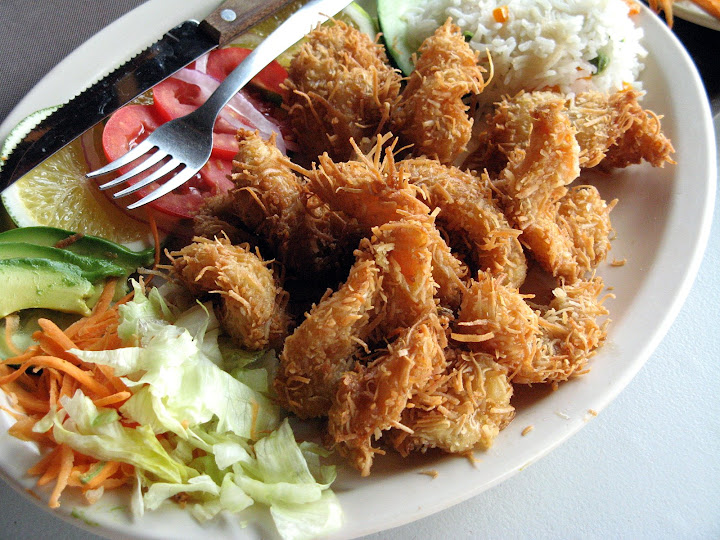
Perfectly cooked Coconut Shrimp- on another occasion
I suppose it was the frogs’ legs that started our conversation on achoques, or neotenic Lake Pátzcuaro salamanders. They are used by the Dominican nuns of the convent of Nuestra Señora La Virgen de Salud to make a syrup, Jarabe de Achoque. It’s said to be sovereign in soothing coughs and sore throats. Later that evening, there followed an email exchange on achoques and the more common axolotl. Mark and I both reminisced briefly on the use of the word, “axolotl” in early issues of Mad Magazine. Mark’s wife, Nancy and their friend, Nancy H. both tasted the Jarabe de Achoque and said it was good. There is even axolotl poetry.
Axolotl/achoque is not on the menu at La Güera
As we finished our meal and paid our bill at the restaurant, I again admired the sharp and snazzy uniforms of the waitstaff. They are modified white tunics with rows of buttons topped by a Mandarin collar. While the ones with white buttons are nice, the black buttons really snap to attention.

Waitress at Mariscos La Güera Campestre
I also glanced into the kitchen, where the cooks were wearing the bright orange Mariscos La Güera T-shirts. It must have been hot as well as busy in there, and none I saw were wearing what I call the “surgeon’s” uniform, swathed in whites with skullcap, but of course, they were wearing surgical masks to protect the customers’ health.

So here's updated ratings on Mariscos La Güera. Matriz at Federico Tena at Libramiento Ignacio Zaragoza, Pátzcuaro. Open every day except Christmas and New Years, 11-6, approximately. Ideal time, between 12 and 2.

(A branch location, Mariscos La Güera Campestre, at kilometer 46.6, carretera Morelia- Pátzcuaro. Huge customer capacity, the size of aircraft hangars. Good food, service a bit more leisurely, as servers have farther to walk from kitchen to table. Rarely as full as the matriz, in our experience. Salon de eventos available. Plenty of free parking; cars washed.)

RATINGS (Applies specifically to la matriz.)

Food: ***1/2 sometimes, ****+

Service: ****+

Ambience: informal, casual, cozy.

Price: -$-$$

Hygiene: ***** (To my knowledge, best organized and probably best hygiene of  any Pátzcuaro.)

Other: Regrettably, a 10% service charge is now included in the bill. We prefer to tip more, so we do.

Best menu items: cocteles de camarones o pulpos, ensaladas de mariscos, micheladas, tostadas, aguachiles de camarones (lime "cooked" shrimp salad), brochetas de camarones with bacon, onion and sweet peppers, camarones empanizados, camarones para pelar, camarones empani-cocos, pescados enteros al mojo de ajo, al ajillo; filetes al gusto. 

Odd items: any fish a la Veracruzana. Not really bad, just a starkly, minimalist interpretation of a lush classic; crema de camarones: AVOID! Tacote de mariscos: great concept, but unfortunately, the seafood filling is under seasoned and tasteless. Caldo de Huauchinango: only if you enjoy slowly and carefully picking tiny bones out of the fish and your mouth.

Torta de filete empanizado: this may have improved over the years due to an upgrade from tilapia to mero (grouper). The tilapia was soft and tasteless, the mero fairly meritorious. Any dish prepared "a la diabla" may be a hit or a miss. I have had good ones but also really bad ones, with a thick, floury, cheesy tasting sauce.

En fin: we love Mariscos La Güera, its staff and its friendly, gregarious owners. We have to continue to adjust to certain occasional inconsistencies in the food. Go during the week, or go early. Stick with the regular menu items. Nearly any shrimp or whole fish dish will be good to great.

Clockwise, from upper left: Camarones y Pulpos a la Diabla; Camarones Empani-Cocos; Mojarra Al Mojo de Ajo
Entradas for a group; ceviches, guisado de marlin (****!) and tiritas de pescado. These are among by favorite apps.
A beautiful Ensalada de Mariscos; presentation varies. I don't eat raw shellfish in México, but you can request it without.
Approximate location of Mariscos La Güera matriz

View Larger Map

Sunday, September 30, 2012

On My 70th Birthday

On My 70th Birthday.

I shall sleep late…until 6:30 a.m. That’s after the “first shift” of 1:30 to 3:30 a.m.

As I drive out, the valley is at its peak of beauty, with green fields and pink cosmos, below mountain peaks holding swirls of clouds.


First, I shall go to Panadería La Espiga to buy teleras, crisp crusted and still warm from the oven.


Then shop at Tienda Don Chucho’s for provolone ahumado y chorizo seco.
Next door is the little fruit and vegetable stand which so conveniently avoids the hassles of Pátzcuaro’s main mercado.


I will eat a plato grande de birria de borrego y dos tortillas del comal grandes at  Birrería Don Prisci’s by El Parian, and drink a jugo de naranja grande.


I wil shop at Bodega Aurrerá early, and for as short a time as possible.

I will be smart, and not drive up into Pátzcuaro Centro where parking is tough and some streets may be blocked for the simultaneous celebration of the Anniversary of the Founding of Pátzcuaro and my birthday.

On the way home I would stop near Tzurumutaro near the Pollos Asados Tejaban place.) at Tienda de AbarrotesLos Fresnos” for water and eggs.

Once home, I would take a nap.

Much later, our amigas/cleaning ladies, Sra. Salud and daughter, Miriam, will prepare a comida for us and a few guests. Things are held up for a couple of hours, the guest list changes every 30 minutes or so, the hostesses “borrow” an onion, a cup of vinegar, some casseroles, and so forth, pero, ni modo. Como México, no hay dos.

Comida consists of a couple of tasty varieties of tostadas (yes, one topping has hot dog bits in it, but it tastes good.) I have impulsively made pizza, with three or four toppings among them. I make ensalada de nopalitos, which is delicious but babosa. (Slimy, drooly.) We will drink pitchers of agua fresca de jamaica. Our dessert will be various gelatinas en cacerola, with fresh fruits cut up onto it, and strawberry yogurt.
See slideshow for details.
The guests will sing “Las Mañanitas”  to me.


It was a strange, constantly unpredictable, yet lovely day. September 28, 2012


September 29 brought a surprise. After resting much of the day, I decided in the later afternoon to take a little walk. I scarcely had reached the church on our street, when I heard mariachi music coming from the house of Miguel and Sara, set back from the street. I followed my curiosity and found the source of the music and merriment. People were dancing, There were many I know, including the lively and friendly couple that plies the roads in their truck, selling cleaning supplies.

The hosts invited me to partake of the music, a jáibol and afterwards, some mole de pollo y corundas. I was given a place of honor next to Don Miguel, 82 years old, as my name is "Miguel" also*. I even got a request song, "La Negra", played by the mariachis. After, of course, "La Mañanitas".


*Now, revealed for the first time in years, my real name is Don Miguel de las Cuevas.

Wednesday, September 26, 2012

A Sunday Comida With Steve Cotton


Steve and his Escape

Last Sunday we had the pleasure of receiving Steve Cotton at our casa en el campo.
Of course, we wanted to have a nice, well balanced, home cooked meal to offer him.
Earlier, I'd given him a a choice of main courses: either salmon fillets or Carbonnades a la Flamande. He chose the Carbonnades.


       ~This is the menu I planned~
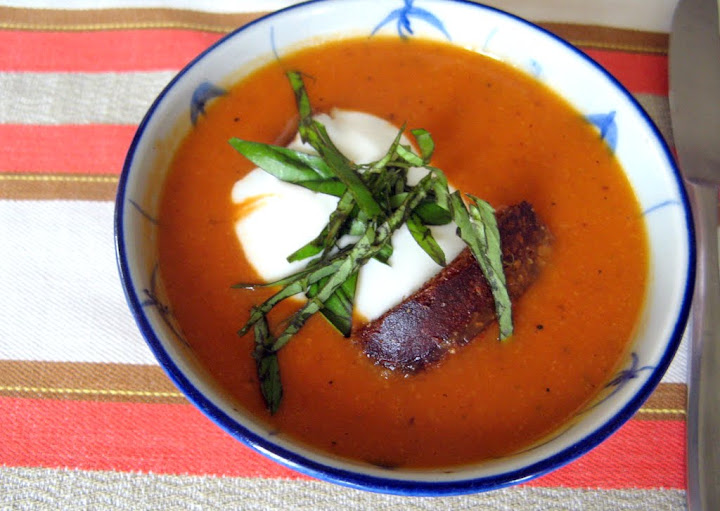
• Roasted Red Pepper Soup (served hot), olive oil crouton, Crème fraîche.
• Carbonnades a la Flamande, Parsley Buttered Tagliatelle.
• Romaine and Watercress Salad, Apple, Dried Sweet Cranberries, mild Goat Cheese, Celery Seed dressing.

•Steamed fresh spinach, slivered sweet preserved lemon, Kim Lan "I Jen" soy sauce. (Just a drop.)
•Bread: teleras from Panadería "La Parroquia", Calle Ibarra 59B, in Pátzcuaro.
•Beverage: September 23, 2012, vintage Agua Fresca de Tunas Maduras. (Thick, purple, very purple.)
•Dessert: Natillas a la Vasca, berry compote sauce, mini palmiers.

I think all was quite successful, with the exception of the spinach, which didn't work well with the chosen seasonings. It also had an unattractive color.

Below is  a sample guideline, not a recipe, for the soup.

The Roasted Red Pepper Soup was from a recipe in The Quick Recipe, by the Editors of Cook's Illustrated Magazine. It's on page 174. It's made with a 24 ounce jar of roasted red peppers, drained, some red onion, garlic and flour.

The onion and garlic are sautéed lightly in butter and vegetable oil and then, 1/4 cup flour sprinkled over. A 1/4 chile chipotle in adobo is added and some thyme leaves. This is then cooked a few minutes to rid the flour of rawness.

Then 3 1/2 cups of canned chicken stock (or better, homemade) is added and the mixture brought to a boil, then reduced to a simmer.

Meanwhile, bread is made into croutons. They used white sandwich bread and melted butter; I used crusty bolillos from a small, wood oven Morelia bakery. I applied just a few drops of olive oil and baked them 12 minutes or until brown and crunchy.

Back to the soup: I had on hand about 2 1/2 cups high quality juice from a can of Cirio Pomodori Pelati, left over from pizza making. I added it to the soup. This addition made the soup thinner, of course. I didn't want to thicken it with a beurre maníe (thus further enriching the soup to excess.), so I took some toasted almonds, seasoned with salt and pimentón de La Vera (a leftover from the Paella Feast), processed them rather finely in the Cuisinart, and added about 3-4 TBSPS to the soup.

After tasting for seasoning (and, I recall dashing in some pepper sherry), I removed the pot from the stove burner and blended it with an immersion blender for several minutes to thoroughly smooth it.

The original recipe calls for 3/4 cup heavy cream added, but I preferred to omit that and instead garnish each small soup bowl with a couple of croutons, a dollop of crème fraîche and some chiffonade of fresh basil. Take advantage of what you have available, within the bounds of good taste.


Roasted Red Pepper-Tomato Soup
The recipe for Carbonnades a la Flamande (beef braised in beer with caramelized onions) was taken from a recipe on SimplyRecipes.com. 
There are many versions. Some start with bacon. Mine did not. Mine had about 2/3 beef and 1/3 pork, all cut into small cubes by our butcher, Moíses Pérez.  I recommend sticking with all beef, and in approximately 1 " cubes.
Most recipes call for Belgian dark beer. It's hard to find here, so I used Indio, purchased at a local Oxxo store.

A tiny amount of ground mace is an addition I remembered from a recipe of many years ago. The Carbonnades is not as pretty as the soup, but it is rich and flavorful.

Carbonnades a la Flamande
The noodles were simply tagliatelle pastas, cooked in salted water, drained, and dressed with a little melted butter and chopped fresh parsley.

Of all our menu, perhaps the beverage was most unusual. Three of us the paella feast had been talking about using more native ingredients in  cooking. Tunas moradas are in season, and with just a little work, it's possible to make this ripe, purple cactus fruit into a refreshing beverage.

I found various methods on the Internet, and worked out one for myself. I'd bought 1.5 kilos of tunas moradas, and early Sunday morning, peeled and sliced them with a paring knife. (Be sure to wear an apron or old clothes.) I set aside half to puree and freeze, the other half went, in two batches, into our blender with purified water. The blending was easy, but the straining of the puree to remove the hard seeds takes a little while. Sugar is added to taste. I thought that the agua would benefit from the addition of some freshly squeezed lime and some grated lime zest. Then I decided to boost the flavor more with a small amount of finely grated fresh gingerroot.

Tunas moradas. Aztec sacrifices?
Here's the result. You can ignore the salt, limes and Tequila as you wish.


In the European manner, we followed the Carbonnades with a
refreshing salad. Inspired by Georgina's salad at the Paella Feast, this salad also had slices of fruit, apple in place of pear, plus the dried sweet cranberries. The divergence came with the mixture of romaine and sharp, peppery cress (berros) plus toasted walnuts, and dollops of goat cheese. The dressing was sweet and less sour emulsified and with celery seeds. (Poppy seeds can be used, but opinion is divided as to whether they are legal in México.)


A civilized pause followed, as the interesting conversation continued.

Two friends showed up unexpectedly, and we invited them to dessert and coffee.

The dessert was very easy to make; a Basque version of natillas, a soft, eggy custard sauce scented with cinnamon and vanilla. I'd made it the evening before and portioned out into dessert bowls. I set them in a pan and then covered them with plastic film and refrigerated them.

For a nice touch, which took it out of the "invalid food" category, I thawed a frozen organic berry mix, sweetened it slightly and let it macerate a few hours. A few spoonfuls of the berry mix were added just before serving, and I stuck a fresh mint sprig in as an edible garnish.


We also had some cookies from Panadería La Parroquia, in Pátzcuaro.


This concludes our program for today.

Monday, September 24, 2012

La Gran Paella Lacustre


La Gran Paella Lacustre
Christmas Day, 2011. We were driving north from Tzintzuntzan towards Quiroga to have dinner at our friends the Ferguson's house. Just past Ojo de Agua, i noticed a guy standing outside one of the villas, waving a sign that said "PAELLA HOY". That was intriguing, but as we already had a dinner engagement, we didn't stop.

About 2 weeks ago, after eating those gorditas at the Quiroga Mercado, we were returning along the same stretch of Carretera Federal 120, when I saw a sign posted, "Casa Paella". It was still early, so we stopped to check it out. After we hola'ed a couple of times, out came this big man, with a big smile and a bigger heart. He is Mauricio Hernández. His beautiful wife "Tey" (María Esthér) also came out to greet us. Then they invited us into their home.

L-R: Tey y Mao
They told us that they were no longer making paella for the public, but they looked at each other and then said that they could make it for us in a group, with at least 5 days advance notice.

The actual site for the feast would be at the Hotel Lago Sol which Mao and Tey manage for the Moreliano owners. The hotel is just down the highway 300 meters in the direction of Quiroga. It's a lovely, relaxing place.

We all were enthused about this paella project, and after exchanging email addresses, we left.

I knew who might be interested. Our friends Ron, Georgia, the Fergusons, and Mark and Nancy, although they were in Colorado. When I emailed the Coloradans, they were enthused and said that they would try to attend. I invited a few others to participate, but they were unavailable.

There was an exchange of emails between Mao and me, and we determined what the paella would have in it as well as the supporting dishes. The price for the meal was agreed on to be $165 pesos per person, including a salad, the paella, bread if desired and a light dessert and coffee. The beverages would be BYOW. Traiga tú propio vino.

The guest list grew to nine in all when Mark wrote that they would bring a friend, another Nancy.

Sra. Cuevas and I made another preliminary visit in order to pay an anticipo (deposit) of about half the total. At that time we also met Georgina, Tey and Mao's daughter, visiting from Seattle. Georgina took on the responsibility of creating the salad.

The night before the Day of the Paella, the Coloradans arrived in good order to their Pátzcuaro home. All was set for el Día de La Gran Paella Lacustre. (Lacustre: lacustrine. Of, relating to, or associated with lakes.

ORIGIN early 19th cent.: from Latin lacus ‘lake’ (the stem lacustr- influenced by Latin palustris ‘marshy’) + -ine1.)

I wanted to supplement the meal with some botanas or tapas. I restrained myself somewhat, and only made roasted seasoned almonds, toasted garbanzos, and a tapa, baked fresh figs filled with goat cheese and wrapped with jamón serrano.

Higos horneados rellenos de queso de cabra
Doña Cuevas and I drove over to the Hotel Lago Sol early, as I wanted to photograph the cooking of the paella. There we met two friends of Mao and Tey, who live near Zacapu.

I won't describe the cooking steps as it would be tedious to write them, and especially to read.

You can look at the slide show below for more details. Click slide to open in original album.


Mao cooked the paella using techniques and ingredients adapted to and available in the region. Keep in mind that we were on the shore of Lake Pátzcuaro, neither near the mountains of Madrid nor on the coast of Barcelona. See below. In my opinion, the results were very good and highly satisfactory.  Most of all, we all had a very enjoyable afternoon.


Boots of Spanish Leather sung by Martin Simpson

The salad was, pleasantly light and refreshing, with mixed greens, dried cranberries, sliced fresh figs and a tart, citrus dressing. That's a slice of star fruit for a garnish.

Ensalada Georgina
Here's what the paella contained, if I can recall everything: rabbit, chicken, chorizo, onion, peas, crab, clams, some other smaller mollusk, octopus, large shrimp, saffron broth and the only item I consider completely superfluous: sections of fat salchichas—frankfurter sausages. It's a Mexican reflex, I think, to add salchichas to many foods, but one "Fud" I prefer to avoid.

Franks, but no thanks
The rabbit and chicken were less interesting than expected. I think that they had been precooked in water rather than browned in the paellera. But the abundant seafood was very good. We could have up to two servings and that was plenty. We had decided bread was unnecessary.


In the end, all was well, and we left, happy, a bit tipsy, very well fed, especially after the two desserts, the first, sliced pear with blue cheese crumbles, and a rich poppy seed cake that Georgia brought. (There were two secret birthday observances, unmentioned to the group.) To my everlasting remorse, I failed to take a photo of the poppyseed cake. But it has now developed into a Special Research Project to find out if poppy seeds are legal in Mexico.

RATINGS

Keep in mind, this is not a typical restaurant, open to the public, with regular meal hours. Paella dinners have to be arranged in advance with Mao and Tey. They will customize your meal according to your tastes.
Prices vary according to how may ingredients the paella will contain.

So, please consider these ratings to be very tentative, and yes, "soft".

Food: ***1/2
Service: ****
Price: $-$ Where each $ indicates about $100 pesos. Ours was $165 pesos per person, and we added a $20 peso gratuity for each diner. That is, in all less than $15 USD at current exchange rates.

Ambience: outdoorsy, relaxing, small swimming pool, soccer pitch, tennis court available. Great, friendly hosts. More like visiting good friends than a restaurant.

Restrooms: Clean and well supplied. The restaurant area is next to a hotel suite and two bathrooms were made available to us.

Contact: http://www.lagosolhotel.com/contacto.asp
Location:
Map from hotel web site


Thursday, September 20, 2012

Fonda Marceva, Morelia Revisited

We have been recently going to Morelia on medical and other matters. Even so, one must eat.

Yesterday, after stocking up on bakery ingredients at La Frontera, on Plaza Carrillo, at the foot of Calle Abasolo, Centro, we decided to drive up the three blocks to Fonda Marceva. Parking can be difficult in that area, but we were able to gain entrance to the very nice, roofed parking garage on the left, just a half block to the north, just below Calle Aldama.

Fonda Marceva, Calle Abasolo, Centro Morelia

Our comida at Fonda Marceva was excellent, although the service was quite off hand and very inattentive at first. But once the two waiters got going, the service improved.

I was without my better camera, so all I could capture were two inferior photos with an LG cell phone. I do have better photos from earlier visits. I think the comparison of the dishes is interesting.

Fonda Marceva specializes in comida de la Tierra Caliente, from the region of Huetamo. We had been there a couple of times before, with varied results. This time it was very good.

THe weather was nice, so we ate next to the patio, instead of inside the rather somber dining room.

Back Patio
For starters, we were brought fresh, hot, handmade tortillas; delicious soupy beans, a generously filled bowl of rich, thick crema and an excellent, roughly crushed salsa verde.

The soupy beans are illustrative as to how simple, but well prepared food can be so highly satisfying.

We ordered as follows: Doña Cuevas had uchepos, or sweet corn tamales. These were more finely textured that those at La Mesa de Blanca at Ziracuaretiro, but equally good. In their fresh, green corn husks, they were beautiful.

I had toqueres, "pancakes" of roughly ground corn, resembling nothing as much as potato latkes. The deep bowl of thick, rich crema adds to the resemblance. I can imagine these with some smoked salmon or caviar. The crema was also perfect, spread onto a warm tortilla, plus some salsa verde or a tentative nibble of the raw chile.


Sra. Cuevas continued with an attractively presented bowl of Sopa de Habas (Fava Bean Soup), with sprigs of cilantro floating in it alongside fresh tomato slices and one, picante fresh chile verde.

Sopa de Habas (LG cell camera)
For a main dish, I had the memorable Frito, a sort of carne adobada of pork ribs and/or backbone, which may have been slowly baked, not fried, in a concentrated adobo sauce. Lightly pickled raw onions garnish the top. On a previous visit, the Frito had much more jugo and I think it was better. Yet this time, it was heavy but delicious stuff.

Frito de Espinazo, May, 2011
Frito de Espinazo, Sept. 19, 2012 (LG cell camera) 
We passed on the desserts, which from the table tent advert appear to be factory made, but I can't swear to that.

We drank a pitcher of tart and refreshing agua fresca de tamarindo. I started with a mezcal, sharp and potent, and ended with a café de olla, which was undistinguished.

The bill came to $276 pesos, plus a tip. I consider that very good value.

RATINGS

Food: ***1/2, Maybe ****
Service: ** 1/2 (See notes in text.)
Price: $-$$
Ambiance: Faded Colonial glory
Restrooms: Worth a special visit.
Parking at the curb is technically illegal, but it is done. Better, a parking garage 1/2 block up Abasolo. Another parking garage, also on left, on Abasolo after crossing Aldama. Yet another parking garage, two blocks east, on the left, on Aldama.

Abasolo No 455. Colonia Centro. Morelia, Michoacán.
Tel: 312 16 66.


View Larger Map. Zoom in for details.

Tuesday, September 11, 2012

La Jaiba Reprise and Surprise


We used to go more often to Mariscos La Jaiba, on Blvd. García de León in Morelia. But somehow, it fell off our radar. Overall, the food is good, but the prices are higher than those in other marisquerías. Our Gold Standard, of course, are the Mariscos La Güeras in Pátzcuaro.

We were in the neighborhood of La Jaiba yesterday for a medical appointment, so we decided to lunch there. Although the main entrance is on Blvd Garcia de León, there is free, shaded parking accessed by Calle Batalla de Casa Mata at the rear.

Drive by photo of main entrance
The door from the parking area takes you through part of the kitchen and past the clean rest rooms, and by these attractive garnish plates, ready for service.


We were seated by our soft spoken waiter and brought a basket of surprisingly decent bolillo, crisp, non greasy tostadas, and the requisite galletas Saladitas; plus limes, serious salsa and seasoned mayo.


Then a somewhat unpleasant surprise came, when our waiter quietly informed me that photography of the food was not permitted. I could only speculate as to the reasons for this prohibition. But he invited me to photograph the seafood display on ice in the front dining room. I wasn't impressed but I acquiesced.


After I recovered my aplomb, we ordered. I started with a warm tostada de marlin, which was very good, as the guisado de marlin was in small dice instead of shreds, and the seasoning was perfect.

For drinks, Doña Cuevas had an agua mineral, as the aguas frescas choices were limited to limonada or naranjada. I had a michelada con Clamato. With the arrival of the drinks and their serving, a certain stuffy, formal style of serving emerged. Our waiter asked us if we would permit him to pour the drinks. A nice touch, maybe, but a bit pretentious for a marisquería, I think. The michelada was excellent, served in a beer mug from which a celery stalk emerged, but did not come with any shrimp. Later I saw two women drinking micheladas in chabelas (goblets, complete with shrimp.) Later, I had another cerveza sencilla y sola.

Doña Cuevas ordered Brochetas de Camarones, which she had enjoyed at La Jaiba on previous visits. In the past, it was an attractive pair of skewers with alternating large shrimp, onion, sweet peppers and bacon, capped by chunks of orange. This time, however, it arrived skewerless, and judging by the higher than average oil level, had been sautéed, not broiled. It was, however, a tasty if less attractive mess. It was accompanied a variable salad of shredded jícama, raw beet, etc, and the truly not photogenic plop of gross looking Ensalada Rusa. She skipped the Ensalada Risa Rusa, which has to rank among the least appetizing salads ever invented. Her platter also held a few pale French fries and some insipid rice.

I chose Huaguachil de Camarones Grandes, "Huaguachil" is apparently a variant spelling of "Aguachile(e)". It takes about 20 minutes to prepare, as the shrimp are "cooked" in fresh lime juice, afterwards served with diced cucumbers and garnished with a few rings of purple onions and some slivers of avocado.

It was really quite good, tart, picante and refreshing, but it now occurs to me that if I chose camarones grandes, for more money, instead of camarones chicos, what did it matter, if the shrimp were cut into small bits anyway?

We were both quite stuffed by meal's end, and no room for any of the desserts offered on a tray. From past experience, most of the desserts are easily skipped without regrets.

The final cuenta was about $433 pesos, an remarkably high figure for two people, but we were aware when we ordered, that our platos fuertes were about $175 or more each.

Since it has been a few years since I last reviewed La Jaiba, I'll update my ratings. I'll try to be fair and overlook the no photos rule. No, its ridiculous!

Ratings

Food: *** Greater attention to details would be welcome.

Service: *** Kind of stuffy for a basically informal place, but more than adequate.

Price: $$ 1/2

Ambience: Nets and fish, crabs and nets and fish, shells and crabs.

Rest rooms: clean and in good working order.

Parking: free, shaded parking accessed by Calle Batalla de Casa Mata, between Bat. de Cerro Gordo and Bat. de Angostura.
Special plus, to their credit: free wifi, and no password needed! This feature goes some ways to canceling my grudge about no photos. If only other restaurants, and especially Starbucks, would remove the absurdly challenging barriers to logging in to the Internet.
I do have a few photos, taken on previous visits.


Taco de Marlin


Coctel Vuelve a la Vida

Friday, September 07, 2012

You can't beat a gordita!

I make no excuses for preferring Mexican market and street food over  chi-chi, "Author Cuisine" and "Fusion" restaurant dining. (Click for example. See Reply # 166).

The food of the people, although not often prettily plated or presented, and served in inelegant venues, has more soul and taste than any prettified Poodle Cuisine amuse bouches in upmarket Polanco restaurants.

Not only is it more soulful and less overbred, but it costs a hell of a lot less!

Yesterday, we went to the not distant town of Quiroga, Michoacán. Quiroga is famous nationwide for its carnitas de puerco, pork braised in its own fat. But overlooked are other delicious goodies. I was hungry and needed a few things from Quiroga's mercado, so we found a sort of parking spot. I went in search of something to snack on.

plazuela near Quiroga mercado
Just beyond this little plaza is the mercado. It's much smaller than Pátzcuaro's, with less on offer, but Thursday may not be the big market day. To the right, under the traditional blue plastic awnings, are some fresh chicken vendors, and then a couple of gorditas stands.


There were two stands selling these small, thick patties of corn, filled to order with any of a variety of guisados. Mole, habas (fava bean), frijol, pollo, papas con chorizo, queso (in two varieties: one was just queso fresco, the other passed through a thin red salsa before being stuffed into a gordita.); chicharrón—I have probably overlooked a couple.

This nameless gordita stand is run by Bety y Marta, so that is what I shall call it. "Gorditas Bety y Marta". The stand had numerous customers both seated on plastic stools and standing, waiting to order. This is usually a good sign. The food handlers slipped a plastic bag over their hand for handling money. Another good sign.

I put in my order, one gordita de papas y chorizo, the other of queso en salsa. I ordered a papas for Sra. Cuevas, who was waiting in the van, a block away. The gorditas are $8 pesos each. =about 65 ¢ U.S.

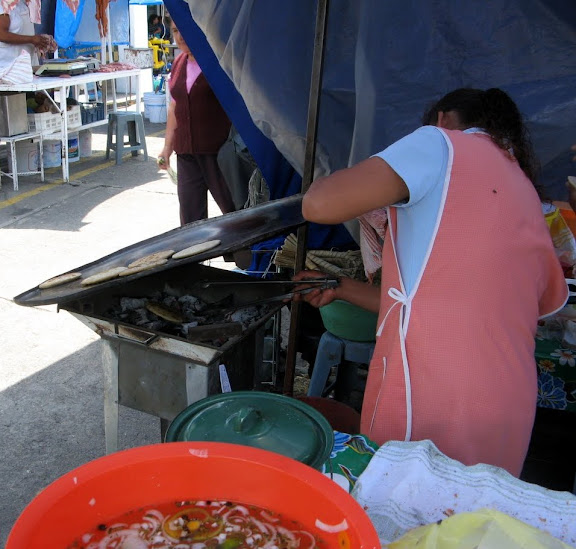
There is a special touch to Bety y Martas' gorditas. Afer the usual cooking on the comal, over a fire of glowing carbón, the cook grabs the gordita with long tongs and places it directly into the fire below.


They are removed in a moment or two, and any clinging ash is dusted off with a kitchen towel. Then Marta splits one side of the gordita, and asks if you want it with salsa."Sí.", is a good answer, in my opinion.

There are two options for jazzing up your gordita (not that it needs it. They are very good simply as is.) The first option is a salsa roja de molcajete. This stuff is thrillingly and deliciously primal. Plum tomatoes, chiles manzanos and garlic are roasted directly in the charcoal embers. Then they are roughly mashed in a molcajete, a volcanic stone mortar with a tejolote, a knob like pestle, also volcanic in origin. A little salt is added. Note that the skins are not removed from the roasted tomatoes and chiles. I suppose that the garlic skins are removed.

roasted tomatoes, chiles and garlic
Here's the rough, crude and absolutely delicious sauce in its molcajete.

Salsa roja de molcajete

The second condiment, in a big bowl on the table holding a mild vinegar and water mixture, with sliced cooked carrots, strips of raw onion, strips of nopal cactus and slices of raw chile manzano,all seasoned with vinegar, salt, allspice berries, I think black peppercorns, and oregano leaves. This is free to customers.

Pickled vegetables in large red bowl, lower left
The first gorditas were so good that I went back for seconds, then thirds. At $8 pesos each, the total was $48 pesos for 6 gorditas. I got a Fresca at a neighboring stand for $7 pesos. This was a very good lunch, for very little money, a quintessentially Mexican meal. Earth and fire.

I firmly believe that some of the best food in México is in places like this. Of course, you might get a bad meal instead. But this one was unusually good.

I am not going to do my usual ratings for this place, for if you can't get a sense of it from what I've written and photographed, then I might as well give up.


Saludos,
 Don Cuevas