Thursday, February 23, 2012

Going Coastal in Zihuatanejo Part 3

Fonda Doña Licha's, on Calle Cocos, about a block west of Paseo del Palmar is a stalwart among Zihuatanejo eating places. It's very much a local place, although it has been discovered by adventurous visitors. It's a great place for tasty, authentic local food, at low prices. It does breakfasts nicely, but the main reason for its popularity are the economical comidas corridas (Set lunches at one, low price. I think the comida corrida ran about $50-55 pesos.)

The place is dedicated to quickly getting good, inexpensive food to its many customers. There are touches of decor, but it's not noted for frills. On the other hand, it's spotlessly clean. (Some guests might be troubled by the few street pigeons which scavenge the floor for crumbs. We were not, as they were quiet and didn't fly about inside and get up on the tables.)

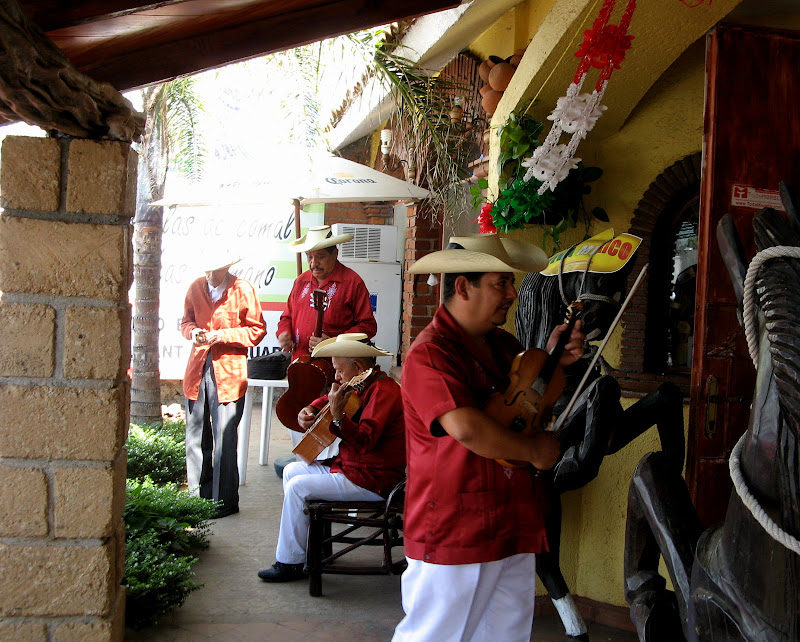
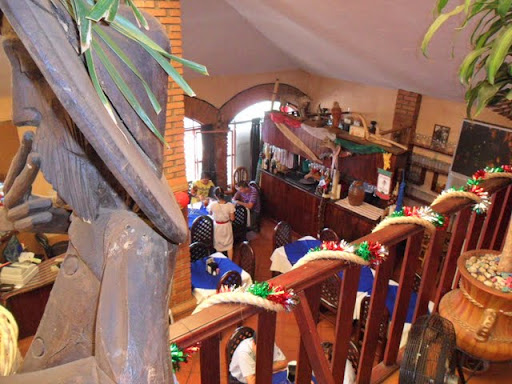
archival photo, 2009
At our first meal at Doña Licha's, I had Enchiladas Verdes Gratinadas, which elsewhere would be called Enchiladas Suizas. I am not a huge fan of enchiladas, but these were good, and not excessively rich.


Doña Cuevas had a comida corrida. It started with a good Sopa de Tortilla, then Pechuga de Pollo a la Plancha (flattened breast of chicken, simply prepared), frijoles de olla (simple, earthy and delicious boiled beans, which come to one's table unbidden but welcome.). We shared a pitcher of pretty good Agua Fresca de Piña, which is extra, and I had a couple of shots of local mescal, at an amazing $10 pesos a shot! The total bill was $145 pesos, or about $12 USD.

On Thursday, our day of departure from Zihua, we had plenty of time until our bus left, so we went to Doña Licha's for breakfast. Sra. Cuevas had two fruit plates, one with yoghurt and granola, the other "natural", and a glass of papaya juice.

I tried the apporeadillo, and drank a mixed glass of papaya and orange juices. Doña Licha's apporeadillo is somewhat more picante and characterful than that at Carmelita's, although I enjoyed both. Of course, the tortillas are hand made at both places, but I give the edge to Licha's for their just off the comal (flat cooking surface) freshness.


I don't recall what our breakfasts cost, probably under $120 pesos. The apporeadillo was about $60 pesos. Overall, it's a great bargain.

Ratings:
Food: ****
Service: **** brisk and efficient
Prices: $-$ 1/2 Bargain!
Hygiene and rest rooms. Immaculate restrooms

These are all of our current favorite Zihuatanejo eating places. We went to a few other places of lesser interest, but I'm not going to review them. We didn't get to eat at the famous Tamales y Atoles Any, a fine, if somewhat touristy place in Zihua Centro, and worth a visit. On our earlier trip in 2009, we had an excellent Mole de Olla and Consome de Pollo. But the Mole de Olla seemed high priced, at $100 pesos. And that was in 2009.

Another omission was that we didn't have any of the local pozole (hominy based soup with pork, chicken or seafood), as it's customarily cooked and served on Thursday evenings, but we were absent then. Another trip will be required.


Sunday, February 19, 2012

Going Coastal In Zihuatanejo Part 2

Mariscos Chendo's

Some restaurants are so enjoyable that they deserve a return visit. We ate at Carmelita's Cafe 4 times in 6 days. But others also got multiple visits, among them were Mariscos Chendo's and Fonda Doña Licha.

I learned of Mariscos Chendo's through enthusiastic TripAdvisor reviews, but I'd also found it on my own when I walked the several blocks of Calle Adelita townward from our hotel. Much of Adelita is torn up for repaving, yet it's still accessible.

Mariscos Chendo's lies near the far end of the street, but worth the dusty walk. I'd looked over the menu and found some dishes which indicated a creative but tasteful talent in the kitchen. Notably, "Cevichendo", an appealing treatment of ceviche* of mixed seafood that included orange juice. There was also a Chile Relleno de Mariscos, a dish that hitherto I'd only imagined. Of course, the menu included the two signature Zihua dishes, Coconut Shrimp and Tiritas de Pescado. Coconut does not thrill me in all its applications, but I can understand the appeal of this dish.

*I love tiritas and some ceviches, but considering that we'd recently had some other health issues, we decided to be prudent and not test the waters, so to speak.

We went for an evening dinner on both visits. The atmosphere is very casual. We were attended by friendly, motherly waitresses who spoke some English. There's a hammock in the dining room, near the family table, which various people spent time swinging between attending to the guests and their own well behaved children. Jazz played quietly over the sound system. Ceiling fans beat the balmy air.

Doña Cuevas ordered a Filete de Pescado Relleno de Mariscos, sin queso. The frying was deft and the seafood impeccably fresh.

Filete de Pescado Relleno de Mariscos
Inevitably, I had the Chile Relleno de Mariscos, with the queso. It was an imposing presence on the plate, bathed in a light, creamy pink sauce. I liked the mild chile and the seafood but the cheese was a bit rubbery. Nevertheless, I had no trouble cleaning my plate of every scrap and drop of sauce.

Chile Relleno de Mariscos
Both dinners were accompanied by fresh mixed vegetables, cooked to just this side of al dente. Even the little mounds of rice were good.

We splurged and had Nutella crepes from the short dessert list. La Señora C. had hers with fresh strawberries and mine with banana slices. Nice, but not really my kind of dessert.

Crepa de Nutella
With agua mineral to drink, our bill came to $325 pesos.

A few nights later we returned. It was like coming home.
Same friendly, motherly waitresses, same scene, a few more tables with diners.


 On this occasion, Doña Cuevas had camarones al mojo de ajo, which were small but sweet, still in their shells. You have to eat them with your fingers, which can be fun.

I had filete de dorado con espaguettis con salsa de pimento. The dorado was prepared with only salt and black pepper and I think a touch of butter. It was wonderful. The spaghetti had a clingy cream and cheese sauce and small squares of colorful sweet peppers. It was good, but the dorado was magnífico. We like this kind of cooking which just enhances the fresh ingredients but doesn't overwhelm them with elaborate seasonings.

Our motherly waitress also brought us a complimentary plate of Machaca de Pescado, vaguely similar to Bacalao a la Vizcaina, but sweet from the dried fruits with which it was cooked, plus some tomato, onion, and chile. Interesting, but I wouldn't order it if I had the opportunity.


Ratings for Mariscos Chendos

Food: ****
Service: *****
Price: $-$$
Ambience: Castaways
Rest rooms: Clean and in good order

I see that my time and space are used up. Doña Licha's will have to wait for Part 3.

Thursday, February 16, 2012

Going Coastal in Zihuatanejo Part 1


Two weeks ago, we escaped the chill mountain air of the Pátzcuaro area by boarding a couple of buses to the Pacific coast city of Zihuatanejo, Guerrero. It's an easy 5 hour trip by bus, somewhat less by private vehicle. Our goal was to get some sun and warmth, hang out by the pool and to eat a lot of fresh seafood. We accomplished these goals to our great satisfaction. I was able to last six days at the coast without going coastal in the coco. (I now wish that we hadn't left, for when we returned to Pátzcuaro, it was as though we were having a winter in Northern Ireland.) Above all, we found some very enjoyable restaurants within reasonable walking distance of our hotel.

Friday, the night of our arrival, we stayed close to our hotel, the Villas Miramar, and walked a couple of blocks to Rufo's Grill. Rufo's is an outdoor restaurant under a thatched palapa roof. It's open only at night. I got a very nice ribeye steak and Doña Cuevas had grilled red snapper accompanied by grilled sliced zucchini and mushrooms.


We'd been to Rufo's a couple of times before, and in general, it's a pleasant place to eat.

Food: ***
Service: ***
Ambience: Jungle palapa
Prices: $-$$
Rest Room: Acceptable, but the way to the baño has hazardous drop offs.
Location: Calle Adelita at the corner of Ntra Sra de Los Remedios, Col. La Madera
Open nights from about sunset, closed Sundays

Live Music Advisory: Subdued and soporific guitar player, later joined by a clever saxophonist. Overall, unintrusive and enjoyable.


We make a point to avoid high priced "gourmet" restaurants, not just because we are cheap, but because we prefer fresh, natural ingredients, prepared simply. Thanks to glowing TripAdvisor reviews, we discovered Carmelita's Cafe. It's been in business only 4 years, but has won the hearts and palates of many devoted customers. We enjoyed it so much that we ate there 4 times in our 6 day stay.

Carmelita's is located somewhat out of La Zona Turística, on the north side of Avenida Heroico Colegio Militar, just west of the junction of Paseo del Palmar, between a car wash and a mini super market, "El Cacahuate".


View Larger Map


Carmelita's dining room

You can read my TripAdvisor review here."Carmelita's Cafe: ¡Sabor y Amor!"

The restaurant has a positive, very friendly energy, from the owner, Sra. Ma. del Carmen Ramirez de Gonzales to her working family and employees.

Carmen
Cocineras bonitas
Of the several dishes we tried, the Filete de Sierra al Mojo de Ajo was delicious and impeccably fresh. Doña Cuevas enjoyed an egg white omelet with vegetables. Another very good dish was the meaty, tender, succulent Costillas de Puerco en Salsa de Jitomate Asado. Look on the blackboard menu for specials of the day. The coffee was decent but the better choice for drinks are the wonderful aguas frescas. We tried pepino y limón, one of sandía, and one of maracuyá on different visits.


Food: *****
Service: *****
Price: $-$ 1/2
Ambience: Garden palapa on a busy street
Restrooms: Very clean and appropriately stocked with paper towels and soap.

Will return for sure!
To be continued

Friday, December 30, 2011

Bigoli, By Golly


It’s not often that our cravings for some international cuisine, relieving our enchilada ennui, are fulfilled by a new restaurant opening in the Pátzcuaro area. Especially a restaurant that competently prepares and nicely serves food other than comida típica.


We had hopes for the new Spanish restaurant, Rincón Español, but were very disappointed and frustrated by our recent visit there. But that is a story to be told later.

We'd been hearing good things about the new Bigoli Restaurante Italiano, in the vacated location of the ill fated steak house, Rincón Sabroso, if I recall its name correctly. It is located at the Glorieta Tangaxuan, across from Bodega Aurrerá, with the access road to the shiny new Coppel department store close by.

Since the departure of La Dolce Vita from Pátzcuaro to Morelia (there metamorphosing into Pulcinella), there had been somewhat of a vacuum for Italian food here. I've stated my personal preferences in regard to Italian restaurants before. I'll sum them up again for those of you who missed it.
I can cook Italian food quite nicely in my own kitchen. Pasta, in particular, is easy. Except for unusual or elaborate pasta dishes, I don't order it in restaurants. If pasta comes as a side to a main dish, that's fine. I might make exceptions for a good lasagna or canneloni.
We met our friends Mark and Nancy at the new Coppel store and walked the few hundred feet to Bigoli. The interior has been redone and furnished attractively. We noted a sideboard was nicely setup and organized. On the negative side, the double doors entrance were wide open and let in traffic noise from the glorieta as well as chilly breezes. I put on a coat.

Our waiter was polished and experienced. He brought us a nice plate of coarsely shredded mild cheese, good sweet butter cut into neat rectangular blocks (I ate one, mistaking it for cheese), and a dish of a mildly picante, creamy tomato-chile dip. The bread was distinguished mostly by its warmth and the sesame speckled crust.

We ordered some antipasti: Bresaola and Arugula and Bruschetta. The Bresaola (thinly sliced air dried beef) was o.k. but the arugula was scanty and we would have liked more.


The Bruschetta topping was fine: diced fresh tomatoes, basil, olive oil and seasonings, but the barely toasted bread lacked the substance to support the topping without getting soggy. Nevertheless, we had no problem eating all of it.


The wine choices are limited, but we chose a bottle of Concha y Toro Merlot, and for Nancy, a glass of C&T Sauvignon Blanc. The Sauvignon Blanc wasn't chilled, but our waiter made an effort to chill the glass by swirling ice and water in it. He also capably knew how to serve wine at table.

We turned our attention to choosing a main course. At first I was focused on the interior menu pages, which were mostly pastas. Than one of my dining companions pointed out that the back page had meat and fish dishes. Some of the descriptions indicated a creative and imaginative chef.

  • For example, Pork medallions filled with huauzontle, almond crusted, in sweet red pepper sauce.
  • Baked marinated salmon in a fennel-apple sauce.
  • Lomo al Jerez: pork loin "larded" with jamón serrano, sauce of sherry, Cambray onions.
In the end, this is how we ordered:

  • Nancy; Filet of Salmon, Mango Sauce.
  • Mark; Filete de Res "Rossini".
  • Doña Cuevas; Insalata "Bigoli" and a half order of spaghetti alla Bolognesa.
  • Me; Filet of Tuna Palermo Style.

Descriptions and comments follow.

Nancy's Filet of Salmon was a nice portion. coated but not smothered in the mango sauce. She said approvingly that the sauce was not as sweet as some she'd had before.

Filet of Salmon, Mango Sauce
Mark's Filete Rossini didn't comply with the Rossini Rules but he nevertheless enjoyed it. There were two tender filets capped with prosciutto and a Bechamel sauce enriched with Manchego and Parmesan cheeses. All good and gooey.

Filete Rossini
Doña Cuevas' Insalata "Bigoli" is best illustrated with this photo:


Mixed greens, slivered green bell pepper, candied peanuts, red onion, dried cranberries, crumbled goat cheese, and a light honey mustard dressing made up the salad.

Her main course was a half order of Spaghetti alla Bolognesa. She let me taste it, and it was very good, too, without an excess of sauce, but lots of savory meat.

Spaghetti alla Bolognesa
Tuna Palermo Style
I erred when I ordered the tuna medium, and thus it came somewhat dry and a bit stringy. I should have asked for it rare. The seasoning was very good, but there were scant juices of the advertised white wine, lemon juice, rosemary, anchovies, garlic and olive oil. The last two ingredients were evident, and there was a zing from the anchovies. But overall, it was acceptable.

Dessert! Three desserts were offered; pastel de chocolate, tarta de peras and tarta de durazno. Mark and Nancy shared the moist, dense, fudge like chocolate cake and I had the glossy tarta de peras. The pear tart was good and I even liked the cheesecake layer between the crumb crust and the pears. It was very cold.

Tarta de Peras
Pastel de Chocolate
More from curiosity than desire, I enquired about coffee, and was told that there was none.

The Chef, Alberto Pozos came out to chat and we learned that he had worked for 4 1/2 years in an Italian restaurant in Puebla. His wife, who also works in the kitchen, is from Pátzcuaro. We congratulated them and wished them well.

Chef Alberto Pozos

Ratings:

Food: ****


Service: ****

Ambience: Casual, Italian trattoria

Price: $$+ (complete meal, with wine, about $250 pesos per person)

Rest room: Old but clean. There were paper towels and soap.

Parking on side street, and for now, on the Coppel lot.

Location:
Av. Lázaro Cárdenas No. 434
Pátzcuaro, Michoacán
Tels: (434) 111-1009
(434) 342-6587

Thanks to Mark and Nancy for taking notes while in the restaurant.
Definitely worth a return visit.
There also is a limited pizza menu.
The signs on the building also say "desayunos"; something worth investigating.

What is "bigoli"? It's a thick, extruded long pasta with a central hole. It used to be made with buckwheat, but nowadays with whole wheat flour, and duck eggs. It is not on the menu at Bigoli Pátzcuaro.
More info.

Wednesday, November 09, 2011

Caldo de Pescado From Hell

This was nothing by comparison
Sometimes cooking gets out of hand and midway, we get that sinking feeling that we wish we'd made a sandwich instead. Thus it was the other day, when we ate at a much later than usual hour, at about 5:30 p.m. The reason was The Caldo de Pescado From Hell.

I'd wanted fish for our comida, so late in the morning, we stopped at a Pátzcuaro pescadería where I discussed the options with the nice lady there. I wanted filets, but no boring basa nor any blah blanco de nilo. (tilapia.) I ended up with an expensive huachinango of around less than a kilo in weight.

Huauchinango, caught on another blog...

The lady said she'd filet it for me at no extra charge. As the fish was solidly frozen, I should come back in 1 1/2 hours for it. She also encouraged me to use the bony parts and the head to make a rico caldo. It cost me $91 pesos, about $6.75 USD.

When I returned to pickup my purchase, I was dismayed to see that there were only two very small filets and a bony carcass.

I was determined to get the most out of my purchase, which to me meant using the bony parts for a Caldo and the two filets in another dish.

I turned to a favorite Mexican cookbook, México The Beautiful Cookbook.

First, the Caldo. On page 72, I found a perfect (!) Caldo de Pescado recipe. I adjusted the quantity to half.
But making it turned out to be a tedious process, using multiple utensils, bowls and strainers, and because of my fatigue, I screwed up and put the diced carrots in at the wrong time, rendering them unusable in the end (lots of small, spiny bones.). But fortunately, after various chopping, dicing, sauteing, chile toasting, blending, with multiple strainings to remove bonelets, blah blah; yet I was able to recover and add fresh new diced carrots to go in with two diced potatoes. After several adjustments for seasonings, chiefly chipotle seasoning cubes, it came out pretty good. It didn't have any fish pieces in it, but it tasted seaworthy.

The two filets of huauchinago required considerably less attention. I decided to make Huauchinago a la Naranja, as on Page 172 of our Gloriously Beautiful Mexico cookbook.

My quantity of fish was about 1/8th of that in the recipe, and as the recipe called for them to be baked, I decided to simply pan cook them.

Concurrently with much of the caldo cooking, I got out the two lonesome fish filets and seasoned them with lime juice, s&p, and garlic. They sat almost an hour, yet didn't dissolve into mush in the lime juice.

One of the ingredients is grated onion, but I really, REALLY had had enough with dirtying kitchen utensils, so I imitated the Mexican cocinera's technique of slashing with a knife at the cut surface of an onion until tiny bits fall to the work surface. (Something I hope to investigate in greater depth in the near future.) Even though my technique was clumsy, it worked and I had a small triumph.

I sprayed a little cooking oil into a non stick skillet, heated it with the onion, laid the fish filets on top, cooked them a minute or two on each side, heated a cup of freshly squeezed orange and lime juice, and poured it over. Brought back to a simmer, and laid on some fresh orange slices and some cilantro for color, as the fish was white, very white.

We reheated some leftover white rice to go with the fish. There was some mixed greens salad, but we couldn't finish it. So, the fish and soup and rice in the end, were enough. The fish out passably tasty, although given time, rest and careful thought, I would have done it differently.

We rewarded for our persistence by drinking two-thirds of a bottle of well chilled Las Moras Sauvignon Blanc with the meal. A good (also inexpensive) wine makes almost any meal better.

Moral of the story: When tired, eat out.

Blue, blue, La Laguna Azul

I first saw this modest sized, popular neighborhood marisquería on a Tuesday afternoon during a photo walk in this picturesque barrio. It lies hard by the Iglesia Capuchinas. Every one of its tables was occupied; a good sign. It lies hard by the Iglesia Capuchinas. We returned with a couple of friends on Wednesday, only to find that it was closed.

Iglesia de Las Capuchinas is to the right.
Finally, on the following Sunday, we met our friend, Ms. L. there. We guessed correctly that Sunday was probably their busiest day. There was immediate seating available on stools at a skinny counter outside, but we were willing to wait for a table. The wait was only about 15 minutes, and we were given a table to share with a young family.

Saturday, November 05, 2011

Ristorante Pulcinella Morelia

Great Pizza and Lots More


We joined two friends at Ristorante Pulcinella in Morelia Centro. It’s in a wonderfully restored space, in a Spanish Colonial building, with a large, central sala flanked to one side by several smaller, more intimate dining rooms.

Upon entering the main room, one’s attention focuses on the wood burning pizza oven, built by Chef-owner Massimo Gigli, originally of Napoli and more recently of the late Ristorante La Dolce Vita in Pátzcuaro. He and his wife, Shadia, a lovely Mexicana originally of Pátzcuaro, have worked hard to create a beautiful dining space in a Spanish Colonial building. 

Massimo and Shadia
Focus on pizza and the kitchen
A front dining room
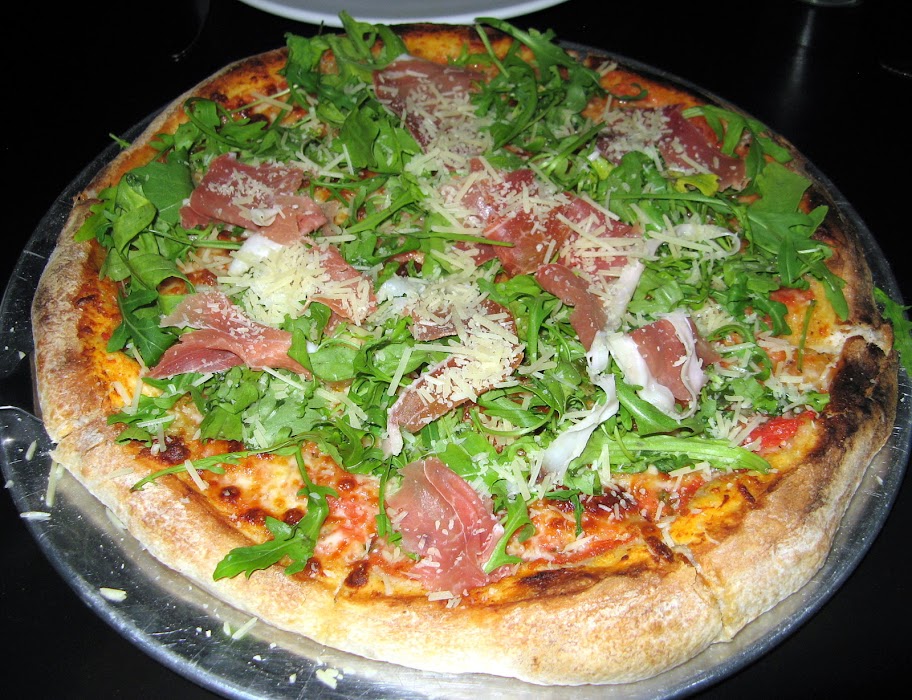
Although the extensive and attractive menus covers the gamut from salads to appetizers, pastas, fish and meats, we were most interested in pizza. Doña Cuevas and I had enjoyed a sublime pizza the week before of fresh tomato sauce, mozzarella, prosciutto, and finished with rucola (arugula) when it emerged from the oven. We owe a thank you to David Haun suggesting this combination.

Prosciutto, rucola and mozzarella pizza
We ordered an Insalata César with Scampi Aglio alla Griglia, $130 pesos and an Insalata Italiana, $85. The scampi were very good, and the romaine lettuce was fresh and generous, but my Caesar Salad was drowned in dressing, albeit a good, made in house one. On the plus side, the Parmesan was shredded, not granulated, but because of the excess of dressing, I couldn’t finish the salad.


The Insalata Italiana was more sparingly dressed with a balsamic vinegar dressing.
Doña Cuevas says that the separate pizza menu has a list of smaller, less expensive salads. Shadia asked if Doña C. wanted a smaller or larger one, but for some reason, I was unaware of this option.

We requested a  medium sized Pizza Margherita, $150 pesos, with an extra crusty bottom, and our friends ordered a large pizza of mild Italian sausage and pepperoni sausage. I don’t know the price. Our waitress, Shadia, was careful to explain that “peperoni” in Italy was sweet ripe peppers, or “Pimientos morrones” in Spanish, and that what our friends wanted was the spicy sausage that goes by the name “pepperoni” in the U.S.

I had the good fortune of observing and video recording Massimo hand fashioning our pizzas. He had explained to me that he gives the pizza dough two rises; the first of two hours and the second of four hours, without refrigerating it. That extended fermentation explains why the finished pizza crust is so flavorful. I made a fine distinction that the crust of the pizza we’d had Thursday night the week before was even more delicious that the one we’d had Saturday. I attribute that to the even longer slow fermentation time.


There’s one aspect of the pizzas we’ve eaten there that in my opinion bears improvement. The bottom crust is too soft and supple to my taste. I prefer a crisper bottom and its lack at Ristorante Pulcinella is because the oven is fired to only approximately 475º F.  The pizza rims or edges attain great character with a nice, lightly charred effect. If only that could extended to the bottom crust. Despite these quibbles, it’s very good pizza.

In our past experiences with the food at Pulcinella’s predecessor, La Dolce Vita, we found that a lavish hand is used with olive oil. The same goes for the mozzarella cheese on our pizzas. For us, it’s just a little too much of a good thing.

Of course, you can also get pizza to go. Here's a beautiful eggplant and prosciutto pizza, just out of the oven, packed to go. But I strongly advise you to eat your pizza there, as soon as possible to when it emerges from the wood burning oven.


A real credit to Pulcinella are the reasonable prices for wine by the glass. Our Cabernet Sauvignon was only $40 pesos the glass. There was also a Tempranillo available.

Our lunch, including a pitcher of excellent Agua Fresca de Sandia and 3 glasses of Cab Sauv, was $555 pesos, plus propina.

So, my conclusion is that Ristorante Pulcinella is a very nice addition to the better dining options in Morelia. Some further refinements could be done. I expect it to get even better over time. I’m looking forward to dining there again and trying something more ambitious than pizza.

RATINGS (Provisional)
Food: ***1/2
Service: **** (Service is relaxed and somewhat leisurely, but attentive without being obsequious. Don’t be in a hurry, just enjoy the experience.)
Price: $$-$$$ in which $ represents $100 pesos per person.  
Ambience: Palazzo Italiano comes to Morelia.
Hygiene and restrooms: Clean

Hours: Wednesday to Thursday 1 p.m. to 10:00 p.m.
Fridays and Saturdays 1:00 to 11:00 p.m
Sundays. 1-5 p.m.

Closed Tuesday
(This info does not jibe with that on their business card, so I advise you call ahead.)
Tel: 3-12-19-99

Location: Morelia Centro, on Avenida Allende # 555, corner of Calle Andres Quintana Roo. Unfortunately, the Google Map place marker is offset a few meters to the west of the correct location.


View Larger Map

Tuesday, November 01, 2011

El Rincón de Allende Morelia

El Rincón de Allende is a nice little coffee shop restaurant with good food, service and prices, just off a corner of the Plaza d'Armas in Morelia.

Recently, medical matters caused us to stay in Morelia's Centro Histórico for two weeks. Most of that time, we were grateful guests of our friend Rosa, who operates the Casona Rosa guest house and the Casa Rosa Suite #13. There were kitchens available in both the Casona and the Casa Suite #13, but apart from a few simple homecooked meals, we ate out a lot.

Friday, October 07, 2011

To Hell, Mann and Back!

This is half the size of ours.
I am pleased to report that the Humpy Dumpty 2 quart squat jar of Hellman's Mayonnaise that I bought at Costco in Morelia is diminishing. Yesterday I was able to transfer the remaining contents to a smaller, more svelte jar. I will be even more pleased to reach the end of it.

I don't know what I must have been thinking when I bought it. Maybe it was that the smaller, compact jars of 3 shrink wrapped McCormick's (Mexico) mayo just didn't last long enough.

Well, the Hellman's sure lasts. It also takes up more than its share of space in the fridge. It is thick, bland, custard-like and unctuous. Mexican mayo is more like a tangier, spreadable emulsion.

I believe that a realistic test of one's adaptability to life here SOB is the Expat Mayo Test. Can you live here and be happy without your favorite brand of NOB mayo? I can. I have come to prefer McCormick's (Mexico) Mayonesa con jugo de limón because it is not only readily available, it is less unctuous than Hellman's. It tastes fine. It also takes up less space in our compact fridge. The emptied and washed out jars are nice for storage.
My Main Mayo in Mexico

We tried Wilsey's. Bad. We tried Sauer's, another 2-quart jar; a gift from our amigo, Peter in Morelia. Nice, but unnecessary. Almost nothing beats McCormicks, to our taste. Yes; La Costeña, another Mexican brand is fine, but Costco doesn't sell it. We have been to Hellmann's and now we'll come back to McCormick's.

Another worthy local brand

There are those expats who so greatly crave the mayo of their NOB youth that they are willing to drive from the lovely Pátzcuaro - Morelia area to the Gringo enclave of Lakeside (Chapala and Ajijíc) to buy it, at greatly inflated prices at Super Lake. Of course, they buy other things while there as well, such as canned green beans. There's no accounting for tastes. We love the inexpensive, fresh green beans here, which take a minimal amount of preparation and cooking time.

A few years ago, another expat, living in the Blesséd, Magic city of Pátzcuaro proclaimed that "Mexican mayo was GARBAGE!"
I thought that was a culturally insensitive, not to mention offensive remark.

It has been pointed out that accomplished cooks can make superior, fresher mayo in their own kitchen. The ingredients are few. Of course, I have done that in past years, but now I just don't want to add yet another unnecessary layer of complexity to my meal preparation. There's also the dubious aspect of eating raw eggs used in the homemade mayo. There are enough hazards to intestinal health without adding possible salmonella. Making mayo in a home kitchen also takes patience. That's a virtue with which I have become less familiar in recent years.

Even Mexican mayo can be abused, in awful applications such as in sushi, on pizza, etc.

I will leave you with one final thought: although I'm at ease with Mexican mayo, I will never accept any ketchup other than Heinz'. Maybe, Del Monte in a pinch. We have had some terrible, Mexican made, ketchup-like substances, red stuff thickened with starches and gels. But that is another topic, another day.

Monday, September 26, 2011

Restaurante Carácuaro

Restaurante Carácuaro (Web photo)
It has been a couple of years since we spotted the Restaurante Carácuaro from our Mexico City bound bus. I was intrigued by the yellow, tile roofed building on the western periférico highway of Morelia. There's another restaurant of the same name and family, on Calzada La Huerta, at la salida a Pátzcuaro, just before the overpass bridges.

We passed the restaurant during several more bus trips, and some Web research yielded sparse results. All we knew was that it featured La Comida De La Tierra Caliente. A comparison with the venerable Fonda Marceva in Morelia Centro is inevitable.

It wasn't until last Thursday, September 22, that we joined our friends Peter and Tere for comida at the Carácuaro.

The dining rooms are somewhat "downmarket" but not unattractive. We chose to go up to the mezzanine dining area to escape the street noise coming into the screened windows as well as the tv blaring near the bar.

Main dining room
Our pretty waitress, dressed in flowing white traje with color accents brought us botanas of salsa, totopos, (tortilla chips), requesón cheese (similar to ricotta) and crema. Of the two salsas, one was muy picante, the other less so. Both were good. This was a nice touch, and a highlight of the meal.

Botanas
We were then brought some toqueras, roughly milled, fresh corn pancake. I'd left the table to go wash my hands, and when I returned to my toquera, it had cooled and toughened. Still, it was good with some salsa and crema on top.

Toquera
Contrary to the usual form, our waitress did not take or drink orders until some time had passed. When she did, Tere and Doña Cuevas shared a half pitcher of naranjada, Peter had a michelada preparada con Clamato; and I a very nice mezcal accompanied by slices of orange sprinkled with coarse salt, plus a bottle of agua mineral. Peter commented that the michelada preparation came with the cerveza alongside; a nice touch, I think.

Michelada

Mezcal
Who could pass up an appetizer with the name "Chavindecas"? Not I. It consists of two soft tortillas with your choice of bistec, pollo or chorizo, moistened with thinned crema and covered in a chopped salad of lettuce, tomato, onion, I think, and avocado plus crumbled queso fresco. Overall, not bad, but the sum of the parts was underwhelming. It may be a relative of the Sonoran-Arizonan "chivichanga" or "chimichanga". The latter are fried burritos heaped with salad, guacamole and sour cream. I couldn't finish my chavindeca, mostly out of boredom. I wanted room for what was to follow.

Chavindeca
Peter and Tere shared an impressive order of uchepos. Unlike those at El Gorjeo and La Mesa de Blanca in Ziracuaretiro, these were more salty than sweet. They were smothered in crema and queso Cotija. (I may be wrong about the type of cheese.)

Uchepos
On to our platos fuertes, Tere went all out and selected a Pechuga Empanizada Rellena de queso, jamón, chorizo y camarones. It was even richer than anticipated. It's the over the top Carácuaro interpretation of Chicken Cordon Bleu.

Pechuga Rellena

Peter tried the aporreadillo, a traditional dish of la Tierra Caliente of shredded dried beef, scrambled eggs and a picante salsa. He reported that it wasn't his favorite version, for the reason, among others, that the salsa was too soupy.

Doña Cuevas had Mole de Pollo. Oddly, only thighs and legs were available. The mole was good, but not outstanding. It came with a side of the most peculiar corundas we'd ever seen. They were flat and wrapped in banana leaves. Unfortunately, the masa was dense, salty and completely unappealing.


I wanted to compare the Frito de Puerco with that I'd had at Fonda Marceva. In either case, it's a lusty sort of dish of fried pieces of pork, some with bone, in a picante, brick-red sauce. This was better than anything else I tried, yet the version served at Fonda Marceva had more complexity, and above all, less grease. The accompanying rice was dreadful, mushy and overcooked. I think it was a reheated leftover. The frijoles were just "o.k.".

Frito de Puerco
We were served one large pretty good tortilla each with our meal. That sounds meagre, but it was really quite enough, although we were offered more, late in the meal.

Afterwards, Tere and Peter shared a small portion of flan that looked pretty good. I had a cafe de olla that was richly brewed. It was a a good dessert.

Our earnest and sincere waitress did a good job, but her service was unpolished.

Here's the score, from my point of view.

RATINGS

Food: ***


Service: ***1/2


Price: $-$$ Our bill was $536 pesos, before tip. Inexpensive.

Ambience: Eclectic clutter. Noisy. Less so upstairs.

Rest rooms: Downstairs men's room needed attention, but was tolerable. Upstairs ladies' room lacked drain pipe from hand sink to main drain.

Would I go again? Maybe, to try the Mole de Olla, (weekends only), the uchepos, and a few other items.

There's also a mariscos menu, something I would not be tempted to order, and a breakfasty menu of chlaquiles, huevos and the usual.


Periférico Independencia No. 3067 Fracc. Mariano Michelena Morelia, Mich.


View Larger Map


Live Music Advisory: there was a small group preparing to perform as we were leaving at around 3:00 p.m.


A forum discussion of Restaurante Caracuaro can be found here.

Saturday, September 17, 2011

Gloria to the Quesadilla and Tlacoyo!

Tlacoyos

(Part of the series, "Six Nights in Colonia Roma Norte, México, DF )

There is a concentration of street food stalls not far from our Hotel Embassy. Cross the northernmost block of Calle Orizaba, across from the side of la Parroquia de La Sagrada Familia, and Calle Puebla becomes Street Food Row. There's a lesser smattering on Calle Orizaba north to Avenida Chapultepec, La Frontera de La Zona Rosa.

On the corner of C/ Puebla and C/ Orizaba, there's a sandwich stand featuring deep fried tamales, a concept which simultaneously fascinates and repels me. It's at the front door of the upscale seafood restaurant, Estampa Del Mar, where you can get a coctel de camarones for, if I recall correctly, $115 or maybe $117 pesos. I suspect that it's not my kind of place.

Fried tamales-the breakfast of Chilangos


I haven't tried the fried tamales, of course, out of  dietary concerns, and we were usually on our way to Cafe Toscano, at the south end of the block.

The Serious Street Food Row is along C/ Puebla, for two or more blocks, toward Avenida Insurgentes.
Take, for example, this stand for carnivores. Look at those  free salsas and condiments and garnishes.
(Unfortunately, we never got to eat there.)


A solitary Sopa de Gallina stand was very appealing. I'd hoped to eat there, but fate played its cards against me. A large bowl with a 1/4 breast/pechuga starts the price list at $30 pesos, and a variety of chicken parts, your choice, goes on from there. I'm fairly certain they also offered huacál, the egg case of the hen, a treat for the adventurous to eat the delicate unborn eggs in their soup.

We did have a chance to try the glorious tlacoyos and see the quesadillas and gorditas at the prime location of Sra, Gloria's post, right close to the northwest corner of C/ Puebla and C/ Orizaba.

Sra. Gloria comes each work day from Chalma, a 2-3 hour trip, depending on traffic. If I have it right, she works the end of the week but not on Sundays. She was generous to permit us to photograph and video her dexterous and able moves.


Click slideshow for larger versions of pics and a short video.

We watched, fascinated, as she handled a flurry of customer requests, patting out masa de maíz azúl, putting in the filling of choice, and deftly forming the tlacoyo by hand. I should define tlacoyo as an antojito of masa de maíz, with a filling such as requesón (ricotta like cheese), or the delicious but heavy mashed papas y habas (potato and fava beans. Sorry, no Chianti was on hand.

But that's not all that you get for your $12 pesos: you can choose toppings such as quelites, wild and cultivated greens, or huitlacoche, the (in)famous black corn fungus, queso fresco, and a choice of several salsas picantes. This is not necesarily comida rápida, although Sra. Gloria works with a young assistant. Your order may take 5 minutes, depending on its complexity but especially of the the line of customers ahead of you.

She told us that she made all her ingredients, even going so far as to nixtamalize maíz azúl seco, (dried blue corn) cook and rinse it, and grind it for her masa.

Although I hate to admit this, this was the only street food we had while in Colonia Roma Norte on this visit. I shall do better next time. It was near the top of my list of "Best Food of The Trip".

Ratings


Food: ****1/2
Service: With a smile and a story ****1/2
Price: 1/2$ Super bargain!
Ambience: urban street, shade tarp and trees. Maybe be a couple of seats, but doubtful.
Hygiene: Good
Rest Rooms: no hay. Nada.
Open Saturday, for sure. Not Sunday nor, as far as we could see, Moday. Other days uncertain. If someone goes there, please let us know.

Would we return? Definitely!

Street View location below. Gloria's stand in the shade of trees, across from the church.

View Larger Map