Thursday, June 21, 2012

Misíon Imposible

A few years back, the R.O.M.E.O. men's breakfast group met at the restaurant of the then Hotel San Felipe in Pátzcuaro. It would be kind to say that the spacious parking and the seating arrangement were the highlights of that breakfast.

Patio and parking
Since then, the Hotel San Felipe changed ownership to the extensive Hotel Misíon chain. It was renamed the Hotel Misíon Pátzcuaro. Last week, our friends Mark and Nancy dined with a group of friends at the restaurant, still named Restaurante San Felipe, and were so pleased that they suggested we join them there for a comida.

At 3:00 p.m. Wednesday, we six were the only diners in the warmly appointed dining room. We were attended quite competently by two white jacketed waiters. The menu is not lengthy, but is more than adequate. They brought us some complimentary totopos y frijoles.


The menu is a bit confusing in that there are listings for both botanas and for antojitos. Some of the same items appear under different categories but with varying prices. In the case of the intriguing Chile Pasilla item, our waiter explained that the one listed in botanas was a sort of build your own taco appetizer, while the antojito version is a type of chile relleno. We ordered the botana version and an order of guacamole to share.

The guacamole was fine, and the chile pasilla botana was novel and nifty. It comes as sort of a kit, comprised of a fried, opened dried chile, strips of queso fresco, crema, chopped cilantro, cebolla y chile perón. We were supplied with baskets of warm, thickish handmade tortillas with which to assemble our tacos. The dish was fun to eat, but the sum of its flavor was o.k., but not equal to the appeal of the DIY parts.

Chile Pasilla botana
On the other hand, the two salsas de la casa, roja y verde, were stellar. The tomatoes and milder chiles of the red had been carefully roasted, while the green was just the right heat, tartness, but above all, chopped in substantial chunks rather than the anemic, watery purees so often served elsewhere.


The weather was cool and rainy, so soup was a logical choice for at least three of us. Two chose Crema Tangaxhuan, a creamy corn chowder laced with bacon and topped by small crackers or croutons.


Crema Tangaxhuan
I chose Sopa Tarasca, a Michoacán specialty, a soup often abused and disrespected. (There are at least two schools of Sopa Tarasca; with bean puree and without.) The version at San Felipe could hold its own in the upper ranks of contenders. It was vivid with tomato-chile broth, thick with tortilla strips, laced with crema y queso and strips of chile pasilla, but without beans. It was substantial and enjoyable.


Sopa Tarasca

With the platos fuertes, I think the quality declined. Mark had a Filete de Res con Champiñones a la Mostaza, of which only he can give an opinion. He invited me to taste the sauce, but I did not think that the yellow mustard in a cream sauce was a felicitous combination.

Filete de res con champiñones a la mostaza
Ron had a simple Filete de Res a la Parrilla. I didn't get his opinion on this yet.

Both Georgia and I both had Chuletas Adobadas. Mine, at least was overcooked; a bit thin and dry, but redeemed somewhat by the pretty good adobo. 

Chuletas Adobadas
Note that the chuletas and Ron's platter came with frijoles but Mark's did not. There were no vegetable sides, as far as we could tell, even though fresh vegetables were present in the salads.

Nancy and Sra. Cuevas both had Ensaladas Mixtas, which combined fresh and cooked vegetables and some ham and cheese. The salads were attractive, and cruets of vinegar and oil were welcome to mix your dressing to taste.

Ensalada Mixta: goodbye, cruet whirl

Desserts:
Ron and I both ordered flan, which was poorly made. I have never had dense, chewy flan before. The caramel tasted like a syrup made from piloncillo. 


This dessert did not pass with flan colors
Nancy and Sra. Cuevas had Crepas a la Naranja, attractive and the orange sauce was good. Crepes would never be among my first dessert choices, but of course, tastes differ.

Crepas a la Naranja
 And now, the envelope, please!


Food: ***1/2
Service: *****
Ambience: ****
Price: $$+ (per person, complete meal. See menu pictures for details)
Restrooms: Clean and attractive.
Parking: spacious and free.

Location: Hotel Misión Pátzcuaro
Av. Lázaro Cárdenas No. 321
C.P. 61600, Centro
Pátzcuaro, Michoacán, México


View Larger Map

Friday, June 15, 2012

Blog undergoing maintenance


I have installed the Disqus Comment System. Previous comments have temporarily disappeared but should be back in 24 hours or so.

The good news is that you shouldn't ever again have to read and write those ugly, nasty image verification codes.

In case of complaints, please contact my technical adviser or our legal counsel.


Saludos,
Don Cuevas

Tuesday, June 12, 2012

Tamales and tamales and tamales


Last week I went to the Buen Provecho Mercado in Pátzcuaro. This is a small mercado de especialidades, with a largely affluent expat clientele.
It's open only from 11 to 1:30, on Fridays! Location is in the Posada Yohuanalli, on Calle Dr. Coss in Pátzcuaro.


Although I went only to get a bag of mixed organic lettuces, I was attracted to a couple selling tamales estilo Oaxaqueños. Somehow, I ended up buying 4 instead of 2, but that's not a problem, as the chicken and chile one I tried was delicious. There should be yet another chicken tamal and two of rajas con queso. (Strips of roasted chile Poblano and cheese.)


These tamales are beautifully wrapped. I consider them works of artisanry.


I got some pics of the wrapped tamales. These are among the most beautifully crafted foods I've seen in Mexico. I noted that the number of ties and knots on the tamales differ. I think that this indicates the filling.


I'm looking forward to my next one. Here's a photo of one in its wrapper.


Tamal Oaxaqueño
It's now the following Tuesday, and I just had the last tamal for breakfast. It was filled with mole de pollo. It was almost as enjoyable as the first, but I admit, I'm tired of tamales. I think tomorrow for breakfast I'll have bacon and eggs and toast.

Here are some old and new photos of the Buen Provecho Mercado.

Monday, June 11, 2012

The Quest For The Ring

Sometimes little things take on great importance and become obsessions.

So it was with the little rubber gasket of our blender, a Licuadora "Man". It was several years ago when a friend in Oaxaca recommended the Man line of Mexican made blenders to replace our cool Breville blender when it fell apart. A small ferretería in Pátzcuaro had a Man Comercial model in stock. It boasted a powerful, two speed motor (I avoid buying blenders with more than two speeds and especially, multiple buttons that collect goo.) and especially, this blender boasted a nearly unbreakable Lexan beaker. The salesman beat the beaker on the bannister of the stairs to demonstrate its durability.  I was impressed, so I bought it. I think I paid $950 pesos.

Not long ago, as Sra. Cuevas was washing up the blender, she noticed that the small, double layer gasket was torn. It was only a matter of time until it would completely tear, so I set out to find a replacement. This rubber ring may be small, but it's vital to the successful operation of the blender. The Man website was helpful in identifying the part. Ref #5: Junta de Hule. Parte #716.

From there, I obtained a list of authorized service providers, finding two in Morelia and one in México Centro, not three blocks from where we'd been the week before!

It was logical to try Morelia next. There was a shop listed called Proveedora del Hogar on Avenida Madero, close to where a friend once lived. About a week or so ago, we successfully navigated the centro and even found parking less than two blocks away. My good luck ended when I reached the shop, only to find out it had moved and was now a TelCel outlet. (I bet that that there are more TelCel shops than taquerías in any average Mexican city.)

The young ladies there gave me directions to the blender repairs place, but we were unable to find it amidst the welter of businesses at "Tres Puentes".

There was still another possibility in Centro, but we were beginning to wear out. But the lady at La Frontera had told me of a licuadora parts store on Avenida Lázaro Cárdenas, near Mercado Independencia. We slowly drove along that street but couldn't find it.

At that point we retreated and I was preparing for another trip to Mexico City, where we are going anyway later this month, carrying the old blender ring to where the "Laiting" (Illumination) District adjoins Chinatown.

But a few days ago, while in Pátzcuaro, I had the bright idea of inquiring at the original ferretería "Manríquez" where I'd bought the machine. He directed me to nearby Vidrioeléctrica, Pátzcuaro's largest hardware store.

Vidrioeléctrica: If anyone carries it, they will.
 About 10 minutes of discussion with the salesgirl ensued. She pulled out various licuadora parts as I described with increasing adjectives what I was seeking.
"Anillo o junta de hule doble y flexible."
At last, she reached into a drawer in front of her and pulled out a Ring. Although it was only $5 pesos, I knew better than to buy more than one, until I tried this one on my blender.

The results were successful, altough the original ring was somewhat glued into the threaded cuff due to fruit juice leakage. After a short soak in soapy water, it came free, and I was able to fit the new one in place. I haven't tried it yet, but I'm confident that it will work.

Wednesday, May 02, 2012

Like Moths To The Flame Part Four


The Final Chapter!
Sunday.

We had a date with our friends in Colonia Roma to eat at Fonda La Veracruzana, on which I reported last year. We had a morning free, so on impulse and to further the search for a really good café espresso, we decided to walk to Café La Habana. We'd passed it as we rode to El Bajío on Saturday.

The walk was pleasant and easy, and we got to see the famed Reloj Chino.

El Reloj Chino
Café La Habana is not far beyond, at the corner of Avenida Morelos and Av. Bucareli.

La Habana is a place I've read about for years but until recently never visited. It has an atmosphere of history and nostalgia. It's said that Fidel Castro and co-revolutionaries plotted the invasion of Cuba while sipping cafecitos in the restaurant.

The Bar at Café La Habana

But after ordering coffees and breakfasts, we concluded that while it's a pleasant enough place, the fare is ordinary. There are cool holders for the glasses in which the coffee is served. Café con leche, here called "Café Habana" is poured at table. It's o.k. The Café Cubana, served black, was more to our taste.


Ron had a Tortilla de Papas Española:


And I had an Omelette La Habana. I confess that I don't remember what Sra. Cuevas had.


Here are the ratings:
Food: ***
Service: ***
Price: $-$$ Our breakfast for three, with several extra coffees, came to $445 pesos before tip.
Ambience: Old Havana

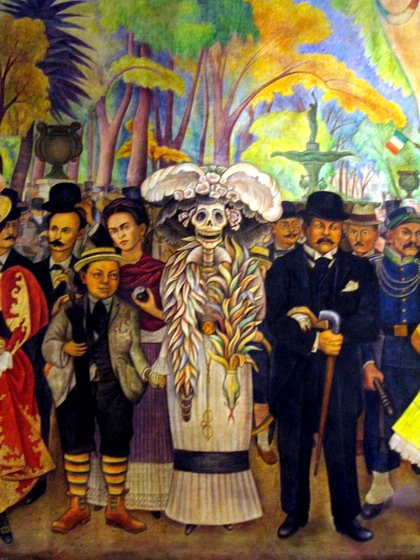
From Café La Habana, we took a long walk by way of Av. Júarez, stopping into the Museo Mural Diego Rivera at the west end of La Alameda. This was our token nod to culture. The principal attraction is the famed mural, "Sueño de una tarde dominical en la Alameda Central". It's worth seeing and other artists' works are represented.

Detail: Left, Diego Rivera as a boy.
José Guadalupe Posada, right. La Catrina, center.
We also saw an antique carousel. All this was in the western section of La Alameda. For reasons unknown to us, the main part of La Alameda was hidden by fencing.


We were on a well trodden tourist track now. We stopped into Sanborn's La Casa de Los Azulejos just for a look, then Dulcería Celaya, without purchasing anything in either place, and onward to El Zócalo. It was as grand as ever. From there, we took a taxi back to our hotel.


Later in the afternoon, we took another taxi to our friends' house in Colonia Roma Sur. That was the most circuitous taxi ride of the weekend, yet the fare wasn't too excessive.

At the house, we conversed a while, then strolled the 8 or 10 blocks to Fonda La Veracruzana. It was Sunday afternoon, and very busy, but we had a table reserved and although it was a bit crowded, it worked o.k.

Instead of going into great detail about each dish, I'll just post a photo with a brief caption and move right along.

These were the blackboard menus of the day, posted just inside. They first two were valid Monday through Friday. I think that the latter two were for the weekend.

Blackboard seafood jungle
Tostada con seviche de pescado
Crema Fría de Aguacate con Mariscos (not a soup as I'd expected)
Ensalada con mariscos
Robalo en salsa de champiñones al ajillo
Mojarra a la Talla
Lomo de Pámpano a la Veracruzana
A few of us ordered dessert, in the form of Sambuca Negra (recommended!) and at least one cup of coffee. With a bottle of L.A. Cetto Vino Rosado and at least a couple of beers, the total bill was in the range of $1700-$1800 pesos. (I don't have a copy of the ticket.)

Ratings:
Food: ****
Service: ****  But a bit hectic on Sunday afternoons.
Ambience: low key, sunny and pleasant.

On the way back, we walked passed the nearby (around the corner, on C/ Chiapas) attractive restaurant "Con Sabor a Tixtla", which has been described by other food bloggers, but is on our list for our next visit. The cuisine is Guerrerense, and there is an attractive website.

Sunday, April 29, 2012

Like Moths To The Flame Part Three

Saturday morning launched with a walk to La Piccolina, which this time was readily accessible. I had wanted to have barbacoa at Barbacoa de Siguilucán, Hidalgo, which on an earlier visit had been across the street from the Hotel Pal. But alas, not this time. It was gone.

So two of us had light breakfasts at La Piccolina, Ron abstaining, as he was saving room for Ricos Tacos Toluca.

En route, on C/ Ernesto Pugibet, we saw the usual long lines to purchase the weekends only barbacoa at Cocina Vianey. This place is very popular, and if you want their barbacoa, get there early or stand in line.

We got to Ricos Tacos Toluca with only short detour. There were already considerable clientele around the stand. The red and green sausages were hung in the window with care. It was like Christmas in April.


When we were able to get close enough to the order window, Ron and I both got a pair of generously filled tacos. He, one chorizo verde and rojo each; I a chorizo rojo and a taco de bistec (thinking I was ordering a taco of cecina enchilada).


The tacos are dressed with long strands of sauteed onions, and you can help yourself to a salsa roja and a spicy salsa de aguacate from two large molcajetes within reach.


We sat at benches outside enjoying our tacos. Meanwhile, Sra. Cuevas was shopping at a large restaurant supply store across C/ López, where she bought some nice, plain white plates and a couple of pairs of spring loaded tongs.

Tentative ratings for Ricos Tacos Toluca
Food: ***1/2
Service: Get in line and order.
Price: -$ BARGAIN! Tacos, $13 pesos each
Ambience: It's a street corner, you know?

We then walked back to the hotel for a long rest until our afternoon reservation at El Bajío, in far flung Azcatpotzalco, on Av. Cuitláhuac. There would be a test of navigation skills, using an iPod touch and Google Maps as an adjunct.

We allowed ourselves about 40 minutes to arrive at the restaurant, but with a willing taxista and the iPod Touch, we made efficient work of it. The route shown on the computer varies slightly from that on the iPod. We didn't make that short loop at the beginning. (Edited to make them the same.)

The cab fare was surprisingly less than $50 pesos, but we gave the taxista a modest tip, for being so adaptable.

It was 3:00 p.m. Saturday afternoon, a peak time for the restaurante. A Sra. Nieto, the hostess as well as Carmen Ramírez, daughter of the owner, greeted us and we were quickly seated. Soon, a better table became available, and Sra. Nieto suggested that we move to it.

We started our comida with a couple of Cervezas Bohemia Claras and a glass of very good horchata for Doña Cuevas. After considerable discussion, we chose three entradas (appetizers) from the menu. (There are a lot more.)

Empanadas de Plátano Relleno de Frijoles Negros; Tacos de Jaiba en Hojas de Plátano (really more of a tamal than a taco); and Panuchitos de Cochinita Pibil (which blew away the tacos of cochinita pibil we'd had at El Huequito).

L-R: Panuchitos, Tacos de Jaiba, Empanadas de Plátano
It was difficult to decide what to have for our platos fuertes. There was a small conjunto de música Jarocha playing and sing very well, but loudly and at close hand.

Ron and I both ordered barbacoa de borrego con nopal asado (usually we would order different dishes) and Sra. Cuevas wisely chose Carnitas Estilo El Bajío.

Barbacoa de borrego con nopal asado

The barbacoa was a slightly dry version that came without consomé, although that could be ordered separately. On reflection, we should have. The Carnitas Estilo Bajío were  juicy, prepared with Tequila and cerveza plus some seasoning vegetables.

Carnitas Estilo El Bajío
Ron also ordered Arroz y Plátanos con Mole de Xico, a signature mole. I tasted it. It is very dark, complex and interesting, but I have doubts that I could consume a whole dish of that mole. It distantly reminded me of Hoisin Sauce.

We finished our meal with a well made café de olla, a licor Agavero, a couple of orders of flan and one order of natillas. The flan was just o.k. and the natillas, a type of liquid custard, was smooth and pleasant.
Flan
Creamy Natillas
Ratings For El Bajío Cuitláhuac
Food: ****
Service: ****
Price: $$$-$$$$$ Our bill was just over $1700 pesos, before tip.
Ambience: Mexican Folkloric

Live Music Advisory: Moderate to loud. Musical group may not be present during the week.
In fact, when we dine again at El Bajío, we will go on a weekday.


View Larger Map

Saturday, April 28, 2012

¡Que lástima!


I was trying to delete a draft from my Dashboard, but unfortunately, deleted "Like Moths To The Flame Part One". As far as I know, it's gone, and can't be retrieved.


Saludos,
Don Cuevas


Update on the rescue: although no digital means were available to me to effect a rescue, I was able to do a rewrite off line, then put a few, simple finishing touches on it when our Internet connection came back on line.

 If anything, IMHO, the rewrite is superior to the original.
I was also able to backdate the publication date to precede the second installment. (I think.)


Saludos,
Don Cuevas

Like Moths To The Flame Part Two

Friday, April 20

Our quest for great paella in Mexico City had led us on a winding path. I knew of at least three restaurantes in which we'd eaten previously that served paella (but we hadn't had it.). The most prominent was the Casino Español, a most likely candidate. There were two seafood restaurants that I knew had paella: Boca del Río and Ostionería La Morenita.

After inquiring on ChowHound.com, I decided to forge new paths to paella. A great deal of Googling unearthed Casa Rosalía, "La Casa de La Paella", at Eje Central 3 Lázaro Cárdenas #46, Centro. We'd walked by this restaurant innumerable times without realizing it existed. Jorge Pedro recommended it. But when I found its website, the menues del día* spoke to me of large meals but perhaps of not great quality. The quest went on.

*Offline at time of posting.

Then El Cabrito Astur, Calle Palma # 40, Centro, appeared in the Google search results. On closer investigation, it was revealed that this was the former Bar Sobia, which had been recommended to us eight years ago by a retired Banamex Director, who worked across the street in the Mother Bank. His recommendation was for the cabrito asado, without mention of paella.

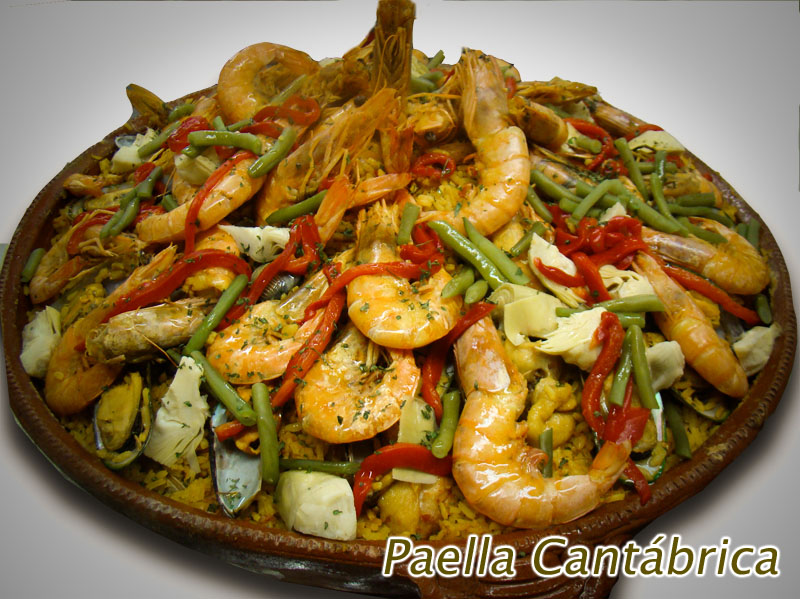
The location, in a cellar, was a plus in favor of making it our final choice. This photo of "Paella Cantábrica" didn't hurt, either.

Looks luscious
The cabrito asado was tempting, too.

Cabrito Asado from their website

We had a reservation for 4:00 p.m., which probably wasn't necessary. When we tried to get a cab outside our hotel, the rush hour was in full spate and we were unable to get a ride. So we walked the mile or so at a brisk pace, arriving only 15 minutes late. No problem.

Descending the mirror lined, half spiral stairs into the dining room was fun. It's a relatively small space, cozy and appealing.


The Maitre D' was affable and helpful. Our waiter was attentive. We chose a Spanish white wine. (Vino blanco Codello says the ticket.) There were complimentary cups of caldo de camarón and little toasts of ordinary pan baguette covered with a garlicky tomato crush.

As aperitifs, two of us drank Dry Sack sherry and one a Dubonnet.

We ordered two orders of cabrito and three of paella. (We were anticipating the arrival of a mystery guest.) The paella takes up to an hour to cook but ours appeared in less time.

First, though, came the cabrito. One order was of pierna, the other of espaldilla. They were flavorsome and moist, although the first pieces I sampled were very bony. Ron especially liked it much better than what he'd had at El Regiomantano on another occasion. Interestingly, the cabrito was served on the inexpensive pottery typical of Lake Pátzcuaro.

The paella arrived in its earthenware paellera. It was good looking but not as good as the photo from the website. The prawns were large, the clams were few, the mussels o.k., the chorizos mediocre. The rice was nice, but underwhelming. Overall, we found it lackluster. Perhaps our expectations had grown too great.

As we neared the last prawn, our Mystery Guest arrived. We had a pleasant conversation with her over some shared paella.

Lesley Tellez
We said adios to Lesley, and went on to order dessert.

The Tarta de Santiago, an almond based, flourless cake, brings back memories of Santiago de Compostela, Galicia.
The Tarta served at El Cabrito Astur was passable, but its texture was more like a thick pudding than the one we had in Santiago.

Tarta de Santiago El Cabrito Astur

Doña Cuevas abstained from dessert but Ron went all out and had an elaborate flan with ice cream, covered in rompope.

One decaf coffee and an Anís Cadena, and a bottle of agua mineral completed the meal.

Flan "León y Asturias

Ratings:
Food: ***1/2
Service: ****
Price: $$$$+ (Final cuenta was $1810 pesos, plus tip. Of the total, $350 was for the wine.)
Ambience: Discreetly European
Conclusion: overall, a pleasant experience, but probably wouldn't return.

Location: Calle Palma #40, Centro Histórico, México, D.F.


View Larger Map

More to come; yes, it's true.

Friday, April 27, 2012

Like Moths To The Flame Part One


There were rumblings from below and above. Mexico City had been shaken by earth tremors and now, Popocatéptl was spewing ashes and lava. Despite these ominous signs, we were drawn like moths to the flame. Our fervor for specialty cooking ingredients could not be extinguished. Once again, our supplies of vital ingredients, such as Pimentón de La Vera, Basmati and Jasmine rice, and not the least, my more than 10 year supply of whole nutmegs had dwindled to mere nubbins. 

A trip to Mexico City was needed. The ingredient shopping was a pretext for dining in some interesting restaurants. We had an extensive lineup as usual, and it was a pleasant challenge to make our final choices. One goal was to find a great paella, of which, more later.

Thursday, April 19, 2012
We left Pátzcuaro on Thursday morning aboard an Autovías luxury bus. We arrived at our hotel by 4:30 p.m. After a sort rest, time enough to settle in, we decided in favor of a late afternoon meal at El Hueqito, Calle Bolívar 83, Centro. The much closer Tacos Xotepingo had been considered, but the nod went to El Huequito. Just as well, too, for on a walk the next day, I found that the Xotepingo location on Av. Balderas, corner of C/ Marqués Sterling, was an empty shell. The carnicería to the side, bearing the Xotepingo name is still operating. So is the raunchy and run down looking Cine XXXX next door. I didn’t look inside. 

We walked to El Huequito where we obtained a table toward the front. I had for some time been enamored of the Tacos Ingleses, but on this and a previous visit, the sliced filet steak tacos, seasoned with Worcestershire Sauce, seemed to be lacking savor. Additionally, the price had risen to $40 pesos per taco.


Doña Cuevas had the Ensalada Huequito, consisting of watercress, bacon, tomato, walnuts and the possibly balsamic vinegar based dressing on the side, $70 pesos.


After the slighly disappointing Tacos Ingleses, we had some very good Tacos al Pastor, the specialty of the restaurant. These are about $11 pesos each.

Not sated, despite bowls of the excellent Frijoles de La Olla, we went on to share some good Tacos de Cochinita Pibil. (these were bested by some panucho de cochinita pibil that we ate later at Restaurante El Bajío, Azcapotzalco).

Ratings for El Huequito

Food: ***
Service: ***
Price: $$+ I no longer consider El Huequito an inexpensive restaurant. Our bill, including drinks, was in the range of $700 pesos.

On Friday morning, we walked from the Hotel Pal to a favorite coffeehouse-restaurant, La Piccolina, on C/ Luis Moya at the corner of C/ Marqúes Sterling. We were mildly dismayed to see it totally packed with people from a tour bus. This was surprising, considering how tiny the restaurant is.

So we backtracked to a coffeehouse we’d seen on our walk back the evening before. This place turned out to be so ordinary, it needs no further mention.

We retraced our way to Calle López and the Mercado de San Juan de Arcos de Belén. I had read in Nick Gilman’s post “A Culinary Stroll In the Centro Hístorico”, on his blog, “Good Food In Mexico City” that four blocks of Calle López, was filled with wall to wall budget eating places.

It was true. After a brief stroll through the mercado (not to be confused with the more famous, gourmet heaven Mercado San Juan, not far away), we ended up at El Paisa, specialists in Caldo de Gallina. A good bowl of “hen soup” will satisfy you for hours to come. Diners have their choice of pechuga (breast), pierna leg), muslo (thigh), rabadilla (aitchbone), and the exotic huacal (the hen’s internal “egg crate”, complete with small, shell less eggs.) 


All three of us chose una cuarta de pechuga, which more than satisfied us. The meat was boneless, a further plus.The soup, accompanied by freshly made tortillas and carrying rice and garbanzos, was very good. There were several salsas and condiments to heat things up.

The price is right, too: $29 pesos a bowl, if I recall correctly.

Ratings for El Paisa
Food: ****
Service: ****
Price: -$ BARGAIN!
Ambience: Huh?
Hygiene: Seems adequate.

Not far beyond El Paisa is the notable Ricos Tacos Toluca, at the corner of C/ Puente Peredo and López, close to C/ Aranda. We peered in, but we were so full that we had to postpone sampling the famed embutidos until the next day.

Just another block, north on Arandas, to La Molinera El Progreso, where the ever patient Sra. Mercedes filled most of my extensive list of ingredients. I did discover that the Basmati rice sold by El Progreso is instant! I had to reject it.

Well laden by this time, we went around the corner to Plaza San Juan, across which we entered the leading Asian food store in the area, El Dragon del Oro. It wasn’t long before Ron pointed out Jamine rice. But it was in 25 kilo bags! Over in a corner, to the right of the checkout desk, tucked away on a self were bags of both Basmati and Jasmine rice. I stocked up on these and a few bottles of specialty soy sauce.

To end the morning’s activities, we made a loop through Mercado San Juan, where we did get some Pimentón de La Vera, picante, some in VERY LARGE cans, but we had one half of the pimentón equation solved. We also bought some nice, but pricey heads of garlic from the talkative old garlic vendor just inside the door.

After this, we walked back to the Hotel Pal, where we rested and awaited the 4:00p.m. reservation time at El Cabrito Astur.

More to come..

Friday, April 13, 2012

Pizza a Mano


Nearly two weeks ago, Laura, a young woman who lives near our rancho asked if I would be willing to teach her and three of her cousins how to make pizza. I was doubtful at first that I would have the energy to conduct even an informal class in Spanish. But the more we talked about it, it seemed not only feasible, but great opportunity to do something interesting and, above all, fun.

We knew Laura from when she was in school. She'd bring her English homework to us to be checked and corrected. Making pizza would be a lot more fun. We were only acquainted with her three cousins, daughters of Norma and Lalo. Lalo cooks and sells carnitas each Sunday morning with the help of his daughters Norma, Anaïs and Lilian.

On Monday, Laura came by and we confirmed that we would meet here on Wednesday at 11:00 a.m. Meanwhile, I prepared a basic list of pizza dough and sauce ingredients, with brief notes on technique, all in Spanish. But the bulk of the technique would be taught and learned by hands on practice. Pizza a Mano.

The students arrived, and first assembled for a group photo.

From left: Lilian, Laura. Norma and Anaïs
I'd decided that we would begin, logically, with making the dough, then the sauce, grate and prepare the cheeses, and finally, prepare the toppings. We would make one basic cheese and tomato pie, then we would go where our fancy led us. Two batches of pizza dough would yield four medium large pizzas.

It was not likely that any of my students would have dough mixers at home, so the mixing and kneading would be strictly a mano.


The girls took turns at various tasks, with my guidance. I chose the toppings, based on availability and my creative whims. I'd cleared off most of our ample, tiled counter top, and with the wooden baker's table, we had plenty of room for the practical side of the class.


Hand kneading dough was not wholly unfamiliar to some, as some had made tortillas de harina at home.

When the first batch of dough was fully kneaded, we took
a break and looked at pictures of another cousin, Licha's quinceañera last December. (Everybody is kinfolk around here.)

Break time over, we turned to preparing the sauce. I explained that the Italian or Spanish canned tomato products that I use are not available in Pátzcuaro, but are in Morelia. I had a box of Del Fuerte Puré de Tomate condimentado, one of the better brands, and best suited to Mexican recipes, but less so for pizza sauce. It's too thin, lacking in pieces of tomato, the flavor is not right, and to make it work, you'd need to add quite a lot of tomato paste. (It's thickened with food starch!)

It could serve in a pinch, but we proceeded with Cirio pomodori pelati and Passata Rustica, available at Wal-Mart and Superama, and thickened with a small can of S&W Tomato Paste, purchased by the carton at Costco. I used a very reliable sauce recipe from the Vegetarian Epicure, Book Two, but cut back or eliminated some of the more extreme seasonings, such as sugar and cinnamon.

The dough had risen very well over an hour, and we divided it in two and lightly rounded them. While they rested, covered, we made another quantity of dough.

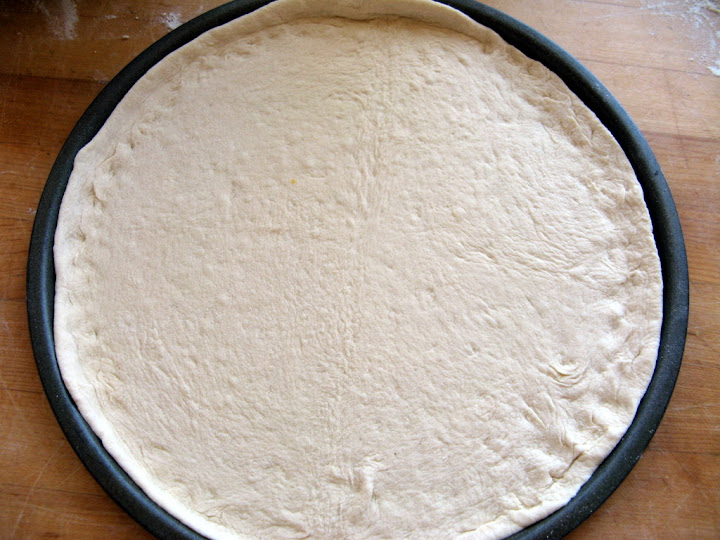
The first dough balls now rested enough to allow us to apply our hands to extending to dough, either by hand or a rolling pin. It's possible but slower by hand, but arguably makes a better base. Rolling out with the rolling pin ("rollido") took some practice to make an even circle, but the results were stellar.


Our first pizza was a basic but very nice cheese pizza.


The second dough ball was transformed into a Pizza Las Cuevas, con nopal, chile Poblano asado, tocino, y cebolla and the usual sauce and cheese.


Everyone was having a good time, especially eating the pizzas.


The second batch of dough was getting a little ahead of us, so we got up to deal with it.

The last two dough balls became a Pizza Verde, con acelgas, longaniza verde.


La Última Pizza del Día had Obertal chorizo Español y piña fresca, con chile Poblano crudo. Simpler, once again, but surprisingly good.


We divided the extras for take home. The approximately 4 hour class was successful in that the students learned new skills, saw the possibilities of creating pizzas with what was at hand. The food was good, but even better, the group was attentive and pleasant to work with. I hope that we can do another class, in the not too distant future.

Pleased as Punch